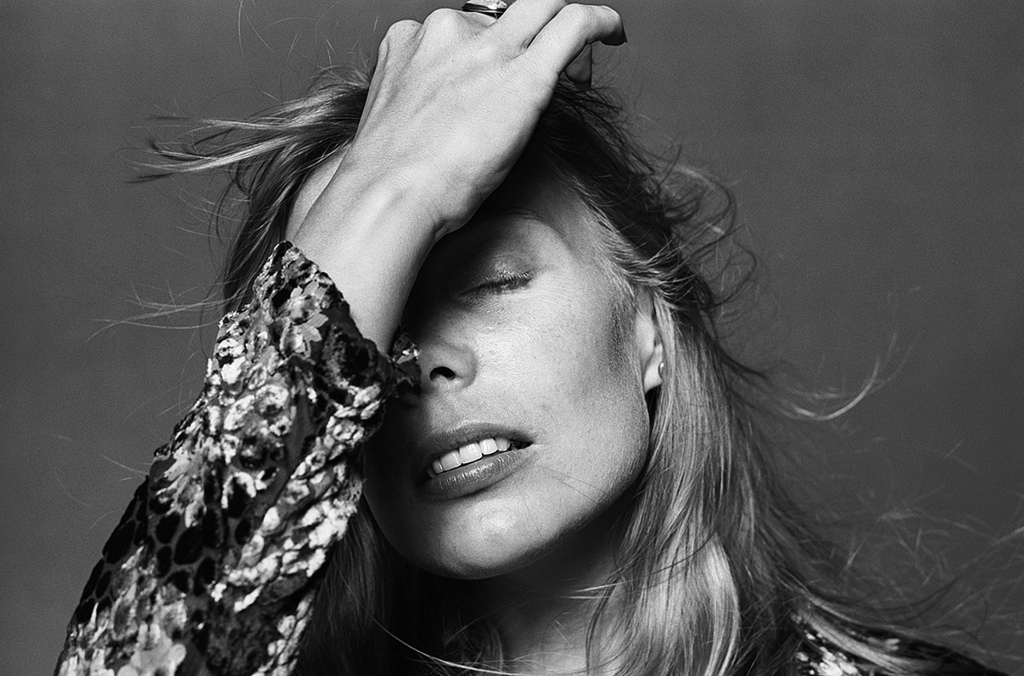
In 1976, after completing a North American tour with the LA Express in support of her album The Hissing of Summer Lawns, Joni Mitchell traveled with friends across the country to Maine. Returning back to the west coast she decided to take a road trip on her own, an ideal opportunity to reflect and meditate as she drove through highways and

Hejira is a special album. For me, it is the ultimate road trip album. Its rhythm and atmosphere feel like an instrumental record. If you tune out the words that Mitchell is singing and listen to her voice as one of the instruments in the mix, the record flows along like a dreamy tone-poem. But don’t tune out the words too long, because Mitchell has a lot to say on this album, and the narratives she delivers are beautiful verses about blues singers, hero female pilots, love affairs, teachers of Budhism, and of course – road trips.

Coyote, the first song on the album, describes her brief relationship with Sam Shepard, whom she met at the Rolling Thunder Revue, the concert tour that Bob Dylan assembled with a travelling caravan of musicians. Shepard was hired by Dylan to write a script for a movie based on the events in the Rolling Thunder Revue. That did not materialize, but Shepard did write a tour log that was later released as a book. Joni Mitchell joined the tour for a number of shows in late 1975 and it remained with her as a lingering memory of ego clashes infused by pharmaceuticals and cocaine. Not only as a spectator, mind you, for she started a cocaine habit during that tour.

The road trip that gave birth to the songs on Hejira also led to an acquaintance with Chögyam Trungpa, a teacher of Tibetan Buddhism. He snapped her out of her cocaine habit and she wrote the song Refugee of the Roads about him. In Coyote she references her memory of the sex, drugs and folk n’ roll experience that was the Rolling Thunder Revue:
Under your dark glasses
Privately probing the public rooms
And peeking thru keyholes in
numbered doors
Where the players lick their wounds
And take their temporary lovers
And their pills and powders to get
them thru this passion play

As for Sam Shepard, like many other relationships she had in the 60s and 70s, that one did not last. Luckily she ended up writing great songs about those affairs. Sam Shepard dedicated a page in his log book to Joni Mitchell, in which he quotes the lyrics from Don’t Interrupt the Sorrow: “Here’s someone who just appears, just walks out with a plain guitar, a beret, and a history of word collage. Every single time the place goes up in smoke like a brush fire. She stands there in the midst of it, making believe she’s tuning an already well-adjusted guitar until the place calms down. No doubt the element of surprise, of the audience not knowing she’s on the bill, is partly responsible for the explosions, but there’s something more important in it – the fact that people listen to her every word. Her music’s nothing outrageous, but her word maneuverings tend to verge on uncanny. ‘I got a head full of quandary and mighty, mighty’ thirst.’ She seems to have merged into a unique jazz structure with lyric and rhythmic construction and even managed to bite the masses in the ear with it.”


Coyote was written during her stint in the Rolling Thunder Revue. She joined the caravan of musicians in New Haven on November 13, 1975. In a performance on that tour on December 4th she told the audience: “I came to this tour in Hew Haven and I just hitched along to the rest of the distance. Its kind of like running away from home to join a circus. I’ve got this tune that has been growing, started off with two verses. A couple of nights later I added another one and last night I got a fourth one. ” The lyrics are close to the final recorded version on Hejira with some differences, for example:
He’s got a woman at home
He’s got another woman down the hall
He seems to want me anyway
started as:
He’s got a woman at home
A woman for the night
and now he wants one for the day
You can hear that early version, just Joni and a guitar here:
Hejira is the first Joni Mitchell album that features Jaco Pastorius. The musical relationship between the two started when Mitchell was about to begin recording the album. Robben Ford, LA Express’s guitar player, played her Jaco’s first solo record in 1976 and introduced Joni to the album. Joni loved the bass playing and asked Jaco to come to the studio to play on some of the songs later to appear in Hejira.

Jaco never heard any of her songs prior to meeting her. Joni later said about bass players and Jaco: “I was trying to find a certain sound on the bottom end, going against the vogue at the time. Bass players were playing with dead strings; you couldn’t get them to change to get a round, full-bodied tone. I liked that old analog, jukebox, Fifties sound-up-right bass, boomier. In the Sixties and early Seventies you had this dead, distant bass sound. I had started to think, “Why couldn’t the bass leave the bottom sometimes and go up and play in the midrange and then return?” Why did it have to always play the root? When Jaco came in, John Guerin said to me, “God, you must love this guy; he almost never plays the root!”. Jaco ended up playing on four songs in Hejira: Coyote, Hejira, Black Crow, and Refuge of the Roads. All these songs have his distinctive sound and style all over them.

Hejira was released in November 1976 and climbed up to no. 13 in the Billboard LP chart in January 1977, the week that saw a number of 70s iconic albums in the top three positions: Stevie Wonder’s Songs in the Key of Life, The Eagles Hotel California and Boston’s debut album. The album’s cover features a photograph of Joni Mitchell by Norman Seeff who took many fantastic photos of her in the 70s.


In 1976 Mitchell played Coyote at The Band’s farewell concert The Last Waltz. There was very limited rehearsal time due to the cast of thousands that participated in that concert. John Simon, who served as the musical director for The Last Waltz, remembers: “the chords she played on the guitar were not standard. The guys would look at her left hand and go, ‘what?’ I remember this one quote from her: I said ‘What’s that chord?’ and she said ‘I don’t know the name of it. I tune my guitar this way, to make myself stupid’, in other words to not fall into predetermined patterns. I had to figure out what the chords were, then figure out some way for the guys to play something that meshed with her”.

Chords aside, the obvious casualty was Rick Danko, The Band’s bass player and an amazing talent who wrote and sang some of the group’s best songs. However he could not handle the bass lines that Pastorius dished off effortlessly throughout the song. If you watch the Last Waltz footage of Coyote, you can see Joni and the band starting off hesitantly until Robbie Robertson starts strumming a steady rhythm and the band joins in a simplified but effective accompaniment. Robertson remembers that performance: “When Joni came out and the lights hit her, she seemed to glow in the dark. She was wearing a beautiful Native American necklace, and I was slightly surprised when she walked over and kissed me. She looked thoroughly enchanting and she sang her song Coyote, and it sounded sexier than ever. Joni’s songs might have been the most challenging of the night, with her syncopation and chord structures that kept you on your toes.”

As an aside, Joni Mitchell also sang background vocals that night to Neil Young’s Helpless. Robbie Robertson tells a rehearsal story: “When Neil Young sang Helpless, Joni did a high background vocals that sent shivers through the hall. In the show Joni wasn’t going to perform until after Neil, and I did not want to give away her appearance before that. I asked Marty [Martin Scorsese] if we could film Joni from behind the curtain while she sang her part on Helpless. ‘Definitely, he said, we’ll have a handheld camera back there’.” He continues with the actual performance of Helpless: “As soon as Neil Young took the stage, I could tell no one at Winterland was feeling better than he was. He made a profoundly touching statement about how proud he was to be onstage with us that night, before we steamed into Helpless. Right away, his harmonica set the mood and was magnificent. Neil’s vocal was so moving on this beautiful Canadian song of remembrance. When Joni Mitchell’s high falsetto came soaring in from the heavens, I looked up and I saw people in the audience looking up too, wondering where it was coming from.” You can hear that falsetto voice starting at 2:30 in the Helpless segment of the Last Waltz. Overall, a good night for the Canadians.

Here is the studio version of Coyote, with Joni, Jaco and percussionist Bobbye Hall.
If you enjoyed reading this article, you may also like these:

The Night They Drove Old Dixie Down, by The Band

Three Views of a Secret, by Jaco Pastorius
No regrets Coyote
We just come from such different sets of circumstance
I’m up all night in the studios
And you’re up early on your ranch
You’ll be brushing out a brood mare’s tail
While the sun is ascending
And I’ll just be getting home with my reel to reel
There’s no comprehending
Just how close to the bone & the skin & the eyes
And the lips you can get
And still feel so alone
And still feel related
Like stations in some relay
You’re not a hit and run driver
No no
Racing away
You just picked up a hitcher
A prisoner of the white lines on the freeway
We saw a farmhouse burning down
In the middle of nowhere
In the middle of the night
And we rolled right past that tragedy
Till we turned into some road house lights
Where a local band was playing
Locals were up kicking and shaking on the floor
And the next thing I know
That coyote’s at my door
He pins me in a corner and he won’t take no
He drags me out on the dance floor
And we’re dancing close and slow
Now he’s got a woman at home
He’s got another woman down the hall
He seems to want me anyway
Why’d you have to get so drunk
And lead me on that way
You just picked up a hitcher
A prisoner of the white lines on the freeway
I looked a coyote right in the face
On the road to Baljennie near my old home town
He went running through the whisker wheat
Chasing some prize down
And a hawk was playing with him
Coyote he’s jumping straight up & making passes
He had those same eyes just like yours
Under your dark glasses
Privately probing the public rooms
And peeking through keyholes in numbered doors
Where the players lick their wounds
And take their temporary lovers
Their pills & powders to get them through this passion play
I’ll have no regrets Coyote
I just get off up aways
You just picked up a hitcher
A prisoner of the white lines on the freeway
Coyote’s in the coffee shop
He’s staring a hole in his scrambled eggs
He picks up my scent on his fingers
While he’s watching the waitresses’ legs
He’s too far from the Bay of Fundy
From appaloosas and eagles and tides
And the air conditioned cubicles
And the carbon ribbon rides
I’m spelling it out so clear
Either he’s going to have to stand & fight
Or take off out of here
I tried to run away myself
To run away and wrestle with my ego
And with this flame
He put here in this Eskimo
In this hitcher
In this prisoner
Of the fine white lines
Of the white lines on the free free way


Leave a Reply