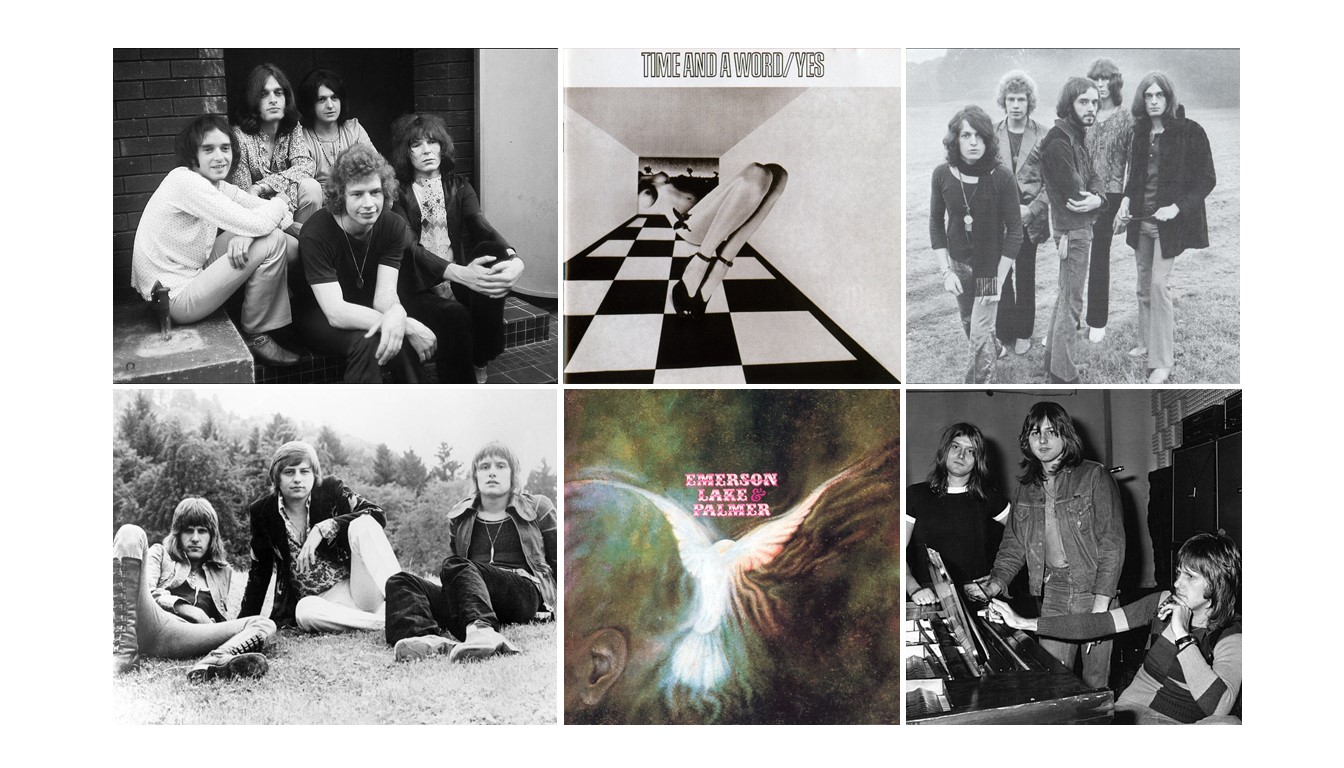
1970 was a year of early albums for nearly all bands in the fledgling British progressive rock genre. Many of the groups in this article series released either their debut album or a sophomore album that broke away from traditional pop and rock concepts into a more ambitious effort. This is also the case with the bands covered here, both of them very soon to become synonymous with the genre.

Yes – Time and a Word
In July 1970 Yes released their second album Time and a Word. It was a major step forward from their eponymous debut a year earlier. Taking inspiration from bands such as The Moody Blues, Deep Purple and The Nice, they decided to incorporate an orchestra into their music. They hired students from Royal College of Music and the services of arranger Tony Cox. In 1970 Cox also arranged and produced Tea and Symphony’s album Jo Sago and Trees’ excellent album On the Shore. In 1982 Jon Anderson said about this development: “I had speakers at the bottom of my bed, blasting out classical music all the time. So in one ear there was rock, and in the other ear was the classics. I was interested in opening up the sound of the band, developing a string sound, and we talked about trying the mellotron, but we thought it only had a certain sound, and that it related to only a certain type of music. We did try it out a couple of times, then we decided to use real musicians, strings and brass and things like that.”

At the end of 1969 and early in 1970 Yes recorded the album at Advision studio in London. Phil Carson, who was musical director at Atlantic Records in the UK and a big fan of Yes, brought in a young engineer who would start a brilliant career with progressive rock musicians in the early 1970s. He recalls: “I got Eddie Offord in because I used to produce cover records of the pop hits of the day for Saga Records. I always used Eddie when we worked at Advision Studios. I’d book the studio for a late session, bring a reel of eight track tape and finish an album in a night! As long as we got out of the building by 6 a.m. before the cleaners came in we were okay. Eddie and I made a number of albums like that. I remember a budget version of Hair we did overnight with student string players. So I knew Eddie was a brilliant engineer.” Offord would go on to produce the band’s masterpiece albums Fragile and Close to the Edge.

On March 28, 1970, after returning from a tour of Scandinavia with The Small Faces, Yes performed at the Queen Elizabeth Hall. They were joined in the second half of the concert by a 20 piece youth orchestra, performing pieces from Time and a Word. The concert was reviewed in Melody Maker, reading: “Yes have scored a considerable success with their first major solo concert. They tried a brave experiment with added strings and brass conducted by Tony Cox. Although it suffered from amplification problems the group scored all the way playing at a peak which earned a kind of ‘musical break-through’ audience reaction which marks the point when a group have ‘arrived’.”
The orchestra is quite prominent throughout the album, adding dramatic flourishes to many of the songs. A fine example is the interesting cover of Everydays, a song written by Stephen Stills for the 1967 album Buffalo Springfield Again. Ray Davis of the Kinks upon hearing the song in a blindfold test in 1970: “Good – I like the strings at the beginning. It’s very hard to get that sound. Sounds like Cleo Laine – probably meant to sound like that chap from The Zombies. Is it a soundtrack?”
Guitarist Peter Banks, who plays a fantastic guitar solo on this tune, had reservations about the use of orchestra, and he clashed with producer Tony Colton over musical differences. He later said of the album: “Despite the problems I had with the producer and not liking the string section, the album itself isn’t bad and there is some good work there and nothing I’m ashamed of.” Shortly after the band finished the recording of the album and prior to its release, Peter Banks was out of the band. Steve Howe joined, and is present in the promotional videos the band shot for some of the songs from the album.

Beat Instrumental magazine wrote in October 1970, “The record really is remarkably fine. The group have enlisted the aid of an orchestral supplement to turn out an integrated album of beautiful precision, guts and joy. Atlantic records must be well pleased.” The American distributors found the front album cover sufficiently indecent for innocent youths across the pond, that they replaced it with a band photo featuring new guitarist Steve Howe.

Drummer Bill Bruford discussed the topic of the band’s progressive music and its impact on listeners: “The audience shouldn’t be aware of what’s happening; they should just get an effect, they shouldn’t know how it’s done. If they’re saying ‘ah, they missed that crotchet out there, oh, that’s three-four changing to five – four’, rather than just feeling there’s something going on in the mood of the music helping the whole thing along, then you’ve made a mistake.” Bruford was quite the oracle when he told Melody Maker in 1970: “The difference between the first and second LP is immense. Consequently I envisage a huge improvement between the second and third.” That third would be released in 1971 – The Yes album, with Steve Howe in the lineup, a progressive rock classic.
Jon Anderson – lead vocals, percussion
Peter Banks – electric and acoustic guitar, backing vocals
Chris Squire – bass, backing vocals
Tony Kaye – Hammond organ, piano
Bill Bruford – drums, percussion
Here is a clip filmed for the song Then from 1970, with Steve Howe in the group, and an instrument switcheroo between keyboardist Tony Kaye and bassist Chris Squire:
Emerson, Lake and Palmer – Self titled debut album
The second part of this article is dedicated to a super group of three major musicians who left their respective bands to form one of progressive rock’s leading bands. We are talking of course, of Keith Emerson, Greg Lake and Carl Palmer, collectively known as Emerson, Lake and Palmer, or ELP.
The seed for the formation of the trio was planted when The Nice and King Crimson shared the stage as opening acts for Chambers Brothers in December of 1969 at Fillmore West in San Francisco.

Keith Emerson (The Nice) approached Greg Lake (King Crimson) during the 4-night run of these shows, with the idea of forming a new trio. Emerson reached an impasse with his band The Nice, but wanted to keep the trio format with other musicians, as he explained in an interview: “The real reason is that I could never see myself playing with another soloist, and any additional instrument in the band would be a solo instrument. I’ve never played with a good soloist in my life. Perhaps if he were really sympathetic with my career and I with his it would work, but at the moment I’m not taking that chance.” Greg Lake did not need much convincing to take Emerson up on that offer: “I’ve always dug Keith’s playing ever since the very first Nice LP. In fact the two soloists I most admire are Jimi Hendrix and Keith. To play with him was just what I wanted, so when the approach came I took it immediately.” The trio was completed with drummer Carl Palmer, who came from the band Atomic Rooster through a recommendation from manager Robert Stigwood.

The band started rehearsing in the spring of 1970, after Emerson completed remaining live performance duties with the Nice. They started interpreting a few tunes from their respective former bands, including Rondo from The Nice’s third album and 21st Century Schizoid Man from King Crimson’s debut. They also started working on a rendition of Modest Mussorgsky’s Pictures at an Exhibition. Chris Welch visited the band in a rehearsal room and wrote in Melody Maker, May 1970: “On hearing them in their lair, they were grappling with a piece of contemporary music by Bela Bartok, which sounded quite remarkable in their dexterous hands. They paused for deep conversation about the placing of accents, Keith peering across his grand piano to Carl concentrating furiously on drum patterns.” Emerson, ever in search of classical music he could make his own, later said, “The Bartok number comes from a piece of sheet music which I found knocking around at home and it’s called Alegro Barbaro.” It later became the opening tune from their debut, titled The Barbarian.
In August of 1970 the band performed their first live gig at a small venue in Plymouth. They were not yet known as a unit but rather as three individuals who previously played in other bands. But only six days later, their second gig proved to be a whole other experience. On August 29, they took the stage in front of 600,000 people at the Isle of Wight Festival between sets by Ten Years After and The Doors. After an energetic concert that included a 34 minutes rendition of Mussorgsky’s Pictures at an Exhibition, they never looked back. Lake said of the event: “It was the biggest show any of us had ever done. The next day, we were world-famous.”

Chris Welch visited the band again just before this milestone show, and reported: “Said Keith: ‘We will be playing a piece based on Pictures at an Exhibition, which will be some of Mussorgsky’s pictures and some of ours. When it was first written there were some harmonies used which are very relevant to today’s music, but were too demanding at the time.’ Carl: ‘we’ve dropped 21st Century Schizoid Man – after I wore out the LP trying to learn the drum part!’”
ELP’s self-titled debut album was released three months after that milestone performance. It is an amazing achievement by three excellent musicians who just started playing together. They manage to sound cohesive despite the complex nature of the music. On the strength of their performance at Isle of Wight, the album did well and even though John Peel called it, “A complete waste of time, talent and electricity”, it reached the top 4 on the UK album chart and the top 20 on the Billboard LP chart.

My favorite track from the album is Take a Pebble, one of the earliest compositions Emerson and Lake wrote together and rehearsed before Palmer joined the group. The piece was performed at the Isle of Wight and left the audience stunned. With all the pyrotechnics that Keith Emerson demonstrates on the Moog and Hammond organ on this album, his piano playing on this piece is no less interesting and virtuosic. The instrumental interludes with the trio playing acoustic instruments proves that progressive rock is not about guitar and keyboard gizmos, but about the musicianship.
The unique sound at the opening of the song is created by plucking the piano strings with a guitar pick. Keith Emerson talked about one of his early influences, modern classical composer John Cage: “I was aware of John Cage, who was sticking things inside a piano like ping pong balls and various other things, so I thought this is a light relief from what I was having to learn. I experimented with it sometimes, until I was told off by the school music teacher – you know, ‘You’re not allowed to do that!’ But I was persistent, I thought, well if you’re not allowed to do something, I’m going to damn well go ahead and do it!”

I always liked the lyrical side of ELP, even though with all the bombastic music they made it became difficult to find these moments. That side of their music usually came from Greg Lake’s contributions. Lake already demonstrated his skill for melody in King Crimson’s debut, writing the melody lines for Epitaph and In the Court of The Crimson King, plus the riff for 21st Century Schizoid Man. Some of ELP’s most enduring moments are the songs Lake wrote including Lucky Man, Sage, From the Beginning and Still…. You Turn Me On. Take A Pebble is a great showcase of Lake’s songwriting, singing and guitar playing. In a November 1970 article in Melody Maker he said this about the song: “I wrote this after Christmas with Keith when there were just the two of us and Carl hadn’t joined us. It started out as a folk guitar thing, then Keith added piano and I used a bass. The solos weren’t there to start with but Keith wrote a solo and I decided to put in a guitar solo as well. It was a solo I had written about five years ago and never had a chance to use before.” Lake used to play a Gibson Jumbo guitar in the early days, then adding Martin guitars to his arsenal. His acoustic guitar work and sound always provided a great segue from Emerson’s Hammond, church organ or Moog solos.
Chris Welch mentioned the tune in Melody Maker after visiting ELP in in the studio: “They played a beautiful number called Pebbles which sounded like a rock-MJQ (Modern Jazz Quartet), with Carl on the brushes, Keith on piano and Greg singing in a rich, warm style”. Referencing the Modern Jazz Quartet is actually not a bad choice. Before the knives, stage gymnastics and revolving pianos, here is Take a Pebble from ELP’s first record.
We cannot review ELP’s debut album without talking about the Moog synthesizer. The album closed with a song that put the trailblazing electronic instrument at the forefront of the emerging genre of progressive rock. The solo towards the end of Lucky Man is forever etched in that period’s music lovers’ memory, whether they know it was performed on the Moog or not.
Keith Emerson first heard the Moog, like many other listeners, through the groundbreaking record Switched-On Bach by Walter Carlos. When he visited a record store in Soho, the store owner told him, “Well you’ve done the Brandenburg 3. Check this out”, and proceeded to play that album. Emerson was floored, and then he looked at the album’s front cover. “There was a gentleman dressed up in a baroque outfit and a thing that looked like a telephone switch board. So I said, ‘What is that?’ And he said, ‘That’s the Moog synthesizer.’”

Not too many Moog synthesizers were to be found in England at the time, but one was owned by Mike Vickers of the Manfred Mann group. Emerson attempted to play it and failed miserably, realizing he was playing a monophonic instrument when Vickers said, “You can’t play chords on it, you can only play one note at a time.” But Emerson quickly adjusted his playing to accommodate the instrument’s shortcoming, using the portamento and pitch bending controls to enrich the soaring solos he dished out. Emerson said at the time of this new discovery: “When I started playing the piano, I progressed to a certain stage where I found I wanted to move on to the wider limits of the organ. Now with the organ I feel I’ve done virtually everything with it that can be done and for me the Moog is the next step.”
The Moog first made a live appearance with Keith Emerson at the final live shows by The Nice in the spring of 1970, with Vickers on hand to handle the difficult task of patching the various modules with patch cords. Emerson played Richard Strauss’s ‘Thus Spoke Zarathustra’, at the time becoming quite popular with its use in the theme from the Stanley Kubrick’s film 2001: A Space Odyssey. Later that year the Moog made a glorious contribution on ELP’s debut album, in the final section of the song Tank and the iconic solo in Lucky Man.

By the time ELP recorded their debut, Emerson was able to purchase his own Moog. When he first got his hands on the complex tangle of modules and cables, he did not even know how to turn the thing on. Vickers, who was also a distributor of Moog in the UK at the time, came again to the rescue: “Mike got back to me a week later and he said, ‘Yeah, it was tricky, but I’ve got six sounds.’ And those six sounds became the basis of the ELP sound actually, I mean, I worked off of that, particularly in the recording of Pictures at an Exhibition and Lucky Man.” It is amazing to think that during the making of the album, the mammoth instrument was programmed to produce only six unique sounds. But sometimes less is more.
As iconic as that solo on Lucky Man is, Emerson was not satisfied with it. He tells the story: “They ran it through the tape, and I was really just jamming around. I got the thumbs up from the control room. Great! The look of excitement on their faces. ‘What? What do you mean?’ ‘That’s it man, that’s the one!’ I said, ‘No, no, no, that’s dreadful,’ I said, ‘Let me have another go.’ And Greg was saying, ‘No man come in and have a listen it’s unbelievable.’ So I went and had a listen to it and I said, ‘Can’t I just do one more? Is there an additional track?’ ‘No man, all the tracks have been used up, we can’t use any more. That is the solo!’ So I was devastated. That’s a solo that I’ve had to live with!’”. Not bad for a bad solo. It ends with the Moog panning from the left to the right speaker, a favorite demonstration track in stereo hi-fi systems shops.
Sources:
Yes – The Complete Story – from the archives of Classic Rock & Prog
Analog Days: The Invention and Impact of the Moog Synthesizer, by Trevor Pinch and Frank Trocco


Leave a Reply