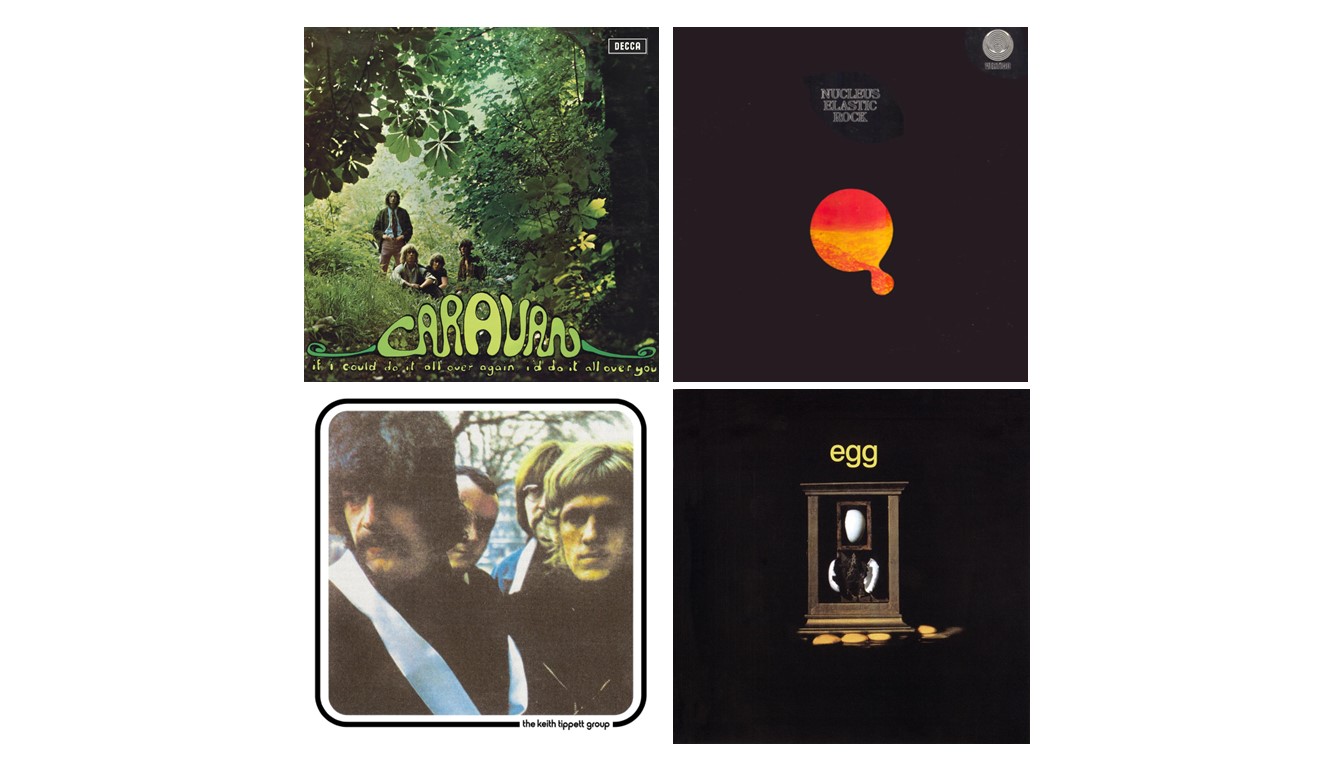
The previous article in this series covered the Canterbury scene, focusing on one of the genre’s best-known bands, Soft Machine. We continue with a review of additional 1970 albums associated with Canterbury, and first is another defining band of that scene.
Caravan – If I Could Do It All Over Again, I’d Do It All Over You
This is perhaps my favorite Canterbury scene album of 1970, from one of the bands that best define the genre’s stylistic esthetic. After releasing their self-titled debut album in 1968, Caravan found themselves with no recording contract when their label MGM/Verve ceased operations in the UK. Guitarist Pye Hastings remembers that period: “We were in a situation which was becoming increasingly frustrating. The whole group was contributing ideas to seemingly no end product. We had to record to fulfill ourselves.”

The following year they signed with Decca on the recommendation of producer David Hitchcock, then at the very beginning of his career. Hitchcock would go on to produce the band’s fantastic run of 1970s albums starting with ‘In the Land of Grey and Pink’ in 1971. Caravan had a busy touring year in 1970. A memorable performance at the Actuel Festival in Belgium saw them jamming with Frank Zappa. Hastings: “He came on stage with his guitar and started jamming along to ‘If I could Do It All Over Again’ which was an incredible experience. He was quite complementary to us afterwards.”
In the spring of thar year, the band went into Tangerine Studios to record their second album. Hastings on the studio experience: “Each track on the album was essentially a live performance in the studio. If something needed correcting, we would ‘drop in’ to the track at that point. Back then if you made a mistake dropping in you also wiped everything that was on tape previously.” Bass player and singer Richard Sinclair talked about the recording process: “The album was a joint effort through. After the first LP, we wanted to produce ourselves, and learnt the different sound techniques and recording possibilities as we went along.”

The album, whimsically titled ‘If I Could Do It All Over Again, I’d Do It All Over You’, included the fantastic piece of music known as Can’t Be Long Now / Françoise / For Richard / Warlock. This multi-part composition is a favorite of their fans and has been a show closer for many years. Pye Hastings: “Although we share compositional credit, we didn’t write together as such. We shared each other’s ideas to certain extent. For example, ‘For Richard’ was composed by Dave Sinclair, but the riff which the main tune goes into was the idea of Richard Sinclair. Then as a band we would develop the song further, expanding on the ideas and so on until it became the long track you hear on the album.”
Pye Hastings – vocals, 6- and 12-string electric guitars, 6 string acoustic guitar, claves, percussion, worn leather strap, ashtrays, voice, impersonation of a friendly gorilla
Richard Sinclair – vocals, bass guitar, tambourine, hedge clippers
David Sinclair – organ, piano, harpsichord
Richard Coughlan – drums, congas, bongos, maracas, finger cymbals
Additional personnel:
Jimmy Hastings – saxophone, flute
Nucleus – Elastic Rock
We continue the review with a number of solo efforts, starting with two groups led by prominent figures in British jazz of that period. The first is Ian Carr who formed the band Nucleus in September of 1969. This is a great example of early British jazz fusion, a parallel universe to the more celebrated American scene of that genre. In 1970 the band won the European Broadcasting Union prize at the Montreux festival and later performed at the Newport jazz festival and the Village Gate club in NYC.

Although the band was stylistically categorized as a rock band influenced by jazz, in a Jazz Journal interview Ian Carr talked about his music preferences: “I am not so interested in the kind of music that is played by Chicago or Blood, Sweat & Tears. If I want to listen to really basic music that is vital as well, I would go to Howlin’ Wolf with his electric Chicago rhythm section. I also like Sly and the Family Stone because they have a fantastic feel.” However, his influences were much wider and spanned modern jazz and classical music: “I would like to possess more records by Gil Evans who has got that kind of influence and I really like Stravinsky. I have just read through the score of ‘The Rite of Spring’ and in it I found that he uses a flatted tenth, a very bluesy chord in rock-blues music, which we use a lot. I now want to listen to Bartok. I have only heard random pieces of his in the past, but I would now like to hear more.”
Nucleus indeed combined the power of rock music with the stylings of jazz, but they also branched out to free-form explorations. Still, unlike some free-jazz ensembles of the time, their music remains highly communicative. Carr: “What we do in Nucleus is simply to have one note which is a root and over that note we can play literally anything. That is the kind of freedom that we are interested in. Not total freedom where you don’t even have a root, but we have one note and over it we have complete harmonic choice. We are interested in the building up of tension and in the releasing of it. In a lot of avant-garde jazz, I find tremendous tension but never a real release. For me, totally free music has no drama.”

In March of 1970 the band released their debut album Elastic Rock. Carr wrote the band’s manifesto on the album’s back cover: “We see music as a continuous process and have tried to express this on the album. We mean continuous not simply in the physical sense of non-stop sets, but in the general sense, that we don’t recognize rigid boundaries, but try to use our total musical experience.”
The album includes prominent composition contributions from Karl Jenkins. The reed and keyboard player would go on to join Soft Machine later in the 1970s and then become a renowned composer of modern classical works. Elastic Rock is a great early jazz rock album that truly brings out the best of both genres. Drummer John Marshall remembers: “The idea was to learn a few lessons from the rock scene in terms of organization and presentation – we had our own PA for example; unknown then on the jazz scene.”
The album features an early Roger Dean album cover art, quite different from the fantasy drawings he would become famous for starting a year later.
Ian Carr – Trumpet, Flugelhorn
Brian Smith – Tenor Saxophone, Soprano Saxophone, Flute
Karl Jenkins – Baritone Saxophone, Oboe, Piano, Electric Piano
Jeff Clyne – Bass, Electric Bass
John Marshall – Drums, Percussion
Chris Spedding – Guitar
Here is the title track from the album:
The Keith Tippett Group – You Are Here… I Am There
Another interesting jazz release came from one of my favorite artists of that period, pianist/composer Keith Tippett. His debut album was recorded in 1968, but only released in 1970. He met three musicians with whom he would form the Keith Tippett Group at a two-week course ran by the Barry Jazz Summer School in South Wales: “I didn’t know anybody, but Nick Evans was introduced to me. We hit it off straight away. He was a fantastic trombonist, a really good reader and a lovely guy. I’d taken some tunes down with me and we were given the opportunity to put bands together for the jam session in the evening. I did one night and I remember Elton Dean and Mark Charig coming up and telling me they wanted to play with me. So I said ‘Of Course!’ This was the second night in a two-week course and already there were four of us who were really tight.”

Coming back to London, the quartet quickly expanded to a sextet with the addition of drummer Alan Jackson and bassist Jeff Clyne. They secured a record deal with Polydor, resulting with the album ‘You Are Here… I Am There’. Unfortunately, the album’s release was delayed for over a year, and by the time it came out Keith Tippett was on to other things. He explains: “I think the label hit money problems and there was something going on with Polydor. So therefore, my first record suffered because of those politics. When you’re young, if you’re working hard you’re improving rapidly and when your first record takes over a year to come out it’s a pain, because by the time it’s out, the band has moved on.”

Christopher Bird wrote about Keith Tippett in the original album sleeve notes: “It’s hard to believe that by the time he turned to jazz, Ornette Coleman was history. The people he has most enjoyed and learned from have been Charles Mingus, Pharoah Sanders, John Coltrane, and among pianists, Keith Jarrett. But now he will get more stimulus from hearing the local heavy-weights live – Kenny Wheeler, Harold Beckett, Oxley, Surman and John Stevens. And of course, the best of the rock groups – King Crimson, East of Eden and Soft Machine.”
Here is a great tune from that album called Stately Dance for Miss Primm. The original liner notes read: “Listen to the wonderful time feel on ‘Miss Primm’ providing the perfect spring-board for Elton Dean’s hairy solo. Yes, the days of duff British rhythm sections are long gone.”
Alto Saxophone – Elton Dean
Bass – Jeff Clyne
Cornet – Marc Charig
Drums, Glockenspiel – Alan Jackson
Trombone – Nick Evans
Piano, composer – Keith Tippett
Egg – Self-titled debut
One more band to release a debut album in 1970 was the sadly short-lived Egg. The trio evolved from a group called Uriel that also included fellow high school student Steve Hillage. When the talented guitarist left to pursue university studies in Canterbury, the remaining trio marched on as Egg and signed a record deal with Decca to release an album on its subsidiary label Nova. The album was produced by the group itself, all its members only 19-year-old at the time. The original liner notes include this fair warning: “The music on this LP is not dancing music, but basically music for listening to. It is harmonically and rhythmically complex, designed to be as original as possible within the confines of the instrumental line up, so it’s pretty demanding on the listener’s attention.” Someone at the record label must have thought this a good attention-grabbing blurb for album buyers. Not so.

Mont Campbell, who wrote most of the band’s material, told Melody Maker in May of 1970: “My god is Stravinsky, and I’d like to do for pop music what he’s done for mainstream music in the 20th century, using polyharmony and polyrhythms.” The band was certainly ambitious. Comparing improvisation to composition, he added: “When you improvise on the same number every night you’ll get basically the same development, you’re looking at it from the same standpoint every time. So I try to do it while I’m writing, to get that development, and I think Stravinsky all the time. ‘Rite of Spring’ is the obvious influence, of course.”
The second side of the LP is comprised of the multi-part epic Symphony no. 2, a collection of improvisations on classic themes by Grieg and Stravinsky.
Dave Stewart – organ, piano, tone generator, mellotron
Mont Campbell – bass, vocals
Clive Brooks – drums
Here is the first movement from that epic, including improvisation on ‘Hall of the Mountain King’ by Grieg.
Sources:
Caravan – If I Could Do It All Over Again, I’d Do It All Over You 2001 CD booklet
Egg, 2008 CD booklet
The Keith Tippett Group – You Are Here… I Am There, 2013 CD booklet
Nucleus – Elastic Rock, 1994 CD booklet


Leave a Reply