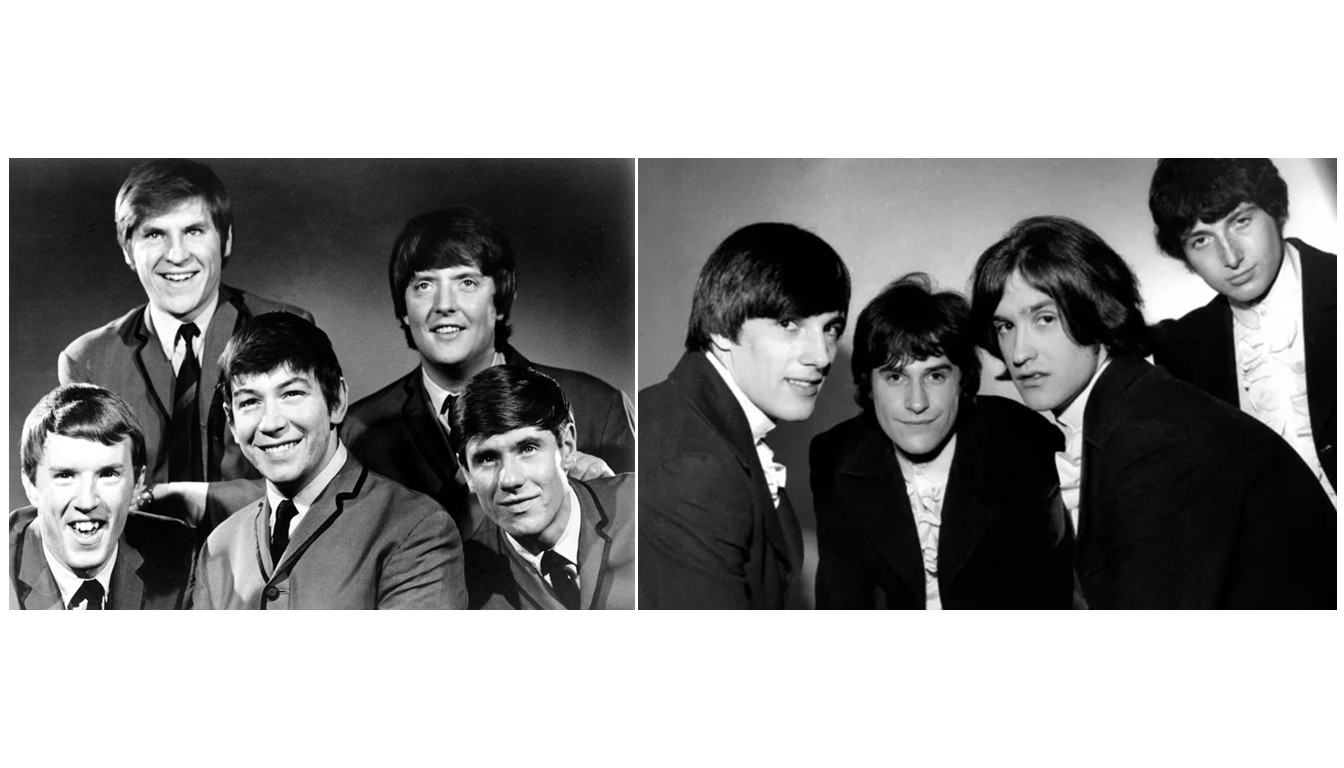
In 1964 the British Invasion was all about British artists taking American material, producing and performing it in a way that appealed to young audiences, and feeding it back to American listeners. In previous articles we looked at British artists who covered songs originally performed by American blues, rhythm n blues, pop, soul, rock n’ roll, doo wop and girl groups. One unique band started their singles career looking at folk songs, and can pride themselves as one of the earliest pioneers of folk rock.
The Animals – The House of the Rising Sun
There is no consensus among members of The Animals about where and when they first heard the song ‘The House of the Rising Sun’. It ranges from a live performance by local musicians in Newcastle to recorded versions by various artists. Lead singer Eric Burdon said, “I first heard this song in the folk clubs of Newcastle and immediately fell in love with it. It somehow clicked and connected with me. I chose the song because it has a mysterious vibe, a haunting melody.” But whatever was the inspiring source, there is no doubt that Bob Dylan’s version of the old folk tune on his self-titled debut album in 1962, was critical to The Animals’ classic interpretation of the song.

Dylan’s version takes its inspiration from an arrangement of the song by Dave van Ronk, who later told the story: “One evening in 1962, I was sitting at my usual table in the back of the Kettle of Fish, and Dylan came slouching in. He had been up at the Columbia studios with John Hammond, doing his first album. He was being very mysterioso about the whole thing, and nobody I knew had been to any of the sessions except Suze, his lady. I pumped him for information, but he was vague. Everything was going fine and, ‘Hey, would it be okay for me to record your arrangement of ‘House of the Rising Sun?’
‘Jeez, Bobby, I’m going into the studio to do that myself in a few weeks. Can’t it wait until your next album?’
A long pause. ‘Uh-oh.’
I did not like the sound of that. ‘What exactly do you mean, ‘Uh-oh’?’
‘Well,’ he said sheepishly, ‘I’ve already recorded it.’”
Record it he did, and that recording came to the attention of The Animals, who decided to start performing it on their live shows. They found that the audience reacted strongly to it. Eric Burdon remembers the time they performed the song during a package tour with Chuck Berry across England: “Playing ‘House…’ on the Chuck Berry tour, we all knew it had to be recorded and released instantly. It got our biggest reaction. Constantly, every night, in spite of the fact the packed house was waiting for Mister Rock’n’Roll to take the stage. People were leaving the theatre singing it. We could hear them through the dressing-room window.”

Guitarist Hilton Valentine talked about the band’s take on the song that captivated their listeners: “The dynamics of the song was what The Animals used to do when we played – start off with a certain pace, move it up a few notches, really drive it – and then drop it, right back down. And then build back to a crescendo at the end.” On May 18, 1964, mid-tour, The Animals went into a recording studio to capture their live performance on tape. After many nights playing it, they needed only one take to complete their unique cover of the song.
Valentine is also the man behind one of the most recognized guitar intros in the history of popular music. That arpeggiated Am-C-D-F chord sequence has been practiced by thousands of guitar beginners at music stores around the world. Valentine said that he took Bob Dylan’s chord sequence and played it as an arpeggio. Talking about the band adopting this opening, he said, “We started rehearsing it, I was coming up with my arpeggio bit and Alan Price said to me, ‘Can you play something different because that is so corny?’ So I told him, ‘You play your damn keyboard and I’ll play my guitar!’ Then, after a few rehearsals, he started playing my riff and we recorded it.” And this is what he said about the guitar with which he played the riff: “Shortly before I left The Wildcats for the Alan Price Combo, which of course became The Animals, I had gotten a Gretsch Tennessean, and a bigger Selmer amp called a Selectortone with the push-button tone selectors. I considered this to be my first good guitar and amp setup.”

When the band listened to their perfect take in the studio, they found to their dismay that it clocked at 4 minutes and 35 seconds long, way over the standard 2:30-3:00 minute radio-friendly hits of the day. Their engineer said, “You’re never going to be played on the radio.” But producer Mickie Most knew he had a hit on his hands. The humble producer remembers: “Everything was in the right place, the planets were in the right place, the stars were in the right place and the wind was blowing in the right direction. It only took 15 minutes to make so I can’t take much credit for the production. It was just a case of capturing the atmosphere in the studio.” Most also decided to release the song in its entirety.
The House of the Rising Sun was released in the UK in June 1964. A month later the single, almost twice the length of most singles, topped the chart. In the US the record label took liberties and chopped it to just below 3 minutes. Valentine recalls: “It was only when we were on tour there that we heard ‘House’ on the radio, and realized they’d chopped over a minute out of it. We were furious. No one had told us.” But the sad discovery was sweetened by its success. The song topped the Billboard Hot 100 chart for three consecutive weeks in September 1964. After The Beatles, The Animals were at the top of the US chart for the longest that year. Eric Burdon summarized its success well: “It was too sexy, too long for a single, wrong subject matter – and no idea how to promote it. Thanks to the crew at Ready Steady Go! and the fans at the Chuck Berry gigs, it ended up right in the corner of the net. It broke The Beatles’ grip on the No 1 spot, for a while.”

The Animals’ version of The House of the Rising Sun received many accolades over the years, naming it the first classic rock song and one of the earliest folk-rock songs. More significant, maybe, is how it came full circle to influence the performer who influenced The Animals. When The Animals were in New York in 1965 to tape their performance of ‘Bring It On Home to Me’, Bob Dylan was working on material for his next album. That album would become ‘Highway 61 Revisited’, his 180 degrees turn from acoustic folk music to electric-based rock. Through a mutual friend The Animals had a chance to meet him at his manager Albert Grossman’s flat. Dylan was practicing his iconic song ‘Like a Rolling Song’ and he said, “The reason I’m going this way is because I was driving along and I heard your House of the Rising Sun playing on the radio, and it was like a lightbulb moment, and that’s what made me think yes, this is really good.”
Years later, Eric Burdon talked about the long-lasting, universal appeal of the song: “It can represent almost anything — the brothel in New Orleans, the coal mine in Newcastle, the state of mind that you are stuck someplace, a bad marriage or any soul-crushing job. There are hundreds of thousands of people who spend their lives in pain and misery and even people who have the money, the clout, and the lifestyle to escape pain and misery who find themselves in that state. It’s not just a story of a woman who works in a whorehouse or a guy visiting one. It’s a song of soul-searching. It’s a song of redemption. ‘To spend your life in pain and misery’ could be about any place one needs to escape from.”
The Kinks – You really Got Me
From a song that inspired folk-rock, how about another that was the is the grandfather of garage rock and punk? In a 1964 interview Ray Davies of The Kinks said, “We really didn’t want to make our songs pop songs. We didn’t want to make syrupy pop songs, that’s for sure.” After two failed singles, their next song indeed sounded like nothing else of its time.
‘You Really Got Me’ is as a basic a rocking song as it gets. The lyrics are essentially a single statement – you really got me. Ray Davies: “I just remembered this one girl dancing. Sometimes you’re so overwhelmed by the presence of another person and you can’t put two words together. I was playing a gig at a club in Piccadilly and there was a young girl in the audience who I really liked. A bit similar to Françoise Hardy. I wrote ‘You Really Got Me’ for her, even though I never met her.”

The song features one of the best-known guitar riffs in rock. According to legend, Dave Davies got the dirty guitar sound by slashing the speaker cone on his Elipco amp with a razor blade. The audio signal was fed into a Vox amp to produce one of the first big hits with a distorted sound, influencing a huge number of aspiring guitar payers. Another legend, putting Jimmy Page in the guitar seat for the mid-song solo, is simply untrue according to the actual soloist Dave Davies, his brother Ray and famed producer Shel Talmy. That timeless solo was almost ruined accidentally, as Ray Davies recalls: “Halfway through the song it was time for Dave’s guitar solo. I shouted across the studio to Dave, to give him encouragement. But I seemed to spoil his concentration. He looked at me with a dazed expression. ‘Fuck off.’ If you listen to the original Kinks recording of ‘You Really Got Me’, halfway through the song, after the second chorus, before the guitar solo, there’s a drum break. Boo ka, boo boo ka, boo ka, boo boo. And in the background you can hear ‘fuck off’. When I did the vocal I tried to cover it up by going ‘Oh no’, but in the background you still hear it ‘fuck off’.”

Another key contribution to the song is by session musician Bobby Graham. The legendary drummer played a crucial role in many the hits that made the British Invasion, including ‘We Gotta Get Out Of This Place’ by The Animals, Dave Berry’s ‘The Crying Game’, Petula Clark’s ‘Downtown’ and Dusty Springfield’s ‘I Only Want To Be With You’. Ray Davies recalled the moment Graham started playing his powerful beat in the studio: “When Dave played the opening chords, Bobby Graham forgot the complicated introduction he had planned and just thumped one beat on the snare drum with as much power as he could muster, as if to say, ‘OK, wimp, take that!’”. The flam at the start of the beat reminds one of the very first note on Bob Dylan’s ‘Like a Rolling Stone’. Graham adds: “That flam at the start of the song was more by accident than anything else. They counted it in, the guitar started and I hit the snare so hard the stroke became a flam. Everybody liked it.”
If you are looking for a delicate arrangement and studio performance with finesse, look elsewhere. This is not what The Kinks delivered in the early part of their recording career. Shel Talmy recognized the excitement that comes with that: “I’ve always been more interested in the overall feel of a take than in precision. If a take is really sensational, but contains a bum note or two, I’ll say ‘Screw It – just let it go.’ Any English producer at that time would rather have slit his wrists than let anything like that out. With a band like The Kinks – who, like most bands of the time were personally polite – I’d rather have to say, ‘Come on, guys, lighten up.’”

‘You Really Got Me’ was released in the UK on August 4, 1964, climbing to #1 on September 16, where it stayed for two weeks. A month later it was released In the US, reaching #7.
A review of the song in Pop Weekly magazine was quite complementary and prophetic: “Too many of today’s stars get a song, good or bad and after a few hours they have an idea how to record it and it’s in the can. Rarely do they think about it. The Kinks do. They sit down and think about one bar. Should it be done this way, they think. Should it be done another way? They work out more than one variation on a number until they have the tune exactly right. If the Kinks can continue this kind of musical work, they have the talent to still be here for a long time turning out hits, whilst most of the other groups will be back to being insurance clerks or tea-boys or whatever they were.”
Years later Ray Davies reflected on his very first attempts at songwriting that led to ‘You Really Got Me’ and their next single ‘All Day and All of the Night’: “My attachment to songwriting only came after I’d had a few hits. I had no real ambitions to do it. We were a cover band; we played blues music, covers – Chuck Berry, Muddy Waters. I just thought, “Well, I don’t like this material they are asking us to do. I’ll write my own. I think if I had been an accomplished songwriter, I wouldn’t have written ‘You Really Got Me’ because there’s something naive and basic about it, with the key shift halfway through.”

Leave a Reply