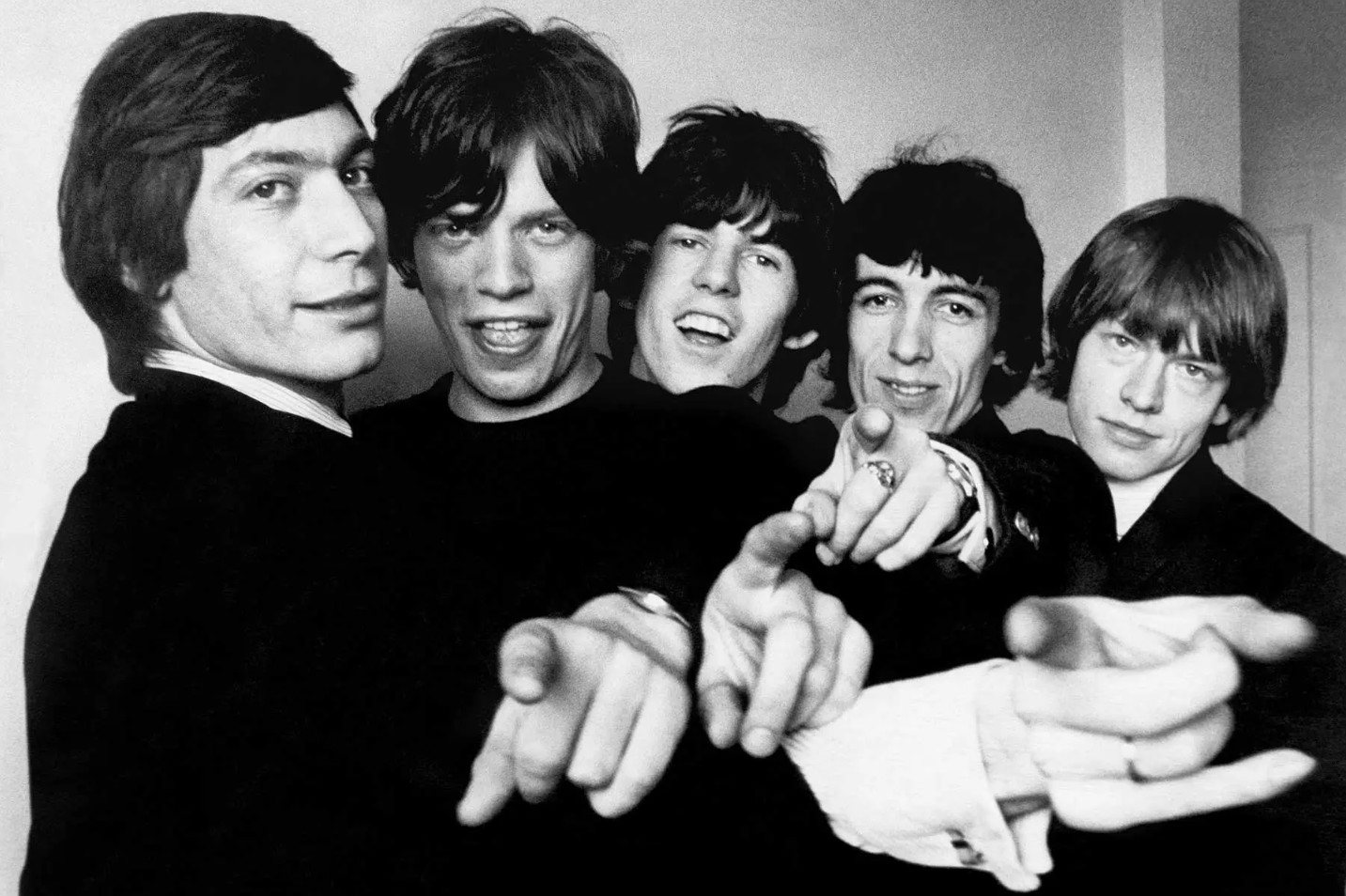
The last episode in the article series covering the British Invasion phenomena of 1964 is dedicated to a band that is rock and roll royalty. This was the first major year of The Rolling Stones as recording artists, after releasing two singles the previous year. In 1964 they released multiple singles in both the UK and US, twice reached the top of the chart in the UK, and also released their debut album.
Not Fade Away
Andrew Loog Oldham remembers the first time he heard a Rolling Stone playing a certain rock n’ roll classic: “The first week of February I found Keith – fag in mouth, guitar on knee, singing bits of Buddy Holly’s ‘Not Fade Away’. He was injecting an acoustic Bo Diddley riff into one of our favorite songs. I heard our next record. The way he played it – you could hear the whole record. It was less pop and more rock. It was a magical moment for me.”
Keith Richards remembers playing the tune during the very early days of The Rolling Stones, when Dick Taylor was the lead guitarist: “At the time Dick was very studious, you’d put him in the purist vein, which didn’t stop him becoming a Pretty Thing in a couple of years. He was the real thing, a good player; he had the feel. But he was very academic about his blues, and actually it was a good thing because we were all a bit off the flight. We’d just as soon break into ‘Not Fade Away’ or ‘That’ll Be the Day’ or ’C’mon Everybody,’ or straight into ‘I Just Want to Make Love to You.’ We saw it all as the same kind of stuff.”

In February of 1964, in the second issue of The Rolling Stones Book monthly magazine, Oldham told a bit of a different story: “In January this year, Mick, Keith and I were sharing a flat together. We’d just been sitting around and wondering what to do next, when we hit on the idea of ‘Not Fade Away’ as the next single. We were all sitting there and singing a whole lot of Buddy Holly songs. Keith had this twelve-string guitar and did a shortened version of ‘Not Fade Away’. He’d hardly done more than a few bars when it struck us all together.” He later said that he considers ‘Not Fade Away’ to be the first song Mick and Keith ‘wrote’, and the way they arranged it was the beginning of the shaping of them as songwriters.
Bill Wyman found this opinion a gross exaggeration: “Any musician knows that Holly’s version had been built on the Bo Diddley beat. I said at that time: ‘Keith played acoustic guitar, Brian harmonica. The rhythm was formed basically around the Buddy Holly song. We brought the rhythm up and emphasized it. Holly had used that Bo Diddley beat on his version but because he was using only bass, drums and guitar, the rhythm was sort of throw-away. Holly played it very lightly. We just got into it more and put the Bo Diddley beat up front.”

‘Not Fade Away’ was recorded at Regent Sound Studio with engineer Bill Farley. Richards remembers the band’s early recording experience in that room: “It was just a little room full of egg boxes and it had a Grundig tape recorder, and to make it look like a studio, the recorder was hung on the wall instead of put on the table. If it was on the table, it wasn’t pro. What they did there was advertising jingles — ‘Murray mints, Murray mints, the too-good-to-hurry mints.’ It was very basic, very simple, and it made it easy for me to learn the bare bones of recording. One of the reasons we picked it was because it was mono, and what you hear is what you get. It was only a two-track tape recorder. I learned how to overdub on it, by what they call ping-ponging, where you put the track that you just recorded onto one track and then overdub. But of course, you’re losing generations by doing that, sound-wise. You’re letting the thing go through the mill one more time, and we found out that wasn’t such a bad idea.”
As Bill Wyman said, that Bo Diddley groove – speeded up and made more prominent – is at the core of the song. Charlie Watts was a huge fan of Buddy Holly’s drummer Jerry Allison, who played that rhythm in a subtler way on the original version: “He doesn’t really play the drums. He plays the songs, and that is really more important within the context of that music. If you’re playing to a songwriter, that’s much more important than having all the technique in the world.”

Future Rolling Stones collaborator, reed player Bobby Keys, remembers how he changed his mind about the band’s cover of the song after meeting them in person: “I first met Keith Richards physically in San Antonio, Texas. I was so biased against that man before I actually met him. They recorded a song, ‘Not Fade Away,’ by a guy named Buddy Holly, born in Lubbock, Texas, same as me. I said, ‘Hey, that was Buddy’s song. Who are these pasty-faced, funny-talking, skinny-legged guys to come over here and cash in on Buddy’s song? I’ll kick their asses!’ When the band toured the US and visited Texas, they shared the same bill. Keys continues: “We were all staying at the same hotel in San Antonio, and they were out on the balcony, Brian and Keith, and I think Mick. I went out and listened to them, and there was some actual rock and roll going on there. And the band was really, really good, and they did ‘Not Fade Away’ actually better than Buddy ever did it. I never said that to them or anybody else. I thought maybe I had judged these guys too harshly.”
Not Fade Away was released in the UK in February 1964 and two weeks later in the US. It was The Rolling Stones’ first top 5 single in the UK and a minor hit in the US. That month the band’s wild image was defined when Melody Maker magazine featured the banner headline: “WOULD YOU LET YOUR SISTER GO WITH A ROLLING STONE?”
Debut album
In April 1964 The Rolling Stones released their debut album, recorded during breaks from touring. It consisted mostly of covers of songs by their heroes: Chuck Berry, Willie Dixon, Rufus Thomas and others. It also included one of the very early songs written by Mick Jagger and Keith Richards. Released also as a single a few months later, ‘Tell Me’ was described by Andrew Loog Oldham as an ‘echo-drenched sloppy blues puppy-in-love feel’. In March 1964 Richards talked about his writing partnership with Jagger: “I usually write the music with a title in mind, then Mick adds the words. I can’t write a note of music, of course, but then neither could most of the best songwriters of the last fifty years.” Richards may have forgotten that the songwriters who have given the world the songs of the American Songbook, as well as the writers in the Brill Building, had all come from a solid background of music education. They could all write a note of music, and then some. But Richards did continue his interview with a comment about two of those gifted writers: “Every songwriter has a number of songs which he wished he’d written. All of Dionne Warwick’s stuff-in fact, anything by Burt Bacharach and Hal David. Those two are really brilliant. Their ideas are so original.”

Bill Farley and Andrew Oldham are in the control room at the back
Years later Richards talked about how he and Jagger became songwriters out of the necessities of operating within the music business. To start, he said, “We were too busy playing on the road to think about writing songs. We reckoned it wasn’t our job. Mick and I considered songwriting to be some foreign job that somebody else did. We were very happy as interpreters of the music that we loved.” However, urged by their manager, a man with a fine business acumen, they started writing songs together. Richards: “Andrew was persistent. Strictly pressure of business. You’ve got an incredible thing going here, but without more material, and preferably new material, it’s over. You’ve got to find out if you can do that, and if not, then we’ve got to find some writers. Because you can’t just live off cover versions. That quantum leap into making our own material, that took months, though I found it a lot easier than I expected.”

One of the very first products of that collaboration was the fantastic ballad “As Tears Go By”, written for Marianne Faithfull and a year later covered by The Rolling Stones themselves. More about the song in an earlier episode of the British Invasion article series:
In a brilliant publicity and marketing move, Oldham decided to released the debut Rolling Stones LP with no title and no lettering on the front cover, just a picture of the five standing sideways with heavily shadowed, unsmiling faces turned to the camera. He remembers: “The Rolling Stones’ LP would have no title and no name, just their moody mugs staring out atcha. Decca balked, I held the tapes; Decca balked in the press, so did I; I still held the tapes. Advance orders went up – in fact doubled – during this stand-off.” Indeed, advance orders for the album topped 100,000. It quickly reached the top of the UK album charts, displacing ‘With the Beatles’, and remaining at the top for twelve weeks.
It’s All Over Now
In June 1964 The Rolling Stones toured the US for the first time, performing eleven shows in major cities. Shortly after they landed in New York City, they met with Murray “the K” Kaufman. The influential WINS radio deejay hosted them on his radio show for three hours, after which he played them a brand-new single by the Valentinos. The R&B band, also known as The Womack Brothers, was led by vocalist and guitarist Bobby Womack, who wrote the song. Murray “the K” insisted that the song, ‘It’s All Over Now’, is a perfect song for The Rolling Stones to cover.

A few days later, during a break in their tour, Andrew Oldham was able to secure a recording session for the band in Chicago. The Studio? Keith Richards picks up the story: “2120 South Michigan Avenue was hallowed ground—the headquarters of Chess Records in Chicago. There in the perfect sound studio, in the room where everything we’d listened to was made, perhaps out of relief or just the fact that people like Buddy Guy, Chuck Berry and Willie Dixon were wandering in and out, we recorded fourteen tracks in two days. One of them was Bobby Womack’s ‘It’s All Over Now’.”
In his book ‘Stone Alone’, Bill Wyman singles out the significance of that recording session in the development of The Rolling Stones: “It was a milestone event for us to be in an American studio, recording on 4-track. We knew the sound we were getting live in clubs and concerts was not what came across on the records we had cut in England. People were not used to that kind of roughness; a really good, funky American feel was what we were after. We’d known that our best move was to get to America as quickly as possible and record there. The big trouble in England was that for a rock group the studio acoustics were bad, because you couldn’t play loud.”

Drummer Charlie Watts remembered the quality of this unique recording studio: “The sound was the thing. It was such a great room and the engineer Ron Malo was fabulous, a bit like Dave Hassinger at RCA. They had a much better idea of the sound of rock’n’roll.” The atmosphere in the studio had a fantastic positive impact on the Stones and all band members are at their best. The single was released in the UK in June 1964, and became the band’s first song to top the singles chart.

New Musical Express magazine found The Rolling Stones cover of ‘It’s All Over Now’ a bit too country for their taste. Mick Jagger replied in an interview: “We never thought about it, we just played. We certainly haven’t gone off R&B. We play the way we feel. If it comes out country-sounding, well it comes out that way.” But there was no denying the band’s ability to internalize the styles of R&B and Blues, born thousands of miles away by folks of vastly different background. Keith Richards commented on this topic in his autobiography ‘Life’: “I can’t figure that out myself, why Mick and I in that damn town should come up with such a sound—except that if you soak it up in a damp tenement in London all day with the intensity that we did, it ain’t that different from soaking it up in Chicago. That’s all we played, until we actually became it. We didn’t sound English.”
Time Is on My Side
The band’s next single was another cover of an American R&B song. ‘Time Is On My Side’ was first released a year earlier as a US single by jazz trombonist Kai Winding, with vocals by formidable female session singers Dee Dee Warwick, Dionne Warwick and Cissy Houston. Quite a session that was, produced by Creed Taylor and engineered by Phil Ramone. It was released on the Verve jazz label, but did not chart.
Six months later it was picked up by R&B singer Irma Thomas, with lyrics added by Jimmy Norman. Although the song was released only as the B-side to Thomas’ single ‘Anyone Who Knows What Love Is (Will Understand)’, The Stones heard her cover on that June 1964 US tour and upon their return to the UK decided to record it as their next single. They follow her arrangement of the song pretty much to a tee, and it became their first Top 10 song in the US, reaching no. 6 on Billboard’s Hot 100 chart.
Little Red Rooster
The Rolling Stones’ next single was in a different style altogether, and likely Brian Jones’ finest moment on record in 1964. After the success of their previous singles, Andrew Loog Oldham and Decca wanted more of the same formula: A British band covering American rock n roll and R&B songs. But The Rolling Stones had a different idea in mind. Going back to their roots, and inspired by the legends who recorded at the Chess recording studio, they opted for a slow blues number.

In June 1961 Howlin’ Wolf recorded two songs written by Willie Dixon. One of them was ‘Little Red Rooster’, about which Dixon said: “On a country farm there’s always one particular animal that creates a kind of disturbance on the yard and keeps it alive around there. Some have a rooster, some have a horse, a goat or little dog. All it takes is a character that raises hell and attracts everyone’s attention. The constant commotion becomes the standard, then all of the sudden it gets quiet. Suppose somebody had to kill the little red rooster. Then it is so peaceful that no one could rest. Then everybody wants the rooster back.”
The song left a deep impact on members of the Rolling Stones, in particular Howlin’ Wolf unique slide guitar playing and his hoarse voice. They decided to cover the song as their next single. The record company strongly advised against the idea, deeming a slow blues song as virtually undanceable and a sure flop. Keith Richards: “We felt we were on the crest of a wave and we could push it. It was almost in defiance of pop. In our arrogance at the time, we wanted to make a statement.” Bill Wyman: “It was a bold statement that nobody except the five Rolling Stones thought could possibly be right. A slow, intense blues song as a single? It might be true to our roots, but it was, argued Andrew Oldham, totally uncommercial and wrong for our new-found fame.”

Brian Jones, the most Blues purist in the band, plays an inspired slide guitar part on this song. His contributions helped the song reach the top of the UK singles chart in December 1964. It is the only blues song that ever made it to the top of the chart in the UK. Mick Jagger said: “The reason we recorded ‘Little Red Rooster’ isn’t because we want to bring blues to the masses. We’ve been going on and on about blues, so we thought it was about time we stopped talking and did something about it. We liked that particular song, so we released it.” Summarizing it best, he also volunteered this insight: “It’s suitable for dancing. It just depends who you’re dancing with!”
Sources:
Stone Alone: The Story of a Rock ‘n’ Roll Band, by Bill Wyman

Leave a Reply