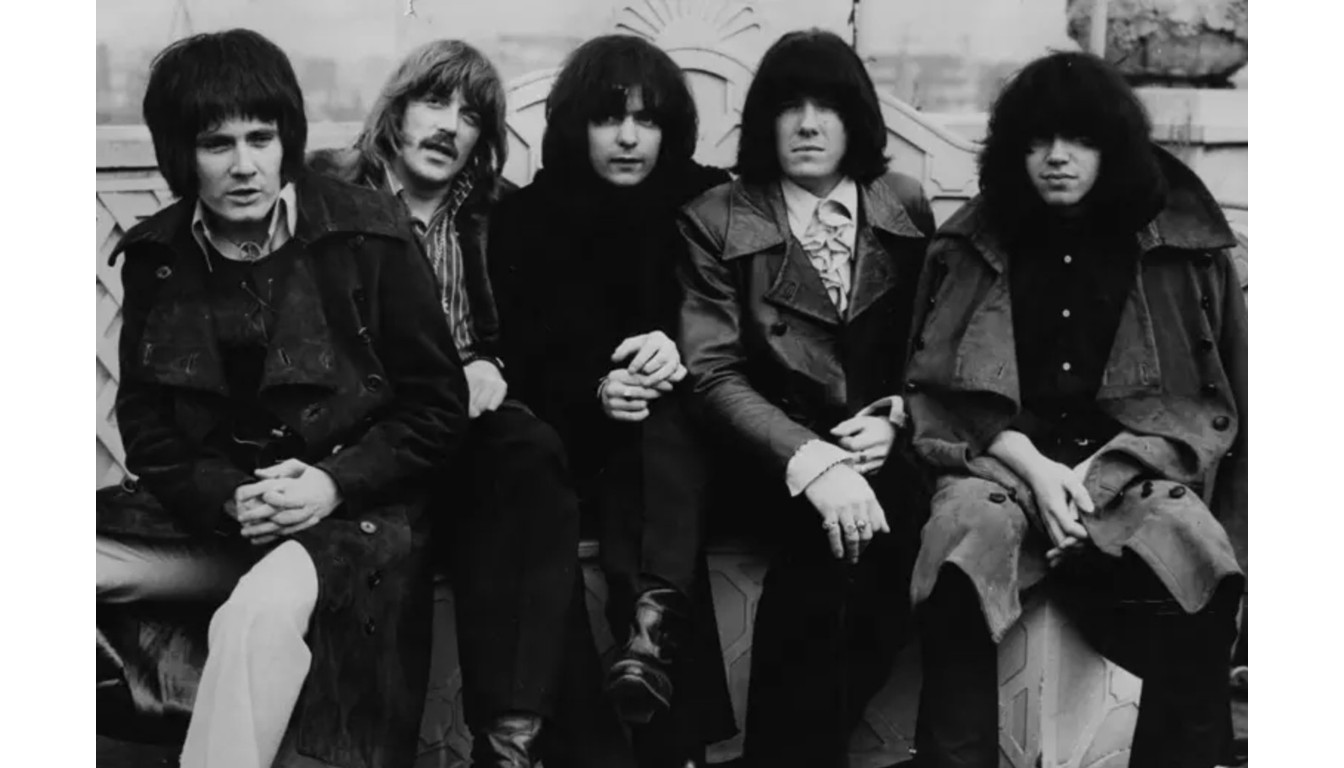
Harvest Records was founded in June 1969 as a subsidiary of EMI Records, to focus on the underground music scene, or as the label’s executives saw it, artists playing the college circuit. Its first order of business was to sign some of its parent label’s artists who fell under that category, and quickly release material they have already recorded. The first album on Harvest Records was released the same month, by a band that embodied the spirit of its fledgling label.

Deep Purple – The Book of Taliesyn
1969 was a pivotal year for Deep Purple. Considered an underground band when they started performing in 1968, its members took pride in their high level of musicianship. On one of their early performances at the Roundhouse club in London, Mick Jagger of the Rolling Stones was in the audience. When the band later heard that Jagger was not impressed with their performance, they replied defiantly, “It’s the day he says he is impressed when we need to be worried.”
In 1969 Deep Purple recorded and released multiple albums and singles and went through a lineup change that set them on a new direction at the turn of the decade. In June of 1969 the band had the honor of having their name on the first release by Harvest Records. The Book of Taliesyn, their second album, had already been recorded in August 1968 and released in the US in October that year, but British audiences had to wait eight more months to see it in local record stores. Named after a 14th century book of Welsh poetry, it follows the structure of their debut album Shades of Deep Purple, with half of it consisting of American songs covers. Two of them were released as singles: Niel Diamond’s Kentucky Woman, and River Deep, Mountain High, originally performed by Ike & Tina Turner.

Cashing in on the success of their first single ‘Hush’ in the US, the band was scheduled to tour North America in October 1968. Their US record company Tetragrammaton asked for a second album to promote during the tour. Coming up with sufficient material for a new album only three months after the release of their debut, while touring extensively, proved difficult. Still, the sophomore album contains a few original gems. Although their early singles were all cover songs, the band was getting better with writing original material. Bass player Nick Simper said: “The creativity was sparked by the interaction between five musicians who really worked well together. We were at our most creative when we sat down and wrote as a group.” The album was recorded with the same production personnel as the first – Derek Lawrence as producer and Brian Aintsworth in the sound engineer seat. A generous advance from Tetragrammaton allowed the band to book two weeks at De Lane Lea Studios in Kingsway, London.

One of the songs on the album, Anthem, shows the direction the band will take in 1969. In an interview with Beat Instrumental magazine keyboard player Jon Lord said: “I suppose you could say we’re playing symphonic rock. We’re classed as an underground group, in the States specially. But different in that we were a Top Forty group first, then went underground.” Anthem, composed by Lord to lyrics by singer Rod Evans, features his distinct organ style and is unique in the band’s repertoire for featuring the mellotron. Just before the three-minute mark the track switches to baroque-influenced melody, arranged by Lord. He once said this of Bach’s music: “Bach proved that mathematics can have emotion. His talent was in service not of science but of the human heart.” This was not the last time Jon Lord used Bach-like arrangements. Later in the 1970s the celebrated Baroque composer was an influence on parts of well-known tracks like Highway Star and Burn.
New Musical Express magazine reviewed the album in their May 1969 issue favorably: “Musicianship is high, especially the organ playing of Jon Lord and the lead guitar work of Ritchie Blackmore. Only seven tracks, but long and well-thought-out ones.”
Deep Purple
Returning to London in January 1969 after touring the US, Deep Purple were ready to resume recording at De Lane Lea Studios. Their first task was to come up with another single. Ritchie Blackmore contributed a wah-wah-heavy guitar lick to a song that Rod Evans penned after Emmaretta Marks. His muse sang with Al Kooper’s The Blue’s Project before joining the Broadway production of Hair, where she was part of the ‘Black Girl Trio’, performing the song ‘White Boys’ in costumes mimicking the aesthetics of Diana Ross and The Supremes. Jon Lord remembers meeting her during their tour of the US in 1968: “She was in Hair in New York, astonishingly attractive to me, a young Leicester lad in the land of beautiful women. I was sitting and talking to that woman only to be blown out by Rod Evans who was far more cool and handsome than I could possibly be. When Ritchie came up with the opening riff, Rod decided to write lyrics about Emmaretta.”
Emmaretta was released as a single early in 1969 ahead of their third album. New Musical Express wrote this in February 1969: “A self-penned item, it’s a thick hard-driving r-and-b sound, with a spirited solo vocal, some startling wowing guitar work and thundering drums. The standard of musicianship is unquestionably high, and Deep Purple’s fire and urgency has a rawness and vitality that are difficult to resist.”
The band continued recording their next album during the first three months of 1969. Producer Derek Lawrence talked about each of the band members: “Paice was very easy to get on with, a very young but brilliant drummer and the most organized. Simper could be very miserable or funny, the kind of guy who always wanted what you had ordered in the cafe! Evans was more interested in how he looked. Jon was the trained musician who was everyone’s friend. Ritchie was the driving force, a practical joker and wind-up merchant and a unique guitar player.” One of the sounds Jon Lord was after required innovative thinking in the studio. Lawrence: “The thing I remember most was putting four screens around the organ’s Lesley speakers and lining them with tin foil to try and get a more biting sound!”. Summing up his recollection from the period he produced Deep Purple’s early albums in the late 1960s, the producer said: “The third album is my favorite simply because the guys had been together longer and were tighter.”

This time the album included only one cover, and a fantastic cover it was. Lalena was written by Donovan and was recorded during the sessions that produced his album The Hurdy Gurdy Man. It was released as a non-album single in September 1968. Donovan talked about the inspiration to this wonderful song: “I was fascinated with The Three Penny Opera as a socially conscious musical, so when I saw the movie version with Lotte Lenya I thought, OK, she’s a streetwalker. Women have roles thrust upon them and make the best they can out of them, so I’m describing the character Lotte Lenya is playing. I saw the plight of the character: ‘That’s your lot in life, Lalena/Can’t blame ya, Lalena.’
The back cover of Deep Purple’s self-titled third album includes this description of the song: “Donovan’s song done how we thought Donovan might have heard it. The only double tracking on this cut is the guitar passage at the end. The slightly ‘jazzy’ feel to the organ is a bow in the direction of Donovan’s Mellow Yellow days.”
The album’s crown achievement is another long track that demonstrated Jon Lord’s claim for Symphonic Rock and his interest in blending classical music with rock. The band described this piece of music well on the album’s back cover: “A sort of 3-part concert about the month of April. The first section is played by just Jon and Ritchie. Jon played piano and organ, and Ritchie played acoustic guitar (a rhythm pattern and a double tracked lead pattern) and electric guitar. The choir was added afterwards. Also Ian on timpani can be heard in the background. The second section is Jon’s orchestral description of April. The instruments used were: two flutes’ two oboes, cor anglaise, two clarinets, two violins, viola and two cellos. The third section is a treatment of the first section in a more ‘Purple’ way. As a whole we hope April hangs together as a personal evocation of a beautiful, but sad (to us) month.” Clocking at a little over 12 minutes, it was the longest and one of the most ambitious tracks the band ever recorded.
Even though promotion and sales in the UK did not compare to their success overseas, local reviews were again complimentary. Beat Instrumental wrote: “A good LP from Deep Purple showing exactly how talented this little-hailed group are, and where they stand musically. Studio facilities are used intelligently to create just the right effect, such as on Chasing Shadows where Ian Paice is heard playing drums, timbales, maracas, and cowbell, and on Fault Line where the drum and organ track is played backwards to give a volcanic feeling. The album finishes with one of the group’s more ambitious ventures to date, a three-part concert depicting the month of April. Strings, oboes, clarinets, flutes, and cor-anglais all brought into play before Purple revert to their more usual sound. All in all, a worthwhile record which takes several plays to be fully appreciated.” Another magazine singled out Lalena and April and summed it up saying, “Yet another tasteful and beautifully produced album from Deep Purple which only serves to deepen the mystery of why they are still unrecognized in Britain.”

The album was released in the US in June 1969, three months ahead of the UK. It featured another eye-catching cover, this time showcasing a panel from Hieronymus Bosch’s painting The Garden Of Earthly Delights, dating back to 1599. The panel depicts Hell or The Last Judgement. Interestingly, a different panel from the same painting was used just two years earlier on another wonderful album, Pearls Before Swine’s debut One Nation Underground.
Another American tour preceded the release of Deep Purple. It started showing a large rift between members of the band. I’ll spare you the well-documented details that led to the departure of Rod Evand and Nick Simper from Deep Purple. Unfortunately, most of what you find written about the original lineup of the band is that separation instead of celebrating the great music they made together. Long story short, as of June 1969 Deep Purple MK II was born, and their first recording was the non-album single Hallelujah. Released in July of that year with part 1 from April as its B-side, it flopped despite the commercial spin the band tried to put on it to get a quick hit with the new formation.
Concerto for Group and Orchestra
The first album by Deep Purple’s new lineup was recorded on the 24th of September 1969 at the Royal Albert Hall. This was Jon Lord’s magnum opus, a glorious opportunity for him to showcase his ability to blend classical and rock music, backed by a bona fide orchestra and conductor. Lord was contemplating the idea of performing with an orchestra for some time before Deep Purple’s manager, Tony Edwards, went ahead and booked the Albert Hall. With less than six months remaining, Lord had a monumental task on his hands: writing a full concerto for rock band and orchestra while keeping a busy touring schedule. He said of that time: “I used to come home from a gig anytime between one and four in the morning and sit down with the manuscript and a huge pot of coffee and write until dawn. The time schedule was very short, especially as it was my first stab at this kind of thing.”

The seeds of Lord’s idea of the concerto were planted early in his musical life when in 1960 he enrolled at the Central School of Speech and Drama in London. He recalls: “Within six months of being at Drama School, I’d met a Dutchman who played the clarinet for fun and we used to play together. By the end of the first year I’d formed a jazz group with piano, bass, drums, and clarinet. We played weird modern jazz.” One of Lord’s heroes in the jazz world was pianist Dave Brubeck, who impressed the young organist with his clever arrangements and experimentation with time signatures.
Lord later heard Brubeck’s milestone 1961 collaboration with Leonard Bernstein on the album ‘Bernstein Plays Brubeck Plays Bernstein’. The first side on that album featured Brubeck’s jazz combo and the New York Philharmonic Orchestra conducted by Bernstein performing Howard Brubeck’s composition ‘Dialogues for Jazz Combo and Orchestra’. The idea of putting together on a live stage a rock band and a full orchestra was quite novel in 1969. While there were prior wonderful studio recordings, including The Moody Blues’ ‘Days of Future Passed’, a live attempt was a new frontier (unless we count the 1968 live recording ‘Three Pieces for Blues Band and Symphony Orchestra’ by the Chicago Symphony Orchestra and the Siegel–Schwall Band, an avantgarde piece which was unlikely an influence here). The Nice’s collaboration with the Sinfonia of London for the album ‘Five Bridges’ was still a month into the future after Deep Purple’s performance.

The project got a major boost when one of England’s major classical composers, Malcolm Arnold, decided to join. He was contacted by Deep Purple’s publisher Ben Nisbet, who said he had, “an enthusiast of his work in his office who wanted him to conduct a piece of music he had written.” To Arnold’s credit, after looking at an early draft of Lord’s score, he accepted the offer. He later said: “I met Jon Lord, listened to what he had written so far, and knew right away that it was extraordinarily good.” Arnold’s favorable view of the written music and the idea of bringing together the rock and classical worlds, were a critical milestone for the project. Lord acknowledged this: “Had Malcolm said it was crap, it would have been dead in the water. I never met a more open, giving musician. I’d send him a few pages, get a letter back saying, ‘Fabolous stuff, keep going lad.’” Still, this was a composition written by a musician novice in the art of notation and arrangements for sections of classical musical instruments. Jon Lord was humble about his efforts at the time: “The first trap I fell into was to write every page for every instrument; you put them all in, everyone playing right from A to Z, which is of course stupid. The next trap I fell into was sectional. I thought in terms of one instrument being used, then the next. The idea is to integrate. That really is the art of orchestration, which I learned a lot about from the concerto. If I were to sit down and write it again, there are some things I would change quite considerably.”

While Lord was focused on the concerto, other band members were in a different space musically. Richie Blackmore saw the future of the band’s new incarnation in heavy rock music. New material written by the band for their next studio album proves this direction clearly, evidenced by the tracks they started recording in October 1969 for their milestone album In Rock, released in 1970. Blackmore discussed this in a 1979 interview for Sounds magazine: “I was not into classical music then. I was very moody and just wanted to play very loud and jump around a lot. I couldn’t believe we were playing with orchestras. In 1969 we went into the classical stuff because it was Jon Lord’s big thing to write a concerto for group and orchestra. He was very sincere, but I didn’t like playing it. The orchestra was very condescending towards us, and I didn’t like playing with them.” But Blackmore went along with the project, hoping for success with their forthcoming rock album: “In 1970 I said, ‘right, we’re going to make a rock and roll LP. If this doesn’t succeed, I’ll play in orchestras for the rest of my life’”. After the release of In Rock, Blackmore did not have to worry about orchestras.

About that cold welcome by the orchestra, singer Ian Gillan had similar feelings, but he also talked at length about how Malcolm Arnold handled that difficult situation: “There was very lackluster effort by the Royal Philharmonic Orchestra, which prompted our conductor to stop all resentment in a no-nonsense manner that quite shocked us. Increasingly irritated by their attitude, half-way through the first movement, he rapped his baton furiously, raised his hands in the air and said words to the effect of, ‘I don’t know what you think you’re doing. You’re supposed to be the finest orchestra in Britain, and you’re playing like a bunch of cunts. Quite frankly, with the way it’s going, you’re not fit to be on stage with these guys, so pick yourself up and let’s hear some bollocks. We’re going to make history tonight, so we might as well make music while we’re doing it’.”
Jon Lord, much more emotionally invested in this project, had a different perspective: “I would say about five percent of the orchestra didn’t enjoy themselves, just a few of the older members. There were some bits which were actually very difficult. The sort of thing a guy in a group could play standing on his head because he’s used to syncopation – being just that little bit ahead of the beat. Whereas an orchestra man can only read the dots on the page.”
Bassist Roger Glover, only three months in the Deep Purple lineup at the time, was thrilled by the whole experience: “None of us read music, so our manuscripts consisted of ‘wait for the silly tune, watch Malcolm and count to four.’ It was awe-inspiring. I’ve never seen so many musicians in one room before.”

The concert on September 24th 1969 was titled ‘Gala Charity Concert in aid of Task Force’, and was divided into three sections. The first featured Malcolm Arnold conducting the Royal Philharmonic Orchestra, performing his 6th symphony, which he premiered two years earlier. This was followed by Deep Purple performing three songs: Hush, Wring That Neck and a new track to be released on ‘In Rock’, the now-classic Child In Time. The night concluded with the main event, a performance of ‘Concerto for Group and Orchestra’, composed by Jon Lord for orchestra and a rock band. In the best tradition of a concerto, it was divided into three movements:
First Movement: Moderato – Allegro
Second Movement: Andante (featuring lyrics sung by Ian Gillan)
Third Movement: Vivace – Presto
New Musical Express magazine raved about the concert, writing, “At the end of the opus the audience went wild. It was an act of spontaneous pleasure, the like of which I haven’t witnessed since England won the World Cup. This wedding may not prove easiest to consummate, but take it from me, there’ll be no divorce.” In contrast, classical music critic Noël Goodwin wrote, “The alliance of pop and symphony last night leaves me with one recommendation: Divorce by consent.” The each their own.
Here is the second movement, featuring Ian Gillan:
The album was released in the US in December 1969 and a month later in the UK. Reviews in Beat Instrumental magazine were in favor of the genre-blending experiment. One review called it, “One of the most exciting musical events of the year”, describing the audience reaction: “A full house of a strange mixture of hard-rock fans, classical buffs and all shades of musical opinion in between gave this work an incredible reception. At the finish, the stamping feet and the rapturous applause of the audience was deafening.” It summed up the concert in the best manner possible: “From the musical point of view this is very difficult to assess, and impossible to criticize. It is purely a matter of personal taste, and really up to each individual to judge whether it worked or not. The only thing one can say is: give the record an unbiased listening, and don’t pass any hasty judgments.”
Perhaps the most striking words about the Concerto have been said by Malcolm Arnold in 1970. Not many rock bands can put a quote like that by a classical composer on their resume: “What strikes me about this pop group is their tremendous musical integrity. This is so refreshing in a commercial world. I loved working with them. They’re thorough musicians.”
Sources:
The Book of Taliesyn and Deep Purple, 2000 remastered CD booklets
Concerto For Group and Orchestra 2002 remastered CD booklet
Malcolm Arnold and Jon Lord: ‘Concerto for Group and Orchestra’ and ‘Gemini Suite’ by Vincent Budd
Leave a Reply