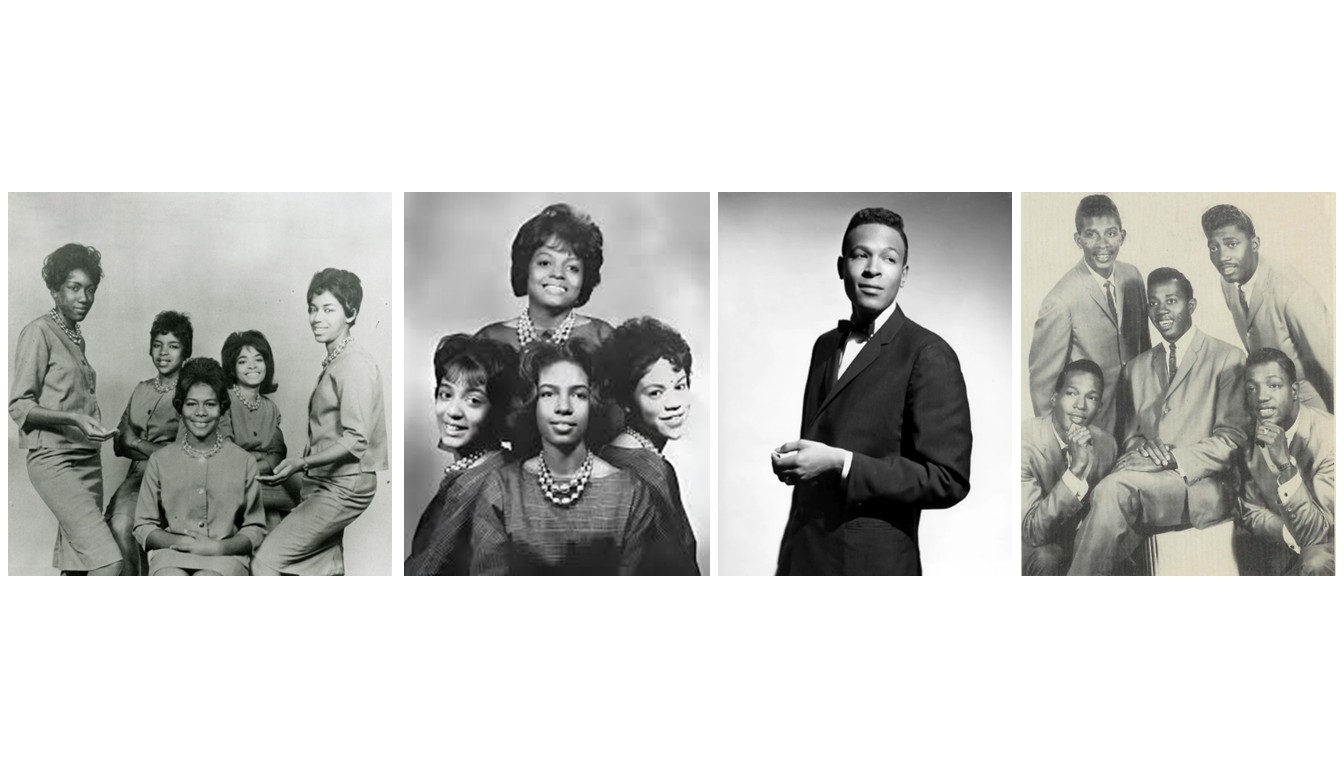
1961 was a year of beginnings for some of Motown’s best-known artists. We will cover three of them here, none able to produce a hit with their first efforts that year. We end with Motown’s first song to reach no. 1 on Billboard’s Top 100 chart by the label’s first great girl group.
The Supremes – I Want a Guy
Berry Gordy remembers the day he first met the girls who later became Motown’s most successful 1960s artists: “I was passing through the lobby when Robert Bateman was auditioning four girls singing an a cappella version of the Drifters’ ‘There Goes My Baby.’ The whiny voice of the girl singing lead caught my attention. She was on the skinny side with great big eyes and a lot of self-confidence.” At the time, the group was a quartet called The Primettes, and their lead vocalist was named Diane Ross. They were still attending high school as seniors, and Gordy, impressed with their singing, insisted that they graduate before signing them to a contract with Motown Records in January 1961. By that time, after a lineup change, they consisted of Diana Ross, Mary Wilson, Florence Ballard and Barbara Martin. Gordy suggested that Diane will change her name to Diana, and asked for a new name for the band. Many names were suggested, as Diana Ross remembers: “Florence just grabbed ‘the Supremes’ because it wasn’t Primettes or Marvelettes or any other kind of ‘ette’”. A legend was born – The Supremes, or as Gordy liked to call them, “the sweethearts of Hitsville.”

Two months later the Supremes released their first single for the label. ‘I Want A Guy’ was written by Berry Gordy (who also produced the song), Brian Holland and Freddie Gorman, who remembers: ”Diana heard me playing the song one day in the studio and she said she wanted to record it. Berry agreed to it. Later, I walked into the room where they were rehearsing it. Diana was seated at the piano with Brian, and the other girls gathered around her. They had to stand. That’s when I knew who was boss.”
The song opens with Ondioline (an early electronic analog keyboard) played by Berry Gordy’s then wife, Raynoma Liles Gordy. The song features contributions by members of Motown’s house band, the legendary Funk Brothers: James Jamerson on bass, Benny Benjamin on drums, Thomas “Beans” Bowles on flute, Eddie Willis and Joe Messina on guitar.

Like other singles The Supremes released in the first few years after signing to Motown, ‘I Want A Guy’ barely sold and did not make a dent in the charts. The Supremes joked among themselves that the record sold three copies, and they were the ones who bought them. The Supremes were making $40 a week, split even between the four members of the group.
Marvin Gaye – Let Your Conscience Be Your Guide
Berry Gordy also remembers the moment he first met another artist that made the label famous. It was December of 1960 and Motown hosted a Christmas party at its studio. His sister pointed to him someone playing on the piano. He recalls: “I saw this rather boyish, slim, handsome guy. Sitting at the piano, gracefully stroking the keys in an almost melancholy fashion, he appeared to be deep in thought.” Learning that his name is Marvin Gaye, and he’s been singing with Harvey and the Moonglows but wants to go solo, Gordy became interested. He sat next to Marvin Gaye on the piano bench. He continues: “Over the party noise I could hear the soft, jazzy melodies he was weaving. There was a warmth and a sadness in the music that made me feel good.
“Berry Gordy,” he said softly, “how you doin’, man?”
“Fine. I heard that you’re a really good singer.”
“I’m okay.”
Okay indeed. Marvin Gaye told his own version of that fateful encounter: “I tried to be cool, so I kept playing, really softly. Then he asked me if I’d do something for him, and without missing a beat, I gave him a real dreamy version of ‘Mr. Sandman’, the song made popular by the Cordettes, only I slowed it down and put more soul into it.”

At that point in his early career, Marvin Gaye wanted to be a crooner and sing standards from the American Song Book like Nat King Cole or Frank Sinatra. When it came time for his first recording session with Motown, Gaye picked songs such as My Funny Valentine, Love for Sale and How High the Moon. Another song, ‘Let Your Conscience Be Your Guide’, was written by Berry Gordy and was selected to be released as Marvin Gaye’s first single for the label. Unfortunately Gordy, who wrote some of the label’s big hits, flopped on this one. Like the Supremes’ debut effort, the ill-fated single made no dent in the charts. Gaye later said: “I was eager to do anything just to be recording, but I got a real lemon to get things going. Here’s someone who’d written ‘Shop Around’, ‘I’ll Be Satisfied’, ‘Lonely Teardrops’ and ‘Reet Petite’, and yet I wound up with ‘Let Your Conscience Be Your Guide’. In all fairness, maybe it was me. Maybe I didn’t do a good job.”
The Temptations – Oh Mother of Mine
We mentioned the Primettes, who later became the Supremes. They were the sister band to a successful Detroit band called The Primes. Members of The Primes and The Distants, a friendly local rival band, would go on to form one of Motown’s most successful bands. Gordy recalls his introduction to members of the band: “I might have seen Otis Williams, Melvin Franklin and Elbridge ‘Al’ Bryant when they were with the Distants or Paul Williams and Eddie Kendricks in the Primes. But what I remember is seeing them together for the first time as the Temptations when they were auditioning for Mickey Stevenson at Hitsville.”

Otis Williams recalls meeting Berry Gordy for the first time while he was singing with The Distants: “We were at a disc jockey record hop, St. Stephen’s Community Center. At the same time, The Miracles were hot with their first million seller, ‘Shop Around.’ We were doing the record hop together, and Berry was coming in with the Miracles. He saw us onstage and how the crowd was reacting to us. We had to go to the Men’s room. That’s when he approached me: ‘Say, I’m starting my own company, and if you guys should ever leave were you are, come see me.’”
At the time of that audition in March 1961, the group called itself The Elgins. Realizing that the name was already taken by another group, they changed their name and The Temptations were born. Gordy talked affectionally about all the band members and their early single with the label: “I loved their sound and told Mickey to sign them immediately. I loved the old raw songs they had, like ‘Oh, Mother Of Mine,’ which became their first record. Those songs didn’t become big hits, but boy—did I love ’em. The Tempts epitomized tall, dark and handsome, standing over six feet, each a distinctive personality. With Paul’s emotionally charged, heart-stopping baritone, Melvin’s warm, deep, rich bass, Otis’s smooth, textured vocal blend, Eddie’s lilting falsetto and the powerful, versatile tenor of David Ruffin, who replaced Al Bryant, they created some of the greatest sounds. Later they would also be known for their incredible showmanship, fancy footwork and dazzling wardrobe.”

Mickey Stevenson, Motown’s Artist and Repertoire manager, remembers how impressed he was at that audition by how well all members of the band could sing. Two months later he took them into the studio to record their first song with Motown. ‘Oh, Mother Of Mine’ was written by Otis Williams and was one of the songs they performed at the audition. Paul Williams and Eddie Kendricks split the lead vocals, with Eddie Kendricks, Melvin Franklin, Al Bryant and Otis Williams singing background vocals. The song, in the style of popular late-1950s upbeat doo-wop hits, left no mark on the charts. Like the Supremes and Marvin Gaye, the Temptations’ early beginnings were not rosy. That would, of course, all change dramatically as the 1960s progressed.
The Marvelettes – Please Mr. Postman
While 1961 was a lukewarm year for Motown Records as chart success goes, the label was able to score one major national hit in August that year. A few months earlier Berry Gordy was nervous. Motown was not doing well financially. After releasing over 40 singles in the previous two years, he only saw success with ‘Shop Around’ by the Miracles in 1960. Gordy desperately needed another hit. He picks up the story: “At the next Friday meeting I found one. It was called ‘Please Mr. Postman,’ a cute, catchy little tune by a brand-new group called the Marvelettes—Gladys Horton, Georgeanna Tillman, Wanda Young, Katherine Anderson and Juanita Cowart. The record was produced by a new team, Brian Holland and Robert Bateman, under the name ‘Brianbert.’”

When they auditioned for Motown, the young girl band called themselves the Casingettes (after they all humbly agreed they ‘can’t sing yet’). Katherine Anderson recalls: “Berry Gordy was the one who told us to come up with an original song. Berry said, ‘These girls are good, but do they have their original material? You can come back when you have your own original material.’” Georgia Dobbins quickly wrote lyrics to a blues melody written by her school friend William Garrett: “I was standing by the window. I was waiting for the postman to bring me a letter from this guy who was in the Navy. That’s how I came up with the lyrics. Then I made up the tune.”
Unfortunately, the song’s lyricist was not able to enjoy the group’s ensuing success. Georgia Dobbins tells the story: ”When it came time for the contract, I presented it to my dad and he hit the roof. He asked my mother, ‘How long has this girl been singing?’ When my dad wouldn’t sign the contract, it was just like somebody had snatched the rug from up under me. You’ve got your little dress and your shoes laid out, and you’re ready to go to the party, but Daddy said, ‘No, you ain’t going.’”

‘Please Mr. Postman’ was given to Motown’s new production duo Brian Holland and Robert Bateman, nicknamed Brianbert. They made some adjustments to the song in order to fit it to Gladys Horton’s voice and also arranged the background vocals. Georgia Dobbins was replaced by Wanda Young, and after a full day of recording they had the song in the bag. Marvin Gaye played drums.
Brian Holland, who would go on to write some of Motown’s biggest hits (Stop! In the Name of Love, Baby Love, Heat Wave, Baby I Need Your Loving), remembers well the song’s early success: “I was so elated when I first heard it on the radio. The Black stations first started playing it. Then it became so popular, on CKLW—that was a big fifty-watt station at that time; it was the biggest station—they started playing it. That’s when it erupted. It became huge. I mean, that was the most exciting time for me as a songwriter to hear that song on the radio. Can you imagine?”

‘Please Mr. Postman’ became Motown’s second million-selling record after ‘Shop Around’, and more importantly – its first number-one crossover pop hit. No small fit in 1961 for a fledgling black label promoting black artists. Ironically, compared to the first three artists covered in this article, who started with lukewarm singles and then rose meteorically to stardom, the Marvellettes started at the top but were never able to repeat that feat again.

Leave a Reply