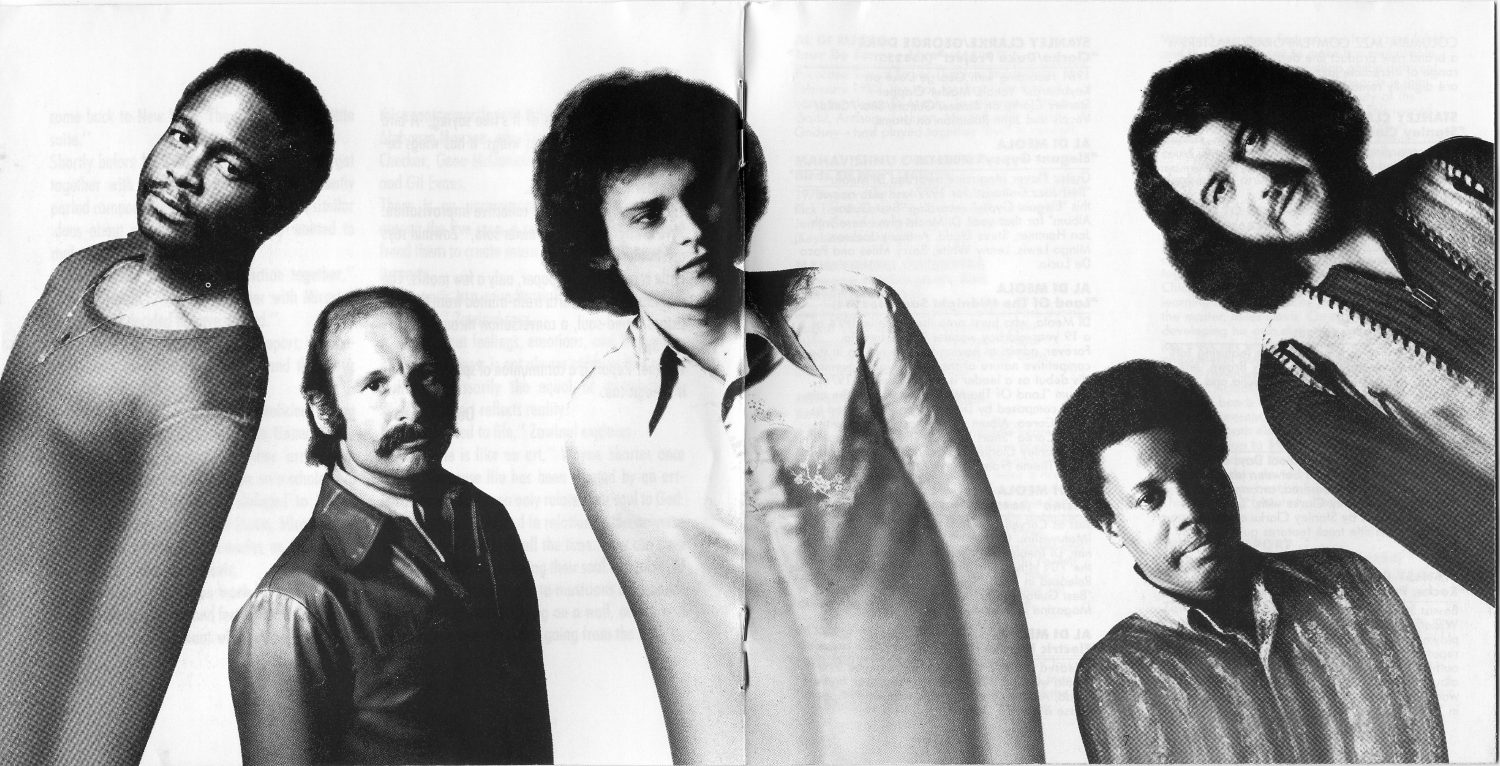
Joe Zawinul remembers the first time he paid attention to Wayne Shorter’s compositional skills, when the gifted sax player was part of Miles Davis’ classic 1960s quintet. This was back in 1967: “I was in the basement of Bill Russell’s house – the basketball player – and he had a great stereo set-up. I had the earphones on and was listening to Nefertiti. It was something like what I had been doing before, structurally – away from all that eight bars shit and then you go to the bridge. The music flowed. That was a real spark.” Wayne Shorter wrote three tunes on that album, including the title track, a unique modern jazz composition in which the rhythm section improvises while the horn section repeats the melody continuously, thereby reversing the role of these sections.
1970 was a busy year for the three founders of Weather Report, with all members of the future group releasing albums and collaborating with each other. Bass player Miroslav Vitouš released the album Infinite Search, featuring stellar performances by Joe Henderson, John McLaughlin, Herbie Hancock and Jack DeJohnette. He also recorded tracks for his album Purple with Joe Zawinul on electric piano. Wayne shorter released two albums on the Blue Note label, Moto Grosso Feio and Odyssey of Iska, with Miroslav Vitouš playing bass on the former. Joe Zawinul recorded the self-titled album Zawinul, featuring Wanye Shorter on one track. More about these albums in these reviews:
At the end of 1970 Miroslav Vitouš contacted Wayne Shorter with the idea of forming a band. Shorter brought Joe Zawinul on board, and one of the most important ensembles in the history of jazz rock was born. A short announcement in Downbeat Magazine’s December 10th 1970 issue read: “After nine years with Cannonball Adderley, pianist-composer Joe Zawinul is ready to go out on his own. On Dec. 15, the Vienna-born master of funk will leave the Cannonball Adderley group to become co-leader, with saxophonist-composer Wayne Shorter and bassist Miroslav Vitous, of an as yet nameless quintet.” In addition to the three founders, the band was rounded up with the young drummer Alfonse Mouzon, who has worked with Roy Ayers and recorded with Gil Evans, and recently participated in Wayne Shorter ‘s album Odyssey of Iska.
Joe Zawinul recalls the first rehearsal of the yet nameless band: “We never talked about a concept. We went down into the studio the first time – Billy Cobham (Alphonse Mouzon was unavailable), Wayne, Miroslav and myself – and made a tape. Immediately we knew that that was gonna be it. That was really an experience. When Columbia heard we had a band, the machine started rolling.”
The band did not stay nameless for long. The three founders wanted a universal name that everyone can relate to. Zawinul: “We were in my apartment in New York – Miroslav, Wayne and I – trying to find a name which would say something, especially what people had in their minds all the time. We were thinking about Daily News, but that didn’t sound good. Thousands of names – Audience, Triumvirate, all kinds. Suddenly, Wayne popped out Weather Report, and we all said, ‘That’s it!’” Zawinul explained why the simple name attracted them: “What the music does to people is also what the weather does to people. It doesn’t really make that much difference to me if it rains or the sun shines, I can be happy either way; but most people, I think, make up their way of living by what’s happening out there when they look out the window in the morning—or even by the report at night.”

On May 25 1971 Weather Report performed for the first time, at a Columbia Records press event. The quartet was augmented by percussionist Dom Um Romao (a future full-time member of the band). Billboard Magazine covered the event, raving (although cryptically): “A musical unit was at hand, a unity which flowed throughout the studio and onto the street. There was a distinctive comment and plea, structure and chaos, understanding and questioning. There was a way of unity for musical genres of life, combining them to explain the parts.”
Weather Report’s debut album was released in May 1971, simply titled Weather Report. It was received enthusiastically by the music press, with Downbeat magazine dedicating an impressive two-page article to the album review. Dan Morgenstern wrote: “The music of Weather Report is music beyond category. All I can add is that it seems to me music unlike any other I’ve heard, music that is very contemporary but also very warm, very human, and very beautiful. The forecast, if there is justice, must be clear skies and sunny days for these four creative men and their associates.” Lester Bangs, not an easy critic to satisfy, wrote in Rolling Stone magazine in August 1971: “It’s all beautiful, lush, hypnotic, mostly quite soothing, but I can’t help feeling that something is missing. Like much of Pharoah Sanders’ recent work, all this lovely lyricism, this sensuous, sinuous, spiritual stuff can come to seem so entrancing, such an aural soma that it almost begins to seem like Muzak.” I’ll take that review, but leave Muzak far behind. I’d rather describe it as Joe Zawinul did at the time: “We always solo and we never solo.”

The album, a blend of atmospheric and energetic tracks, enjoys the rich sounds of many percussion instruments, starting a tradition of hiring stellar percussionists throughout the future history of the band. Let’s give it to the drummers. Zawinul said about Alphonse Mouzon: “When Wayne and me started Weather Report, I heard this guy, Alphonse Mouzon. Somebody told me that the guy was a tremendous sight-reader. Plus he could really swing, he played with Chubby Checker, he had a good background, a good solid background. And he played jazz, so, we checked him out. He played in a band at the Apollo Theater where I was playing my last gig with Cannonball. So Wayne and me decided we’d get Al Mouzon, and Al Mouzon was in the band for a little while, and he was very good.” Mouzon talked about his short but fruitful experience with the band: “We rehearsed so much that what we played was natural. It was spontaneous, continuous improvisation, which is good because it was fresh. Themes and motifs were brought to the sessions and we expanded and improvised on them, and we’d play them and play them. We could sound the same but different each time. Joe would tell me what to play, but I listened and played my own way. I just made it different. That’s why he loved me.”

The record also features the contributions of two percussionists. Airto Moreira, at the time with the Miles Davis band, and Barbara Burton, a symphonic and freelance percussionist hired by Wayne Shorter. Joe Zawinul on Airto: “He has the most uncanny ability to hear what you want. He doesn’t even have to rehearse with us. He didn’t. He just comes in and hears the music and he knows what to pick, where to come in. He’s incredible; he’s a natural talent.” Barbara Burton recalls the recording sessions: “I enjoyed the experience. I really went out of my way to come up with some interesting stuff, like the bubble effects on ‘Morning Lake’. I knew the music flowed, and I knew it was class A work. It was a chance to be creative, and I’m always looking for a chance to do something different and new.”
The back cover of the original LP includes the following words from Columbia Records’ President Clive Davis: “Together these gifted young musicians have created Weather Report, a soundtrack for the mind, the imagination, for opening up heads and hearts. The sounds caress, twist, tickle the ear…forests waking, wind rushing, wooden balls rolling, springs winding…island carnivals, birds in summer, love at dawn, murky madness, still water. Weather Report is not only about feelings and emotions – it is also about human reality.” Who knew businessmen could pen odes like this?

On to the music. The band decided to open the album with a track that conjures the feeling one is in outer space. ‘Milky Way’, as Wayne Shorter describes it, is “Coming from a vacuum — nothing into something. We’re on the outer edges of the milky way as seen from some all-seeing, mythical perspective, and then panning in and coming in closer, into the next cut and to humanization and reality.” The band founders saw some universal message in that opening musical statement. Vitouš echoed the imagery, saying the opening is, “as if you were sitting in a space ship, watching meteors flying by.” Zawinul summed it up: “It’s like a soundtrack to your mind. You can put yourself where you want; there’s enough room in space.”
Amazingly, the atmospheric track that sounds like an artifact of early electronic music, includes none of the machinery associated with that genre. Zawinul talked about the instrumentation: “Horn and acoustic piano — no electronics whatsoever. But I think it’s a new way of doing something with the pedals and with the saxophone.” In 1984 Zawinul expanded on how the band created the sounds on that unique track: “I silently held a chord down on the piano and had Wayne play an arpeggio of the same chord, blowing his saxophone right inside the piano at the soundboard. The tape recorder was started on the echo at the end of the sound, not when he was playing.”
Side one of the LP closes with one of my favorite Joe Zawinul compositions. Orange Lady was written while he took a trip with his family in Austria in 1967, a productive trip that also yielded the composition In A Silent Way. Zawinul: “I wrote ‘Orange Lady’ thinking mainly of my wife, but also of most ladies who have children and are stuck in a big city. There’s a certain sadness in it. In my case, in order to really make my wife happy, and make myself happy by making her happy, I’ll take her out somewhere in the country – that’s what the middle part is about – and then that changes the whole attitude and you can go on being happy for a while again, and then you come back to New York and it’s like the same thing all over again – it’s like a constant change from a certain sadness.”
Miroslav Vitouš contributes a wonderful bass part on this track. He remembers: “Orange Lady was such a beautiful melody. I said, ‘How about playing this in unison with the arco bass?’ I just picked up the bow and played the melody with Wayne.” The sax player explained how the arrangement changed when Zawinul brought it for the band to play: “It’s funny — Joe described that like a blues feeling, but he didn’t use the word having the blues, and that’s indicative of the change in what we’re doing. We dig the blues and all that stuff, conception-wise — but we cannot play something that’s been played before, because the change is calling to us. It’s a necessity.”
Zawinul added more context about what feelings he intended this piece of music to evoke: “I always write what I feel at the moment, and I think I had a lot of heart when I did that. In Orange Lady, happiness starts after a lot of sadness. It’s like going for a little holiday in the Islands after being in New York for a long time. You can hear the percussion of the happy second theme lingering on after we come back to the second theme. It’s like you still have the feeling of the Islands when you come back to New York. The piece is like a little suite.” Dan Morgenstern singled out the tune in his May 1971 Downbeat article: “I don’t want to discuss it in detail, but I would be amiss if I didn’t mention that there is, on Orange Lady, a unison melody statement played by Shorter and Vitous in which the bassist bows in a manner quite beyond description. And that’s just one of the many remarkable things Weather Report has to offer the listener.”
In December of 1971 the album won the Downbeat Readers Poll as “Jazz Album of the Year”. Many saw the album as a direct descendant of Miles Davis electric jazz explorations, most significantly the album In A Silent Way. In 1973 Joe Zawinul told Rolling Stone magazine: “I don’t think We’ve left Miles behind. We are just somewhere else. Another entity that grew out of him. He’s the father and we are the sons, and even when you are small and you stand on the shoulders of the father, you are going to see farther than he.”

Zawinul mentioned the album a number of times in subsequent interviews. In 1978 he told Downbeat: “I listened recently to a tape of our first gig, at Penn State in Philadelphia, about 170 people there. It was mean. It was Wayne, Dom Um Romão, Miroslav, Mouzon and myself – I just had a Rhodes. Incredible.” in 1984 he said, “The first record, Weather Report, was a feeling-out period. We had never played a live gig together before we recorded it. We did the album in three days, and our feeling was ‘What’s happening here? What is this?’ We knew we could improvise very well together, but it was not a very forward, or let’s say, a very powerful record; we were more laid back.”

Alphonse Mouzon, who left the band in the summer of 1971, added: “We were a jazz experiment. It was so open. I love that record, not because I am on it, but because it was so different — so refreshing.”
Album credits:
Wayne Shorter: Tenor and soprano saxophones
Joe Zawinul: Electric and acoustic piano
Miroslav Vitous: Electric and acoustic bass
Alphonse Mouzon: Drums, voice
Airto Moreira: Percussion
Barbara Burton – percussion (uncredited)
Don Alias – percussion (uncredited)
Sources:
Weather Report Annotated Discography
Downbeat May 1971: WEATHER REPORT: OUTLOOK BRIGHT AND SUNNY, by Dan Morgenstern


Leave a Reply