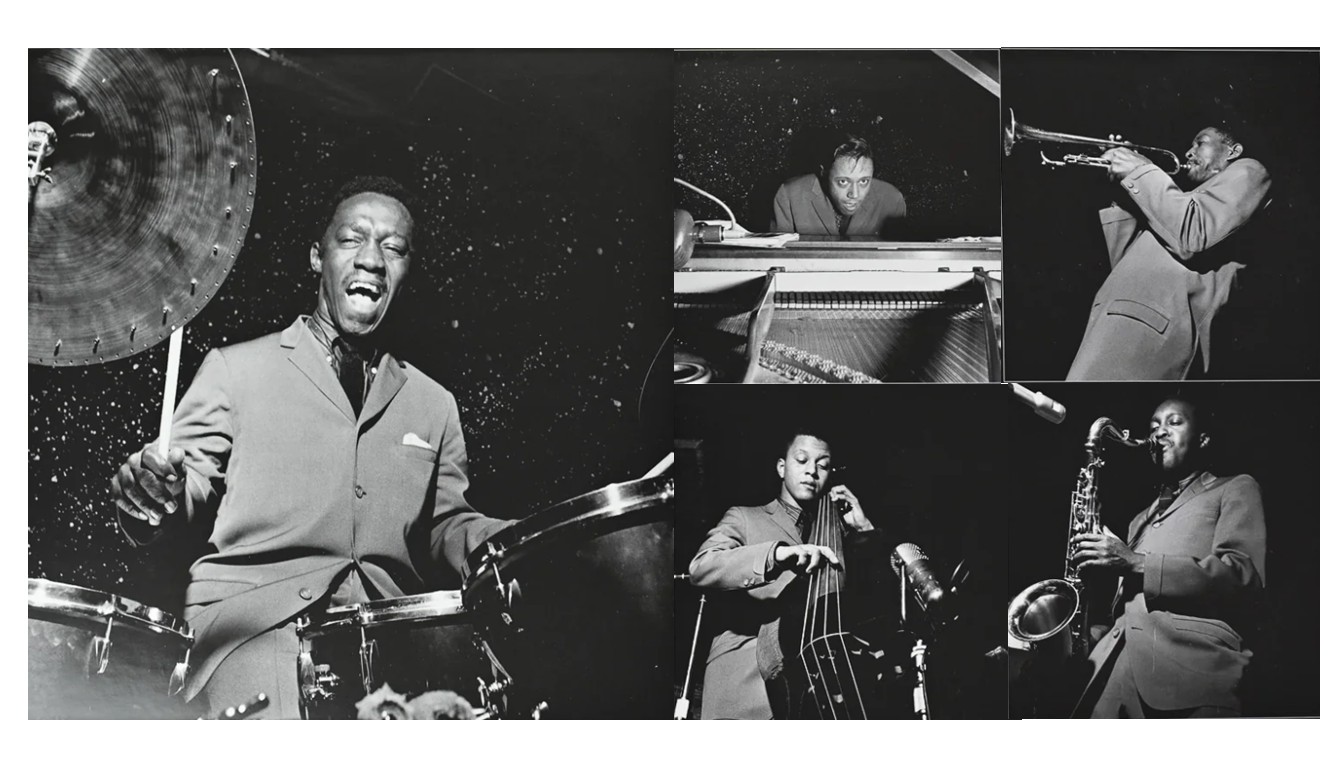
The first two articles in the 1955 jazz series are dedicated to artists who recorded for Blue Note Records that year. This episode focuses on a group of musicians who formed the first incarnation of the Jazz Messengers. The albums we will review here involve a number of recording sessions held at Rudy Van Gelder’s studio throughout the year with very similar lineups, eventually leading to the debut album by Art Blakey and the Jazz Messengers, one of the most enduring and influential jazz combos in the history of the genre.
1955 was a critical year for Blue Note Records. That was the year the label transitioned from 10” LPs, a format it started to ship in 1952, to 12” LPs. This meant that a single LP could now hold about twice the amount of music. The new 12” album series was labeled and numbered BLP 15xx, starting with BLP 1501. The first 12” albums Blue Note released in 1955 were compilation albums that contained music recorded in the late 1940s and early 1950s by some of its staple artists such as Miles Davis, Bud Powell and Thelonious Monk. The transition to the full-length LP aligned with the start of Blue Note’s golden years, a decade between 1955 and 1965 when it released all of its classic hard bop albums. Two key artists in 1955, who ushered the style that became synonymous with Blue Note, are Horace Silver and Art Blakey. While coming from the tradition of bebop in the 1940s, they realized that the style was becoming stale and repetitive in the 1950s. They were looking for ways to better connect with audiences.

Horace Silver commented on the importance of keeping the audience engaged in live situations: “In jazz you get the message when you hear the music. When we are on the stand and we see that there are people in the audience who aren’t tapping their feet and who aren’t nodding their heads to our music, we know we’re doing something wrong. We don’t want to go too far out. We want people to understand what we’re doing.” He was able to accomplish that by adding elements of blues, R&B, Latin and gospel music to his compositions. Hard bop ascended as bebop became less satisfying and innovative in the 1950s, and was a reaction to the more cerebral and arranged cool jazz, a west coast phenomenon that was very successful in the early 1950s.
Horace Silver and the Jazz Messengers
The five musicians that would end up recording as Art Blakey and the Jazz Messengers recorded together for the first time on November 13, 1954. Horace Silver, who led that session, tells the story: “I went into the studio three times to do trio recordings for Alfred. I used Art Blakey on drums for all three sessions, with Gene Ramey on bass for the first, Curly Russell for the second, and Percy Heath for the third. When Alfred asked me to do a fourth trio session, I said, ‘Alfred, if you don’t mind, I would like to use some horns on this session.’ He said, ‘Okay, who would you like to use?’ I said, “Kenny Dorham on trumpet, Hank Mobley on tenor, Doug Watkins on bass, and Art Blakey on drums.’”
A highlight on this recording session is the track Doodlin’, an early hardbop artifact that became Horace Silver’s first hit when released as a single. He tells one more story, this one Rated R for strong language: “The quintet was playing at Basin Street, and Miles came in. I had just written ‘Doodlin’,’ and we played it for the first time that night. Miles came up to me after the set and said, ‘Man, that tune Doodlin’ is so funky. If I was a bitch, I’d give you some pussy.’” The song was later covered by Lambert, Hendricks and Ross who famously performed it at the Newport Jazz Festival in 1960.
The recording session yielded four tracks that were released as a 10” LP titled Horace Silver Quintet Volume 3. Downbeat magazine reviewed the LP in June 1955, saying, “The quintet swings hard in this session with the best solo work by Silver and the long under-rewarded Dorham. It digs deeper than most into the emotional roots of all jazz, traditional or modern.” In the same issue, the album was played to clarinetist Tony Scott in a blindfold test. This is what he had to say about what he heard: “That’s a really swinging record. The main guys I can recognize are Blakey at the drums, definitely—so definitely! —Horace Silver at the piano, and the trumpet sounds to me like Clifford Brown as I last remember hearing him. The tenor man could be Hank Mobley. It’s a wonderful composition. Lots of spirit here, and everybody blows. I’d give this five stars.”

Blue Note, happy with the results, invited the quintet to record again on February 6, 1955. Horace Silver was able to surpass the success of the previous session, bringing to the recording studio what would become one of his best-known tunes. Amazingly, it was almost dropped from the LP release by Blue Note label heads Alfred Lion and Francis Wolff. Silver: “The day before the session, we rehearsed ‘The Preacher.’ Alfred and Frank said it sounded too much like Dixieland music. They suggested that we delete that tune and jam a blues in its place. Art Blakey pulled me aside and said, ‘Horace, there ain’t nothin’ wrong with that tune. You should insist on doing it.’ I went back to Alfred and Frank and told them I didn’t want to delete ‘The Preacher’ and jam a blues in its place. I suggested that we cancel the session until I could write another tune that they would like and then reschedule the session. They both went into a corner to discuss the matter and decided to let me record ‘The Preacher.’”
The second recording session with ‘The Preacher’ was released as another 10” LP, titled Horace Silver Quintet Volume 4. The two albums were the beginning of the first incarnation of The Jazz Messengers. After the band became a success, Blue Note released the two recording sessions as a single 12” LP in 1956 titled ‘Horace Silver and the Jazz Messengers.’

Horace Silver had nothing but compliments for his band mates, calling them, “The greatest band that I’ve ever played with—and I’ve played with some great ones.” He went farther to talk about the individual musicians. First, the horn section: “Kenny Dorham and Hank Mobley are two of the most underrated musicians in jazz. They worked so well together. They were both giants. They sure played some slick shit when they improvised. The way they phrased, and the lines they played, their harmonic knowledge was so beautiful.” Then the rhythm section: “Art Blakey is one of the great jazz drummers of all time. He and Doug Watkins and I used to lock in rhythmically and swing so tough that we’d inspire the horn players to greater heights. We were constantly kickin’ them in the ass rhythmically. With all that fire we were puttin’ up under their asses, they had to take care of business and cook. And they sure did just that.”
The band performed consistently throughout 1955 and played as a unit on a number of Blue Note albums. Silver said of that experience: “Some nights, we’d be cookin’ so tough it would seem like we were floating in space. I’ve never grooved with any group of musicians so consistently as I did with the Jazz Messengers.”
Hank Mobley Quartet
A month after Horace Silver’s second recording date, in March of 1955, four of the quintet’s members recorded another session, this time under tenor saxophonist’s Hank Mobley’s name. After playing over the previous two years on albums by Dizzy Gillespie, Max Roach and J.J. Johnson, this was Hank Mobley’s debut as a leader. The recording session consisted of Mobley’s original tunes and one standard, Love for Sale by Cole Porter. In later interviews Mobley said he considered this album the best of his early recordings. As opposed to a blowing session that was standard practice on many recording sessions, the musicians on this set spent a considerable amount of time preparing before going into the studio.
A Downbeat magazine review of the album questioned if Mobley, a good sideman, was able to sustain an album of his own. But it concluded that, “Mobley is certainly worth hearing, and so especially is that wailing rhythm section and the incisive solos by Silver. Because of Mobley’s warmth and beat, this LP came close to four stars, and is, in any case, recommended as a good example of one of the major approaches in modern jazz.”
Kenny Dorham – Afro-Cuban
Two days after the Hank Mobley session, three of its participants convened again at Rudy Van Gelders’ studio, this time to reunite with trumpeter Kenny Dorham for an octet recording of Latin jazz music. A key participant on this album is conga player Carlos “Patato” Valdes, fresh in NYC from Havana, Cuba. This is his first full-length recording as a sideman. A year later he would be teaching Brigitte Bardot the mambo in Roger Vadim’s classic 1956 film “And God Created Woman”.
This was Kenny Dorham’s first album as a leader for Blue Note Records. In September of 1955 Downbeat reviewed the album, writing, “Chief importance of this set is the playing of the long-neglected Dorham. Kenny has rarely sounded as consistently at inventive ease as on this set, and I hope the LP heralds the fuller arrival of Kenny into public recognition. Kenny has worked with most of the major modern jazz innovators, and has evolved into one of the better horn men in modern jazz, both with regard to sound and conception.”
A great tune on the album is Minor Holiday, written by Kenny Dorham after Minor Robinson, a trumpet player in New Haven. The tune was performed later in the year on the Jazz Messengers album At the Cafe Bohemia, Vol. 1 (read on for a review of that album). Dorham: “I tried to write everything so that the rhythm would be useful throughout and would never get in the way.”
Art Blakey and the Jazz Messengers at the Cafe Hohemia, vol. 1 and 2
Café Bohemia, on Barrow Street in Greenwich Village, started life under the name “The Pied Piper” in the 1940s, hosting jazz musicians such as Pee Wee Russell, Sidney Bechet and Mary Lou Williams. In 1949 the establishment was purchased by Jimmy Garofolo, who tried to run it as a bar and restaurant with girly shows. How it became a legendary 1950s jazz club is a story worth telling, as its owner relates: “One night I had to throw out a character who’d been drinking Brandy Alexanders without any money to pay for them. The next thing I knew, he was back offering to play a few weeks here to pay off his obligation – and because he wanted a regular home base from which to play when he was between engagements. Somebody told me his name was Charlie Parker and he was a saxophonist. I was pretty naive about jazz at the time and I didn’t know him from beans, but it turned out he was a big man in the jazz world. When I put out signs announcing he was going to play, I had a stream of people coming in wanting to know if the great Charlie Parker was going to play here. It was the way they said ‘here’ that got me.”

This was early in 1955, and Charlie Parker never actually played at Café Bohemia, for he died on March 12 that year. But he paved the way for many other jazz musicians to play there and release albums that were recorded at the club. Notable performers at the Bohemia in 1955 were Cannonball Adderly, who made his breakthrough in NYC after sitting in with Oscar Pettiford at the club, and the Miles Davis classic quintet with John Coltrane. One of the earliest recordings at the Bohemia to be released as an album took place on November 23, 1955. Actually, two albums: The Jazz Messengers at the Cafe Bohemia, Vols. 1 & 2.


Early incarnations of the Jazz Messengers started in the late 1940s, when Blakey led a group known as “Art Blakey’s Messengers” in his first recording session as a leader, for Blue Note Records. Blakey also led a short-lived group named “Seventeen Messengers” that quickly collapsed financially. The name went dormant until 1955, when the core group of musicians we reviewed so far, including Horace Silver, Kenny Dorham, Hank Mobley and Doug Watkins, gelled to a point when they realized they had a steady group in the making. Art Blakey recalls that early stage of the group: “Horace suggested that we call this the Jazz Messengers – which was beautiful. They made me the leader. I thank God for Horace, Kenny and the guys – they gave me a big push forward.”
The Jazz Messengers were consciously trying to distinguish themselves from other jazz acts of the day. Blakey had seen many jazz performances that were nothing more than glorified jam sessions. Musicians showing up in clubs, unrehearsed and looking shabby, playing endless solos and boring the audience. He wanted something different: “We thought the musicians should look better on the stage. We thought the jamming should be cut out. I don’t think that the jamming was fair to the audience. I think musicians should look like professionals, and I don’t think they should get on the stand and look like a bunch of bums. People see you before they hear you, and they ain’t paying for that now. Once in a great while you go to a jam session, and that’s what you expect, but you ain’t going to pay for that every night.”

The original line up of the Jazz Messengers can be heard only on two recordings: the Horace Silver recordings that we reviewed above, which was later released as a Jazz Messengers album, and the two albums that captured their performance at the Café Bohemia in November 1955. The first minute of “Art Blakey and the Jazz Messengers at the cafe bohemia, vol. 1” sets the stage for the ensuing music perfectly. Art Blakey, acting as Emcee, opens the first set with this announcement: ‘And at this time, ladies and gentlemen, for those who’ve come in late, we are now having a little cooking session for Blue Note right here on the scene—putting the pot on in here. And we’d like for you to join us and have a ball.’”
A couple of tracks stand out for me on this set, one from each of the volumes. The band plays “The theme” on the first album, a tune that became a standard show closer to many jazz performances, famously adopted and adapted by Miles Davis with his quintet. It is based on the chord changes of “I Got Rhythm”, but it is credited here to Kenny Dorham due to changes he made to harmonies and a new bridge. Along the piece you will hear quotes from other jazz standards such as “52nd Street Theme” and “Rhythm-a-ning”.
The second volume opens with the track “Sportin’ Crowd”, credited to Hank Mobley. This is another jazz standard that went through different titles as it was adopted by various musicians over the years. It started life in 1946 as “Royal Roost” (or an alternate title “Rue Chaptal”) when performed by Kenny Clarke and his 52nd Street Boys. Most famously, it resurfaced in 1956 as the title track on the classic album Tenor Madness by Sonny Rollins and John Coltrane.
Sources:
Let’s Get to the Nitty Gritty: The Autobiography of Horace Silver


Leave a Reply