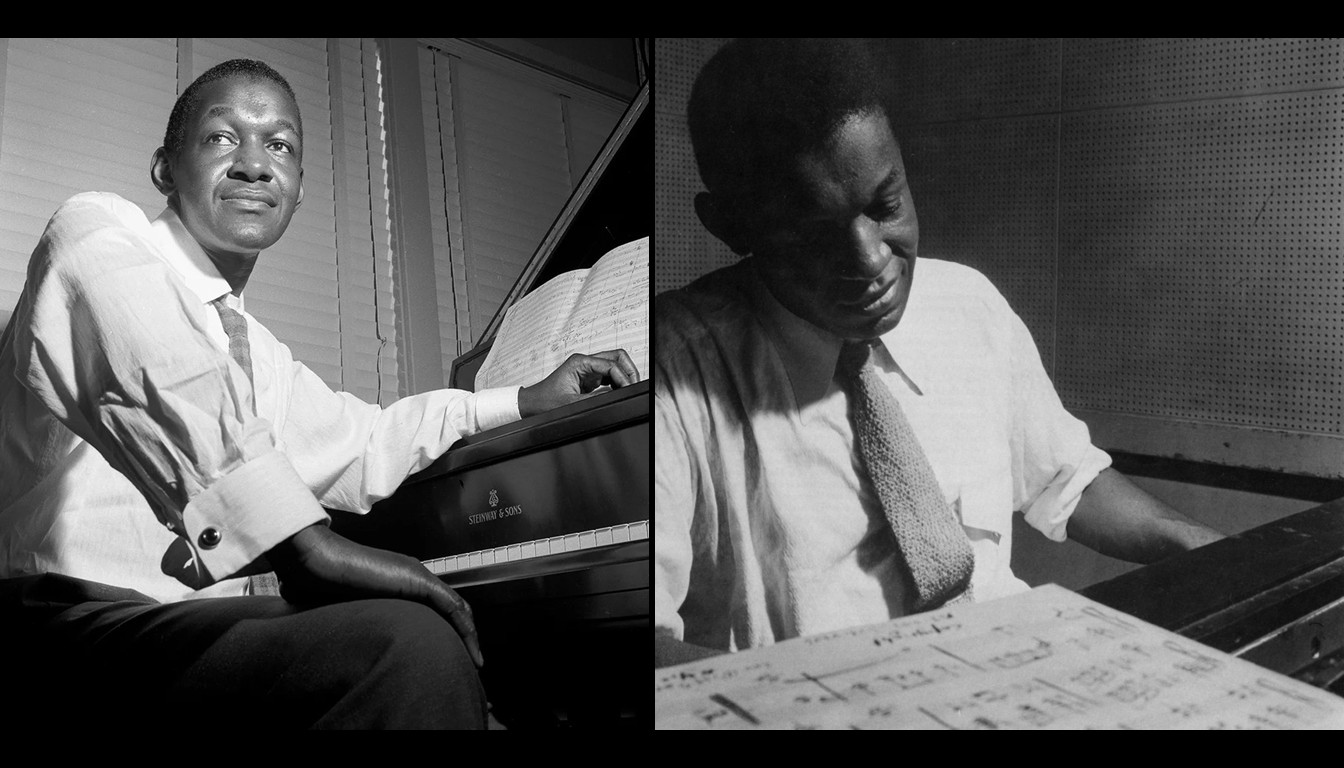
The second article in the 1955 jazz series about artists who recorded for Blue Note Records is dedicated to an unsung hero of modern jazz. Herbie Nichols, an innovative pianist and composer, has barely seen anything written about him during his lifetime. Most record labels stayed away from recording him, and the majority of his live performance opportunities forced him to accompany music stylistically far from the compositions he wrote. But 1955 was his shining moment, when Blue Note recorded him playing his music for albums under his own name. To date, almost all his recorded output as a leader comes from four sessions held in 1955 and one in 1956.

Herbie Nichols had a different conception of jazz compared to his contemporaries. You quickly get the sense that this is not your average jazz pianist when you read about his influences. While he mentions Duke Ellington and Art Tatum as greats in the jazz idiom, he talks extensively about classical music composers. He starts with some of the big names in Baroque and 19th century music: “I guess I’ve always had a burning desire and compulsion to compose. Ideas come from almost anywhere. Beethoven and Bach and Chopin are the strong music pillars which I lean on whenever I find myself in a dark corner.” He then continues with name-checking a 20th century composer not often cited by jazz artists: “Villa-Lobos‘ many compositions under the title Choros and Bachianas Brasileras are infinite fantasies which bear repeated listening. Whenever I want to become astounded, there is always his great piano work, Rude Poeme.” And then he concludes with some of that century’s most complex and innovative composers: “I listen repeatedly to Bartok’s delightfully brooding Sonata for Violin and Piano, No. 1, also to the Concerto for Violin and Orchestra. Stravinsky’s Firebird Suite and Le Sacre Du Printemps (The Rite of Spring) just about wind up the basic core of music I can never do without.”

These influences are evident in the jazz compositions that he brought to the Blue Note recording sessions in 1955. For years he was trying to get his music to be recognized, but other than sporadic recordings by other artists, his music, by and large, went unnoticed. Mary Lou Williams, another innovative musician, picked up on the uniqueness of Nichols’ compositions and performed a few of them on recordings she made for Atlantic Records. Nichols talked about the challenges he faced in finding live performance opportunities, and the strong stand he took about the music he insisted on playing: “The club owners used to think that I was too far out. I’ve actually had guys tell me they would hire me if I changed my style. Now I didn’t mind playing any style when I was working for somebody else. I think it’s good for a musician to be able to play more than one way. It gives you more things you can do in your own style. But if it’s going to be the Herbie Nichols Trio, then it’s going to be Herbie Nichols’ music.”
Part of the problem was finding musicians who could play the music Nichols was composing and arranging. His music, even for a minimal ensemble of three musicians, was meticulously arranged, as he commented: “Jazz has come a long way since the ‘stomp’. A lot of myths have been dispelled and we find countless master jazzists who are masters of classical music as well. Time signatures are altered freely nowadays. For instance, I am beginning to learn that certain tunes that I write cannot become alive, even for one chorus, unless I score the drum part fittingly. Specific suspensions and inversions must be explicitly indicated or else I find that there is no ‘sound’.”
The problem of finding suitable jazz musicians who can cope with his music was solved for the recording sessions reviewed here. The solver was none other than Blue Note Records co-founder Alfred Lion. Nichols said of him: “I begged Al Lion ten years for a record, but I was 36 before I ever recorded. He said I was the most persistent man he ever met. But he’s one of the most open-mined of them all.” Lion, who had infinite reach to jazz artists of the highest degree, picked them right for the sessions he scheduled for Herbie Nichols: drummers Art Blakey and Max Roach, and bassists Al McKibbon and Teddy Kotick.

It is to Alfred Lion’s credit that he realized the artistic merit of Herbie Nichols’ music and offered him five recording sessions, resulting with two 10” LPs and one 12” LP, with minimal chance of commercial success. In 1985 he talked at length to producer Michael Cuscuna about these recordings: “I hadn’t been so excited about someone since I first heard Thelonious Monk. Herbie and I went to Nola’s studio one afternoon and he played me tune after tune after tune. My gosh, they were all great. I wanted to record everything he had just like I did with Monk in 1947. His stuff was so original and it swung. I preferred using Art Blakey with him, but I think Herbie preferred Max Roach who had more intellectual approach to the drum thing like Herbie did. But they were both great and the music was very hard to play. A day or two before each session, we had long rehearsals at Nola’s in New York to make sure the bass and drums understood and felt the tunes.”

But it wasn’t as smooth as that. Al McKibbon was not Alfred Lion’s first choice as a bass player for Herbie Nichols’ first recording session in May 1955. Bass player Gene Ramey, who was invited with drummer Art Blakey for that session, was a member of Thelonious Monk’s first trio in 1947, together with Art Blakey. He remembers the rehearsal, when Nichols asked him to play the first tune in the key of D-flat while Nichols played it a half-step lower in C: “Now, those keys are at war. If he had wanted me to go in E-flat or even E, it might have been interesting. But that’s a bad marriage, C and D-flat. So I made everybody mad, refused to do it. I called Al McKibbon and he made the record.”

The two May 1955 sessions with Al McKibbon and Art Blakey yielded two 10” LPs, with all the music composed by the pianist: The Prophetic Herbie Nichols Vol. 1 and 2. The first volume opens with the tune ‘The Third World’, its title summarizing other musicians’ view of Nichols music. Leonard Feather writes in the original sleeve notes: “The title derives from a chance remark made one night by alto man Sahib Shihab when he and Nichols were working at the Elks’ Rendezvous years ago. ‘What are you playing, man?’ Shihab said, ‘You sound like you’re in a third world.’” Trombonist Roswell Rudd, who from 1960 to 1962 played with Herbie Nichols, expands on the uniqueness of that composition: “The Third World was the beginning of my harmonic liberation. It has all six possible bass progressions: chromatic up to tritons, notable ascending motion in minor thirds and descending fourths. Take this form, invert it, transpose it 360 degrees and you’re prepared for just about all contingencies. This ascending minor third harmonic motion became trademark of John Coltrane’s music a decade later.”
The albums were reviewed in the September and December issues of Downbeat magazine in 1955. Both reviews appreciated the music and found many satisfying qualities in it. The first review included this paragraph in its description of the album: “What I do hear here is a man with a fresh harmonic individuality, an unusual, provocatively probing sense of humor, and an overall imagination that would be welcome in any era of jazz. His music is also very warm and personal and grows and grows on the listener with each playing. The set is recommended as one of the fresher albums of the year.” The second review, also favorable, found the music lacking development, writing: “Here is a really individual talent with a deep rhythmic sense, much warmth and an unusual store of equally unusual humor. But Nichols has considerably further to go in terms of broadening his writing — and his playing — conception. His opening lines are usually quite engaging, but they’re seldom developed as well and as extensively as they should be. But the set is recommended for a challenging, however limited, jazz.”

For the three remaining sessions in August 1955 and April 1956, Alfred Lion teamed Herbie Nichols with not only one of the best drummers in the history of modern jazz, but also perhaps the best match to the pianist’s sense of orchestration and arrangement. Max Roach had this to say about recording with Nichols: “Herbie was gentle and sensitive, easy to work with. The other side of the coin: his music was not easy to get into, although he gave plenty of space for interpretation. But because of the individuality that expressed itself in his compositions, it was difficult to go into the studio and do the whole thing in three hours, which is the kind of pressure we were under. We had to deal with the music immediately. There was no time to savor it or sleep on it. Some of the recordings turned out pretty good in spite of this, a testimony to Herbie’s sensitivity and patience. There was a most wonderful aura about this big man.”
Roswell Rudd was in awe when he wrote in the booklet accompanying the compilation ‘Herbie Nichols – The Complete Blue Note Recordings’: “How did these guys manage to pull off this miracle in five sessions, especially the last three? Learning all this unusual music in an incredibly short period of time, going into the studio and laying it down for posterity with eminent integrity, precision and sensitivity. This I’ll never be able to comprehend.” He added additional context on what it takes to play Herbie Nichols’ compositions: “You really had to know theory and have accuracy and precision with a lot of training. This is music of great detail. If you examine the music up close, you realize that everything is very carefully placed. If you miss by a sixteenth note, or an eight note, or a half tone, forget it, man.”
One of the tunes recorded in August 1955 was Herbie Nichols’ claim to fame as compositions go. ‘Lady Sings the Blues’, originally titled ‘Serenade’, is his best-known melody, for none other than Billie Holiday made it her own on an album of the same name in 1956. It was also the title of her 1955 autobiography and the 1972 movie starring Diana Ross. Nichols on the tune: “The Lady Sings the Blues is a bluesy, rhythmical tune in which one can almost hear the legendary strumming of heart-strings. The great Billie Holiday, upon hearing it one night, fell in love with it and immediately began to make up her own earthy, inimitable lyrics.”
The August 1955 sessions yielded another great tune, ‘House Party Starting’. Author A.B. Spellman wrote in his book ‘Four Jazz Lives (Jazz Perspectives)’: “It is a lovely, simple tune repeated over and over with very slight shading in tempo and color. By these subtle repetitions, Herbie focuses and refocuses the listener’s attention on all the various implications of the one idea. It is an exclusive kind of improvisation, a structure of containment that manages a mirrored movement of emotional matter from a single thematic base. There is a relaxed quality of the rhythm accompaniment, but all the action is integrated into the melodic development.”
The sessions with Teddy Kotick and Max Roach in August 1955 and April 1956, were released on a 12” LP simply titled ‘Herbie Nichols Trio’. One review, realizing the music will not be to everybody’s tastes, read: “Herbie Nichols does not belong to any group. Working out his complicated tonally and rhythmically reiterative style while blowing piano in all the jazz grooves, he is never on the outside but in the distance. Herbie Nichols always loses part of his audience, but the rest are sucked in, dizzified by the music.” Downbeat magazine zeroed in on Nichols’ musical skills: “The things he can do with time and the fact that his rhythm and harmonies are interrelated, are exceptional. He is not at all interested in currently hip tempos, mannerisms, or finger dexterity, and he shows that he is not at all afraid of a steady ‘four’ rhythm, of a modernized version of simple Thirties ‘riff time’ conception, of a swing bass – and that he can bring such things off.”

We are lucky to have the recordings from these Blue Note sessions. They were later released as a whole in the excellent 3-CD compilation “Herbie Nichols – The Complete Blue Note Recordings”. Alfred Lion, whom we need to thank for the vision to record such an uncommercial artist, later talked about a missed opportunity he had later in 1955 to record more of the gifted pianist: “When we recorded the Jazz Messengers at the Café Bohemia in November 1955, Herbie played solo piano between their sets. I wish we had recorded that but who knew. Rudy (Van Gelder) and I had our hands full just getting the Messengers organized and recorded. But Herbie was something special. I don’t know why we could never sell his records.”
I will let Roswell Rudd, one of the best qualified to talk about the artistry of Herbie Nichols, have the last words: “Herbie Nichols was an artist. He was a storyteller, a writer, a great chess player, a trickster, a fine accompanist to many singers, and wrote material in many different genres from cabaret shows to West Indian music. He was very knowledgeable, but again, a student, an eternal student. He was not a great entrepreneur. So as far as being a bandleader and a hustler, I didn’t learn any of that from Herbie, but I did learn so very artistic devices and intricacies about composition and improvisation and style in this music of ours.”
Sources:
Herbie Nichols – The Complete Blue Note Recordings, liner notes by Herbie Nichols, Michael Cuscuna and Roswell Rudd
Leave a Reply