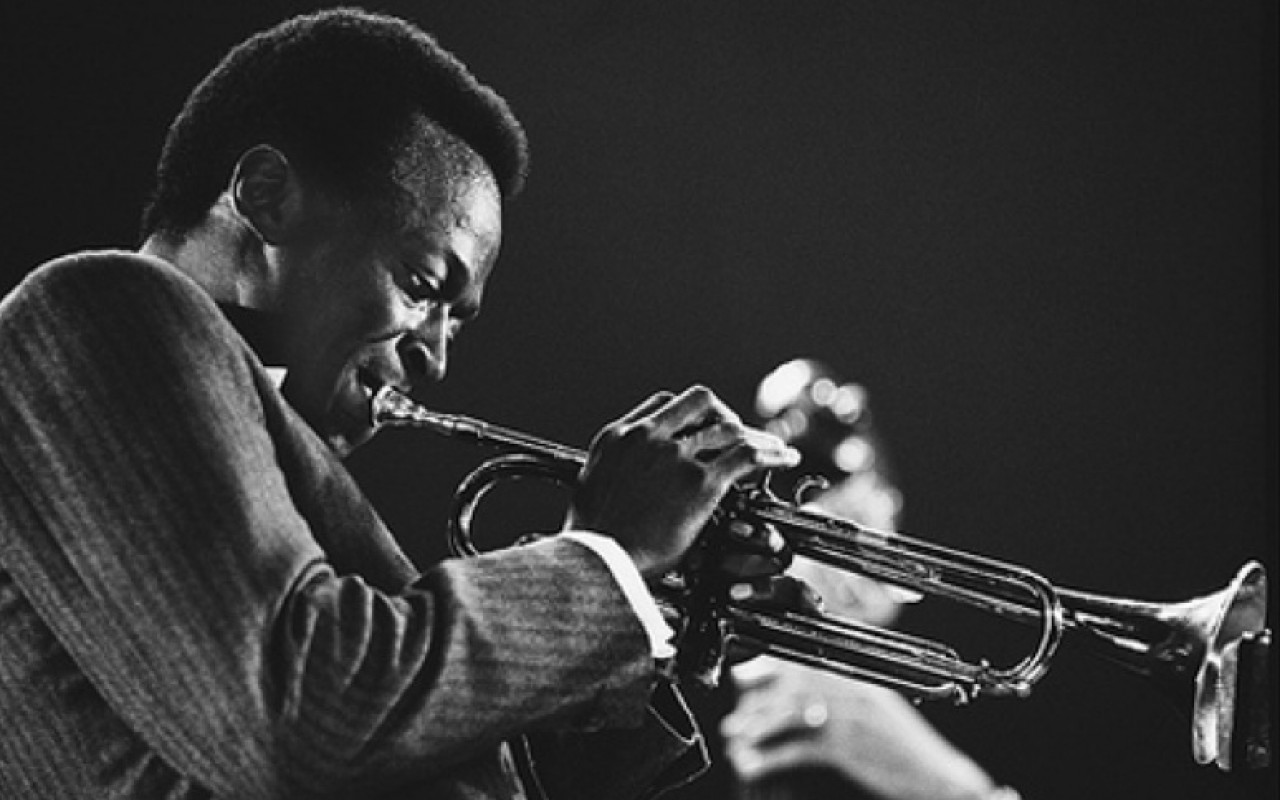
In the first half of 1955 Miles Davis was in a much better shape than he was in a long time. After kicking his heroin habit at his father’s house in 1953, he came back to New York City a more complete musician. His tone on the trumpet improved and so his ability to lead groups of musicians at recording sessions and in clubs. The quality of his 1954 studio output for Prestige exceeded most of his early 1950s recordings and yielded some of the best records in his career thus far: Walkin’, Bag’s Groove and Miles Davis and the Modern Jazz Giants. He was ready to move on to the next stage of his career, gain wider recognition and no less important – make more money. Two factors in his professional life were lacking and prevented him from reaching his goals – a bigger, nationwide record label, and a stable working band of musicians. But starting in June 1955 events started unfolding at an accelerated pace for Miles. In 1955 he was able to accomplish both goals.

On June 7, 1955 Miles Davis went into Rudy van Gelder’s Studio in Hackensack, NJ to record a session for Prestige. This was a quartet date, significant for being the first session with pianist Red Garland. Miles knew Garland for a couple of years, after the pianist moved to New York City from his home state of Texas. The two shared a love for boxing, Garland being a former professional boxer who went eight rounds against Sugar Ray Robinson in 1942. More importantly, Miles saw in Garland someone who could bring into his band the style of Ahmad Jamal, what Miles called that ‘melodic understatement and lightness’.

Miles was a big fan of Jamal, and the session included two tracks that were favorites in Jamal’s repertoire: Will You Still Be Mine and A Gal In Galico. Garland complied with Miles’ request to “give me Ahmad’s sound, because Red played his best when he played like that.” The experience of playing some of Jamal’s repertoire and applying his style had an important influence on Garland, who later got a trio feature on one of his sessions with Miles Davis and played Jamal’s composition Ahmad’s Blues. In 1958 Miles Davis would say, “All my inspiration today comes from Chicago pianist Ahmad Jamal.”
That trio feature impressed Prestige Records manager Bob Weinstock enough to get Garland his own recording contract with Prestige, a fruitful relationship that yielded about twenty records for the label over the next decade. The standout track on Miles’ quartet session from June 1955, which was released as The Musings Of Miles, is I See Your Face Before Me, a ballad featuring Miles on the Harmon mute and an excellent playing by Red Garland. That tune sounds very much like the music Davis will soon be making with the quintet. But we have a few more months until that takes shape.
The following month, on July 17, 1955, Miles took the stage at the Newport Jazz Festival with an all-star band sandwiched between performances by Count Basie’s band and Dave Brubeck’s quartet. The group included Zoot Sims on tenor, Gerry Mulligan on baritone, Thelonious Monk on piano, Percy Heath on bass and Connie Kay on drums. Miles was brought in at the last minute and his name was not even on the program. But his performance on Monk’s ‘Round Midnight was a pivotal moment in his career.
In his autobiography Miles recalled the event: “When I got off the bandstand, everybody was looking at me like I was a king or something – people were running up to me offering me record deals. All the musicians there were treating me like I was a god… It was something else, man, looking out at all those people and then seeing them suddenly standing up and applauding what I had done.” At the time though, Miles said nonchalantly in an interview “What’s all the fuss? I always play that way”. I seem to agree with him. While his performance is indeed great, Miles had many solos on his recent albums no less significant than the one at Newport. Maybe people finally noticed him in the festival setting. Nevertheless, that performance got him his biggest career boost, courtesy of Columbia Records executive and producer George Avakian.

Avakian was a jazz aficionado and scholar, but he also had an ear for popular music and the taste of the wider audience at large. That same year he signed Johnny Mathis, then only 20 years old. He saw something in Miles that could take him to new audiences: “What struck me was that Miles was the best ballad player since Louis Armstrong. I was convinced that his ballad playing would appeal to the public on a very large scale. While his bebop playing had established his reputation among musicians and jazz bands, I knew bebop would never connect on a large scale. It was ingenious music but far too complicated for the average ear and too hard for the mass market to follow the melodies. It’s really Miles’ melodic playing that put him across with the public on a wide scale.” Within weeks of his Newport performance, Avakian offered Miles a lucrative contract (for a black jazz musician) but had to make a concession to Bob Weinstock. Miles owed his current label five more albums, and Avakian agreed not to release any material by Miles until all his recording obligations to Prestige were fulfilled. Realizing that the trumpeter is at a great point in his musical career, Avakian made sure there was no stipulation that prevented Miles from recording for Columbia during that period.

Less than a month after his performance at Newport, Miles was back in the recording studio for another session organized by Prestige Records. This was a sextet date with Jackie McLean on alto sax, Milt Jackson on vibes, Ray Bryant on piano, Percy Heath on bass and Arthur Taylor on drums. McLean, who’s first recording session was with Miles Davis back in 1951, contributed two compositions to the album: Dr. Jackle and Minor March. Miles recalled an incident on that recording, after the band recorded McLean’s tunes. After Miles gave Arthur Taylor a few words on encouragement when the drummer struggled on the next tune, McLean approached Miles and said, “Miles, what’s happening here? You don’t treat me like you do Art when I fuck up. You let me know right away what I did. How come you don’t come down on Art like you come down on me?” Miles, losing patience with the sax player who was high on drugs, replied, “What’s the matter with you man, you got to pee or something?” McLean packed his sax and left the studio. He only played on his tunes. Here is one of them, Minor March:
In the second half of 1955 Miles Davis focused on organizing a stable band. Little he know that before the end of the year he would form one of the most important groups in the history of modern jazz. Within a span of a year and a half that band would record some of the genre’s most revered albums.
Miles Davis’ first recording session with Philly Joe Jones was in 1953 at a session for Prestige that became famous for its inclusion of Charlie Parker who appears on the credits with the pseudo name of Charlie Chan, as he was under an exclusive contract with Mercury. By that point Parker replaced Heroin with alcohol and was gulping vodka like it was soda pop, making him less than a productive partner on that date. The session was aborted at some point and Miles had to complete that session three years later with a different group. The tracks from the two sessions were combined on the album Collectors’ Items. At the time of the first session Philly Joe Jones (nicknamed Philly for his hometown and to avoid confusion with Count Basie’s drummer Papa Jo Jones) and Miles were hanging buddies, both also Heroin junkies. In 1954, after Miles stopped using, they were doing a lot of live session work together with various groups of musicians. Their next studio session together was that quartet with Red Garland in 1955. Miles had a special place in his musical heart for drummers, and Philly Joe Jones – at least for that period of time – was the ideal drummer for him: “Philly Joe was the fire that was making a lot of shit happen. See, he knew everything I was going to do, everything I was going to play. He anticipated me, felt what I was thinking.” Joe Jones had a style all of his own which Miles just felt comfortable with. Aside from Tony Williams, Joe Jones is the drummer Miles talks about the most in his autobiography: “Sometimes I used to tell him not to do that lick of his with me, but after me. And so that thing that he used to do after I played something – that rim shot – became known as the ‘Philly lick’, and it made him famous, took him right to the top of the drumming world. After he started doing it with me, guys in other bands would be telling their drummers, ‘Man, give me the Philly lick after I do my thing’.” His best compliment to the drummer is in this short sentence: “Even after he left I would listen to a little of Philly Joe in all the drummers I had later.”

One more piece in the quintet’s puzzle fell into place as Miles Davis was starting to rehearse a band for a booked engagement at the Cafe Bohemia. At the recommendation of Jackie McLean he was introduced to a newcomer in New York City, a young bass player named Paul Chambers, 20 years old at the time. Chambers was playing with J. J. Johnson and Kai Winding and gaining a lot of respect within the jazz circles. Miles summarized his first impression upon hearing Chambers as only he can: “When I first heard him I knew he was a bad motherfucker.” Years later when Coltrane was reflecting on his period with the quintet he said of Chambers: “A bassist of Paul Chambers’ stature is hard to find in New York because he understands the junction: he hears the piano and the drums, and all his work consists in improvising in the service of these instruments. His melodic line is kind of a result of the melodic lines of the two other musicians.”

Miles Davis needed one more musician, a horn player, to complete the lineup for a new quintet. But that role proved to be the most difficult to fill. His natural choice was Sonny Rollins, whom he started playing and recording with early in the 1950s. He got Rollins to play those booked Cafe Bohemia gigs in July 1955 and started lining up more gigs in other clubs. But then Rollins disappeared without a word, having gone to Lexington, Kentucky to kick his own Heroin habit. That proved a turning point for Rollins, who in 1956, after successfully getting off the harmful drug, made a huge comeback with his albums Tenor Madness and Saxophone Colossus. Davis then set his eyes on Cannonball Adderley who was playing with Oscar Pettiford, but the alto sax big man had a teaching gig in Florida. Next in line was john Gilmore, the odd one in the horn player nominees list. Gilmore played with Sun Ra’s Arkestra, a great band but maybe not the best fit in style and vibe for what Miles was after. Avakian summarized it well in his liner notes to ‘Round About Midnight, the first album Miles recorded for Columbia: “Gilmore, like a handful of other younger saxophonists, had been pushing the horn to new limits….Tenor saxophones, especially, were able to honk, howl scream, cry, pop, growl, and tongue-slap tones, and Gilmore had taken the horn further in this direction than anyone else at the time. But he was not what Davis was looking for.” Jackie McLean was also a possibility, having a long history with Miles. But at a Prestige session on August 5, 1955 the two had a fall out and never played together gain.

The final piece fell into place at the recommendation of Philly Joe Jones, who reminded Miles of a musician he knew from his hometown of Philadelphia, one John Coltrane. Miles knew the tenor player from early gigs they did together at the Audubon Ballroom in Harlem, and was not impressed at the time. Sonny Rollins, who also played those gigs, had a different impression: “Coltrane and I first met in 1950 in New York, where we worked together for a few memorable gigs with Miles Davis. I really had to listen carefully to him. I often wondered, what was he doing, where was he going? I didn’t think it would be proper to ask, but I listened harder, and eventually I began to understand his music. Later, we became good friends. Good enough friends for me to borrow money from him, and Coltrane and Monk were the only two people I would ever ask for a loan.” Red Garland said of Coltrane: “I’ve always been struck by the continuity of his ideas and by his unique way of handling changes. He can start a chord in the strangest place. The average cat may start on the seventh, but Coltrane can begin on a flatted fifth. And he has the damnest way of breaking chords down, but I have no trouble accompanying him because of that sense of continuity.”

In September 1955 Coltrane was playing in Philadelphia as part of organist Jimmy Smith’s trio. Miles met Coltrane and noticed a big improvement in Coltrane’s playing, but they did not click at first. Miles, rarely providing instructions to the musicians in his band, found Coltrane’s quest for knowledge irritating. It is interesting to compare the two giant musicians’ recollection of that situation. Coltrane, politely: “After I joined Miles in 1955, I found that he wouldn’t talk much and will rarely discuss his music. He’s completely unpredictable. Sometimes he’d walk off stage after just playing a few notes, not even completing one chorus. If I asked him something about his music, I never knew how he was going to take it.” Davis, colorfully: “Trane liked to ask all these motherfucking questions about what he should or shouldn’t play. Man, fuck that shit. To me he was a professional musician and I have always wanted whoever played with me to find their own place in the music. So my silence and evil looks probably turned him off.” After their meeting Coltrane went back to play with Jimmy Smith, and Miles, with a looming gig in Baltimore on September 28, 1955, had to beg the horn player to come back and join them. It was a practical proposition: Coltrane was simply the only one he could think of who knew all the tunes. Necessity is the mother of invention, and what an invention that was: the classic Miles Davis quintet of the 1950s, one of the finest jazz ensembles in the history of the genre, was born.

Miles realized the power of the group early on. This was no run of the mill group with random jazz musicians booked for a single recording session or a few club gigs. With the money coming to him from Columbia and higher fees he was asking from the clubs that booked him, Miles was able to maintain the group as a steady working band. Miles remembers: “Now we had Trane on sax, Philly Joe on drums, Red Garland on piano, Paul Chambers on bass, and myself on trumpet. And faster than I could have imagined, the music that we had been playing together was just unbelievable. It was so bad that it used to send chills through me at night, and it did the same thing to the audiences, too. Man, the shit we were playing in a short time was scary, so scary that I used to pinch myself to see if I was really there.” The band performed at clubs in Baltimore, Detroit and New York City before going into their first recording session on October 26, 1955 for Columbia. They attempted 5 pieces through 31 takes, obviously not yet honing their skill to play together as a group in the studio. Ah-Leu-Cha, a piece written by Charlie Parker back in 1948, is a good showcase of the band at that point, a month after being formed.
On one of the band’s gigs that was broadcasted on radio from the Peacock Alley Lounge in St. Louis early in 1957 Miles introduced the song. Davis: “… called ‘Ah-Leu-Cha’.” The radio host asked: “Is that a foreign language?” Davis replied: “Charlie Parker’s language.”
On November 16, 1955, a few weeks after the Columbia session, the quintet went into Rudy Van Gelder’s studio to record their first session for Prestige. A favorite tune from this session is The Theme, a quick and short club performance set closer, here getting a full arrangement with a fine bass solo by Paul Chambers.
Prestige got a full album worth out of that session and released it as Miles: The New Miles Davis Quintet. It shows a group coming into its own, but as Miles said: “This record for Prestige was nice, but nothing like what we were going to do for them in our next sessions.” One album down, he now had to deliver four more albums to Prestige.
Sources:


Leave a Reply