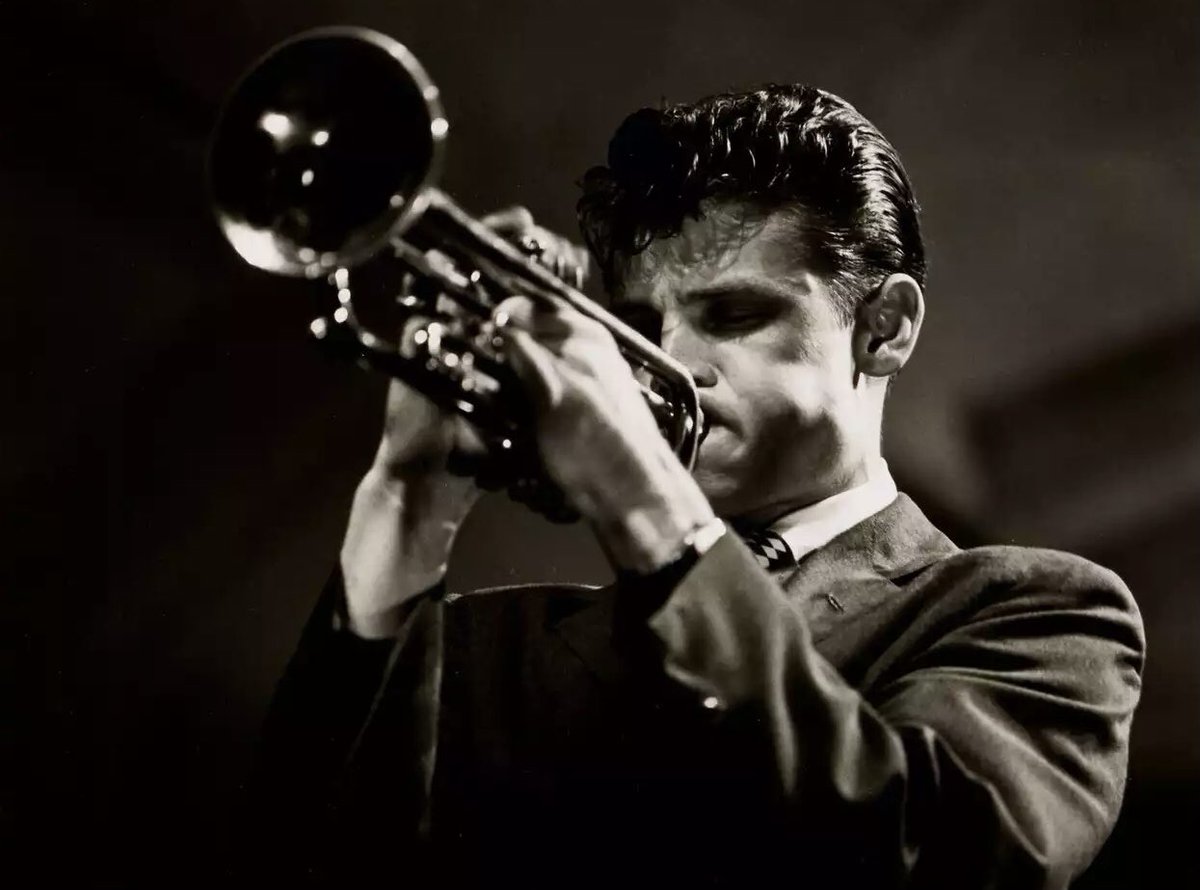
1955 was a year of two halves for Chet Baker. After winning his second consecutive Trumpet player of the year award in Downbeat’s Critic’s Poll, in the first half of the year he recorded for Pacific Jazz as an instrumentalist and vocalist. In the second part of 1955 he toured extensively and moved to Europe for a period of time, where he recorded with his band and local musicians.
In February 1955 Chet Baker went into Capitol Melrose Studios in Los Angeles to record a session for his next album on Richard Bock’s Pacific Jazz label. The session had an interesting lineup including, apart from Baker’s quartet, flute player Bud Shank, four cellists and a harp player. No less than three arrangers wrote scores for that session. In the previous three years Baker recorded a number of sessions with a string section for Columbia Records, and they proved quite successful. The combination of William Claxton’s dreamy cover photos of Baker in the recording studio with the lush orchestrated music was a winning combination, and the albums were quite successful.

Back in 1954 Pacific Jazz also released Chet Baker’s first attempts at singing on the album Chet Baker Sings. For an album containing ballads of despair delivered in a fragile voice that so many people love, it is interesting to hear what people in Chet Baker’s orbit said. This was Baker’s debut vocal album, and he was struggling with the singing parts. It took him many takes to get the vocals for each of the songs. Dot Woodward, Richard Brock’s secretary: “He must have had a hundred takes on every tune. He’d get through part of the tune, then he’d have to go back and do it again.”
Ruth Young, who married Chet Baker in the 1970s, said this about his singing: “None of these songs had any meaning for him, truly. He could have been singing Charmin commercials. He was coming from a musical place, and the words were mere notes to him.”
The album made Chet Baker a heartthrob. Girls lined up outside his room in jazz clubs, asking for an autograph. Bassist Jimmy Bond remembers: “Some of the women who chased after Chet were gorgeous, unbelievable. He would leave with three or four.” The album included the tune My Funny Valentine, later becoming a staple of Chet Baker’s career.
In a city obsessed with looks and charm, Baker’s image became the interest of women and girls who were as much captivated by his looks as in his talent as a trumpeter. Pacific Jazz was looking to cash in on that commercial appeal and combined strings with Chet Baker’s vocals on one of their own albums. The result was Chet Baker Sings and Plays, released in 1955.

The liner notes, written by Los Angeles jazz critic Bill Brown, paid attention to the musicians participating in that session: “Several talents helped make this an outstanding album. Arrangers Johnny Mandel, Marty Paich and Frank Campo wrote the string sections. Pianist Russ Freeman arranged the quartet sides and played piano throughout. Flautist Bud Shank and harpist Corky Hale are heard with the strings.” Corky Hale, who later married songwriter Mike Stoller, can be heard on many albums by fine artists including Nina Simone, Anita O’Day, Peggy Lee, Roberta Flack and others. The notes continue to praise the quality of the recording: “This painstaking effort to weld the best possible combination of abilities is typical of what has become known as the West Coast School of Jazz. So is the use of cellos and flute as accompaniment in the jazz idiom.”
The flute, harp and cellos can all be heard in a beautiful arrangement of George and Ira Gershwin’s song ‘Someone To Watch Over Me’, originally from the 1926 musical Oh, Kay!
The album’s liner notes discuss Chet Baker as a singer: “You will notice as you listen that the tunes in this album take on new meaning even though Chet’s treatment tends to diminish the importance of the lyric. Because his basic ideation is as an instrumentalist, Baker tends to sing the musical values rather than mouth the words. What comes out sounds almost as though it had been blown through his horn.” The notes continue with recognizing Baker as a singular talent who can express himself extremely well as an instrumentalist and vocalist: “When he plays you will note that the instrumental choruses build upon what was already been stated vocally. This interdependence is doubly effective for, although other vocalists use instrumental techniques, Baker stands virtually alone as one who can extend his vocal ideas with his playing.”

Perhaps the most significant effect of Chet Baker as a singer is outlined in one more passage that Bill Brown writes next: “There is also an involvement of the listener with the artist when Baker sings, a sort of emotional entanglement which is hard to define. See if you don’t have a feeling of personal achievement as Chet ‘makes it’ through some of the difficult vocal passages.”
The song that best demonstrates this emotional entanglement is ‘Let’s Get Lost’, written by Jimmy McHugh with lyrics by Frank Loesser for the 1943 film Happy Go Lucky. Chet Baker recorded it in a second session for the album when he was back in the studio a week later with his quartet, including Russ Freeman on piano, Carson Smith on bass and Bob Neel on drums. The song became one of Baker’s most popular songs and possibly the one best identified with him. In 1988 the song title was chosen for a fantastic documentary film about Chet Baker’s life, well-worth watching.
A review of the album in Downbeat magazine opinioned that while Chet Baker, “does play some excellent horn”, his vocal abilities are sub-par compared to singers such as Frank Sinatra (who released an excellent album that year with ‘In the Wee Small Hours’) or Mel Torme. The review read, “Chet just doesn’t have the equipment to assay a project of this size. Saving grace is his sense of phrasing, almost always present in an instrumentalist who sings, but lyrics have meanings, and Chet doesn’t seem to grasp them often enough.”
Another highlight on the album is the song ‘You Don’t Know What Love Is’, another jazz standard. It was written by Don Raye and Gene de Paul for the Abbott and Costello film Keep ‘Em Flying (1941), in which it was sung by Carol Bruce. Interestingly the song was dropped from the final release of the film. It is a fine example of the difference between Chat Baker the instrumentalist and vocalist. While his vocal delivery is somewhat nonchalant in contrast to the song’s lyrics, when he plays the trumpet he is much more emotional.
In April 1955 Downbeat magazine announced to fans of Chet Baker that their idol will be participating in a movie and, “he will have an important part running through most of the picture, in which much of the action takes place aboard a US military plane.“ Tom Gries, director of the film – Hell’s Horizon – said that the decision to use Baker for the role of “Jockey” was made after hearing his Columbia LP with strings and his more recent vocal work on Pacific Jazz.

On July 16, 1955 Chet Baker performed at the second annual jazz festival in Newport, Rhode Island. He played a set with his quartet, which pianist Russ Freeman remembers as, “a pain in the ass—bad sound, screaming mobs, too many musicians milling around. It wasn’t a place for creating good music — most jazz festivals aren’t.” He later joined an all-star band on stage that included Dave Brubeck, Paul Desmond, Clifford Brown and Gerry Mulligan.

In September 1995 Downbeat run a news article that announced a European tour for Chet Baker. Performances were scheduled to start at the Concertegebuow in Amsterdam and continue to include three weeks in France, three days in Switzerland, a day in Belgium, a tour of American bases in Germany, and five days in Scandinavia. There was also a plan to book Baker in England as a vocalist only, to circumvent the British Musicians Union bar on American instrumentalists. Chet Baker’s quartet for the tour would be composed of pianist Russ Freeman, drummer Pete Littman, and new bassist Jimmy Bond. At the last-minute Freeman dropped from the tour, opening the door to Dick Twardzik, a young and brilliant pianist from Boston.
A year earlier Twardzik shared the stage at Storyville jazz club in Boston with Chet Baker’s quartet who were the main attraction. Talking later about the pianist Baker said, “The first time I heard him play I couldn’t believe it. He had somehow bridged the gap between classical and jazz.” Russ Freeman, who played piano with Chet Baker on that gig, called Richard Bock at Pacific Jazz to let him know that, “There’s a young guy here who plays piano like you wouldn’t believe. You have to record him.” Bock followed on the recommendation and in October 1954 recorded Twardzik for a Pacific Jazz album produced by Russ Freeman. The album, titled “Russ Freeman / Richard Twardzik – Trio”, was released a year later. The back cover included this quote by the gifted pianist: “Development is not my primary consideration. The ability to project ever-changing emotions or moods, plus rhythmic freedom, is far more important to me.”

Sadly, Twardzik had a serious heroin addiction. He often overdosed, even on-stage. His habit intensified during his European trip with Chet Baker, but magically his playing remained first-rate. On October 11 and 14 the quartet recorded sessions held at Paris’ Studio Pathé-Magellan. Dick Twardzik brought to the studio compositions written by his Boston composer friend Bob Zieff. Unable to get anyone interested in recording these works in the US, Zieff gave them to his friend with the hope of recording them in Europe. Twardzik felt that Europe would appreciate Zieff ’s work, influenced by Debussy and Alban Berg and with a generous use of dissonance. Chet Baker found the compositions intriguing and later commented, “The originality and freshness of Zieff’s line and chordal structure is going to please a lot of people, I think – at least musicians and other serious listeners.”
On October 21, 1955 Twardzik failed to show up for rehearsal. Chet Baker sent drummer Peter Littman to check on him at the hotel, where he found Twardzik dead in his room. A heroin needle was still in his arm. A few days later, when Baker performed in London as a vocalist, he came on stage in a funereal charcoal-gray suit. Melody Maker covered the show, writing, “White-faced, he clenched the microphone and announced that his pianist was dead.” He continued to sing a set of melancholic songs including This Is Always, My Funny Valentine, Someone to Watch Over Me, But Not for Me. “He sang as though to himself, eyes closed, face screwed tight in concentration,” the review continued. After fifteen minutes Baker left the stage, too grief-stricken to continue.
Sources:
Deep in a Dream: The Long Night of Chet Baker, by James Gavin

Leave a Reply