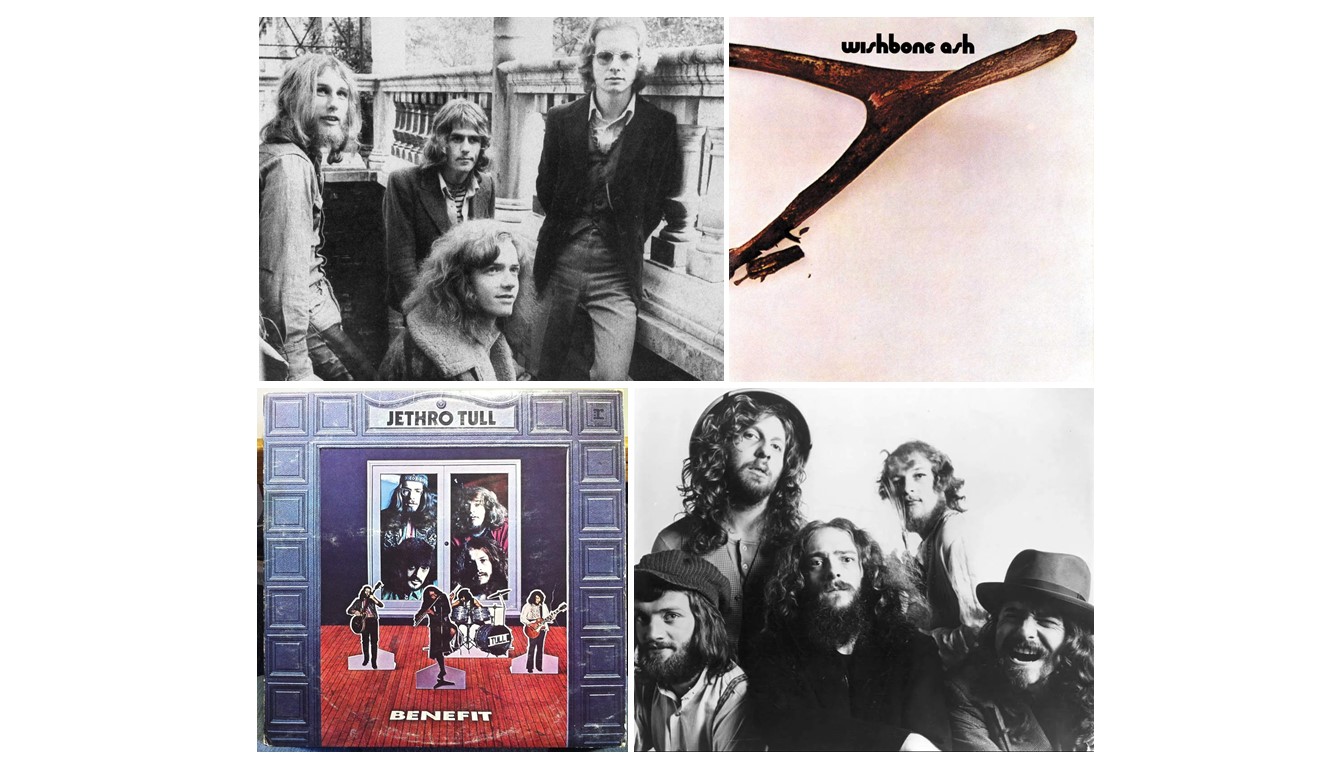
Jethro Tull – Benefit
Jethro Tull started the year 1970 with The Witch’s Promise, a song released as a single in January. It scored the band a miming performance at Top of the Pops, injecting the show with something much different than its regular sugary fare. Ian Anderson told Beat Instrumental magazine in February 1970: “Doing Top of the Pops is important because, however plastic and phoney it is, it does give people a chance to see us. I hope people get a kick out of seeing us there miming away. If you can ever switch on your set and see an hour of the Nice or the Family, then I’d like to think that we helped bring that situation about by appearing on Top of the Pops.” Bassist Glenn Cornick remembers that rare TV spot with a smile: “I had to prance around like a prat for more than half the song, not doing anything, as the bass part doesn’t start until well into the song! We enjoyed doing TOTP as we got to play with ‘real’ Pop Stars like Robin Gibb and Engelfart Humperstink and so on, who seemed rather bemused to see a bunch of blokes like us on the show.”

Jethro Tull was not in the mold of a band to score easy hits with catchy pop songs, but in their early career they were able to get three singles into the UK top 10 singles chart. After their 1969 hits Living in the Past and Sweet Dream, they were on the hook to produce another one. Anderson said of their next single: “It’s just a couple of tracks. There’s no A or B side. There’s a lot of pressure to follow up hits and people might say, ‘Jethro Tull didn’t have a hit’, but so what? They’re just two songs we’re putting out to bridge the gap before the next album. It would be nice if people are still playing them in six months’ time, like an album.” Anderson found the constraints of a pop single too limiting: “It’s difficult to come up with anything representative of us that lasts only three minutes. You have to concoct a song for a single rather than coming up with one that means anything to you.”
But it was the single’s B-side that scored the band a hit after its inclusion in the US release of their next album. Different views have been voiced about the subject matter of Ian Anderson’s song Teacher. The singer, flutist, guitarist and songwriter explains: “What I was singing about was those creepy guru figures that would mislead innocent young minds like those of the Beatles. They would suck in people and use the power of persuasion to bend their will and lead them on a spiritual path to enlightenment. And a lot of the time, of course, it was just about getting your money and driving around in a big, white Rolls-Royce, which struck me as worthy of writing a song about. I wasn’t singing necessarily about spiritual leaders of a particular ethnic persuasion or a particular religious view, but just the idea of the teacher, the guru.”

The band had varying views of their satisfaction with the song. Guitarist Martin Barre told Melody Maker in January 1970: “It’s the first single we’ve done that I’ve actually liked. It’s more spontaneous than the others and we get a really live sound. I never play any of our previous singles but I will play this one.” Ian Anderson was less complimentary about his own song: “Every so often there are those songs that fall into the conventional pop rock structure—songs like ‘Teacher’, for instance—but that style isn’t our forte. We’re not very good at it because I’m not that kind of a singer, and it doesn’t come easy to me to do that stuff.”
After releasing the album Stand Up in 1969, which topped the UK album chart, Jethro Tull had the difficult task of following up on that fantastic and successful record. The band was touring hard in 1969, with three visits to the US and 170 shows that year across the UK, Europe and the US. Many of the songs that Ian Anderson wrote during that period ended up on their next album, Benefit, and they captured his mindset at the time: “Some of these songs reflect a sense of alienation and a growing desire for a steady home base to which I might return after my travels.” Writing songs on the road was a means of escaping the shenanigans surrounding a travelling rock group, as Anderson reflected: “It was very difficult to be in a hotel and just force yourself to pick up a guitar and play when you were really sick of it and just wanted to go home. I forced myself to pick up the guitar and play it because I wanted to inject something into a lonely hotel room other than groupies and dope, which seemed very boring and something which everyone else did. I didn’t see much point in doing that, so I just wrote the songs. And that was all I had and that was my only recreation.”

Benefit, the band’s third album, was released in April 1970. Anderson referred to it as “the riff album”, and it is indeed one of the band’s most hard-rocking albums, with Anderson playing electric guitar on most tracks. He recalled working with guitarist Martin Barre on their guitar parts: “Martin and I were playing quite often in the studio together with double-up guitar riffs and harmony riffs and so on. That was possibly the only time that that really occurred. There were definitely some Wishbone Ash moments in our playing these kind of simple harmony guitar riffs!” Guitarist Martin Barre Told Melody Maker in February 1970: “We have got away from the sound of the flute and haven’t used it a lot on the album. In fact Ian’s playing more guitar than flute, we’re only using the flute then we feel that the song needs the atmosphere of the flute.”
Recording the guitars, however, proved a difficult task in the studio. Although they were producing brilliant music, none of the members of Jethro Tull at the time were experienced musicians with deep knowledge of their instruments. Ian Anderson explains: “Martin gave me for the recording of that album a Gibson SG cherry red guitar, which has kind of pointy horns and a sort of faceted edge on the shape of the body. It was a nice looking guitar, but I think the reason he gave it to me was that it was a pig to tune up and it didn’t sound very good! But we didn’t really understand about the careful choice of strings, the octave length of different strings, and setting up bridges and saddles.”

The band’s sonic range saw a major lift on this album with the contributions of keyboardist John Evans, who would soon join as a formal band member on the invitation of Ian Anderson. The two knew each other from their early days attending Blackpool Grammar School. They formed The John Evan Band (the last name change was the suggestion of the third member of the band, Jeffrey Hammond). Evans then left the music business to pursue a pharmaceutical degree, but in 1970 was lured back into life as a full time musician by Anderson: “I was getting a bit tired of working all the time, and I thought about the good old days when I used to play a bit. So I thought I’d give it a crack, and went along to put a few overdubs on after college.”
Ian Anderson talked about the band’s pursuit of a more refined sound by adding keyboards to the mix: “We had come across various other keyboard players in various other bands, and I really wanted someone who came from a more classical background other than someone who was a barrel-house player from a blues band. If you were looking for a keyboard player you would find guys who could hack out a few bluesy kind of boogie-woogie licks that lots of people could do. But that wasn’t the sort of musician I was looking for. I’d worked with John in the early days of the Blackpool bands. I knew what he could do.”

John Evans made fantastic contributions to Jethro Tull’s music throughout the 1970s, the band’s greatest decade that saw the release of classics including Aqualung, Thick as a Brick, A Passion Play, Songs from the Wood, Heavy Horses and more. Band members had nothing but respect for him. Here is Glenn Cornick expressing his views with sentiments shared by other members: “John really brought a great deal of depth into it. He gave us a chance to do things that we wouldn’t have done otherwise. Some of the other songs we could have got by on, but the acoustic piano was the big thing that I liked about it – the ‘graaand piaaano’. And I’m sure it gave Ian the chance to do more stuff. It opened up his writing potential. And y’know, a couple of songs on Benefit, unless we’d brought in outside session players, we couldn’t have done them.”

Benefit is not generally considered one of Jethro Tull’s best albums, and only a few numbers from it were performed live by the band. But there are a number of favorite tracks on it and the highlight for me is To Cry You a Song, another riff song. Martin Barre sheds some light at its origin: “It was a response to Blind Faith’s ‘Had to Cry Today’, although you couldn’t compare the two; nothing was stolen … The riff crossed over the bar in a couple of places and Ian and I each played guitars on the backing tracks. It was more or less live in the studio with a couple of overdubs and a solo. A rifferama and a timeless one as well.”
Bass player Glenn Cornick, who left the band after a US tour following the release of the album, considers the song Ian Anderson’s second best hard rock song after A New Day Yesterday from the album Stand Up. It was intentionally selected to open side two of the LP, as he recalls: “You had to open side two with a bang or people might not bother to go to the second side.” Drummer Clive Bunker is also fond of that song: “A great song to play live. It meant that I could have a bit of a thrash, and the audience could have a bit of a thrash too.” And finally, Ian Anderson dispels a myth: “Any references to drugs (‘flying so high’) were entirely unintentional. Clearly a reference to the Pan Am flight home after the nine weeks away.”
Ian Anderson – vocals, acoustic guitar, electric guitar, flute
Martin Barre – electric guitar
Glenn Cornick – bass guitar
Clive Bunker – drums
John Evan – piano, organ
Wishbon Ash – self-titled debut
If the double electric guitar work of Ian Anderson and Martin Barre made a strong impression on you, then how about a band that took the concept of twin guitar leads to a whole new level? Ian Anderson mentioned Wishbone Ash when he spoke about the guitar work on Benefit, and for a good reason. Sounds magazine wrote about Wishbone Ash in October 1970: “Many groups have attempted a two lead guitar line-up but seldom has it met with any measure of success within such a framework and both Ted and Andy are aware of this, especially the fact that egos are easily bruised when there are two such highly featured soloists. ‘We learn a great deal from each other and we have worked things out pretty well. There’s never been any jealousy between us and this is part of the secret of making the two guitar line-up work effectively,’ said Andy.”

Wishbone Ash started when bass player Martin Turner and drummer Steve Upton were looking for a guitar player and, unable to decide between two excellent candidates, Andy Powell and Ted Turner, asked both of them to join. The band used to jam during sound checks with Deep Purple’s Ritchie Blackmore when the two bands shared bills in various clubs. Blackmore was impressed by the upcoming band and helped them land a record deal with MCA. Famed radio DJ John Peel said after he listened to them: “I heard Wishbone Ash for the first time, and haven’t been so impressed with a relatively new band for a long time. Their music is original, exciting and beautifully played.”
In December of 1970 the band released its self-titled debut album. Many listeners who have not seen the band live prior to listening to the album, missed the fact that the intricate guitar work was performed by two guitar players. Martin Turner: “People fail to realize, when they hear us on record, that we have two lead guitarists. They’ll hear us and say great, bloody good double tracking. Possibly we’re more effective on stage for that reason.”

A favorite track on the album is Errors of My Ways, a lovely rock ballad with folk influences. Andy Powell mentioned the strong impression that folk rock bands like Fairport Convention had on him when he was writing this song. Martin Turner fondly remembered the time the band worked on this song: “We used to spend a lot of time jamming in manager Miles Copeland’s basement and you can certainly here the results on this song. The whole song is very sweet and somewhat naive but full of melody and innovation. We were very young lads when this was recorded, Ted had only just left school a few months before! Andy was good at this folky style, I sang the harmony melody lines which were translated beautifully onto guitar by the harmony twins. Vocals are me on top and Andy on the low part. You can easily spot that it was recorded in the pre click track era – the song actually slows down after it opens.”
Melody Maker was not too complementary in its review of the album in January 1971, but found a bright spot with that song: “Best track for my money is Errors of my Ways which gets away from the standard rock bag, becomes neo-folk at times and is the type of set that the band should further, for it gives them a chance to show off a remarkable sense of freedom, which in itself is a pointer for future success.”
Sound engineer on the album is Martin Birch, who in 1970 worked on over 20 albums by artists including Fleetwood Mac, Deep Purple, Jeff Beck, Skin Alley, Peter Green, Small Faces and others.
Andy Powell – lead guitar, vocals
Ted Turner – lead guitar, vocals
Martin Turner – bass, vocals
Steve Upton – drums
Sources: Jethro Tull – Benefit, A Collector’s Edition booklet


Leave a Reply