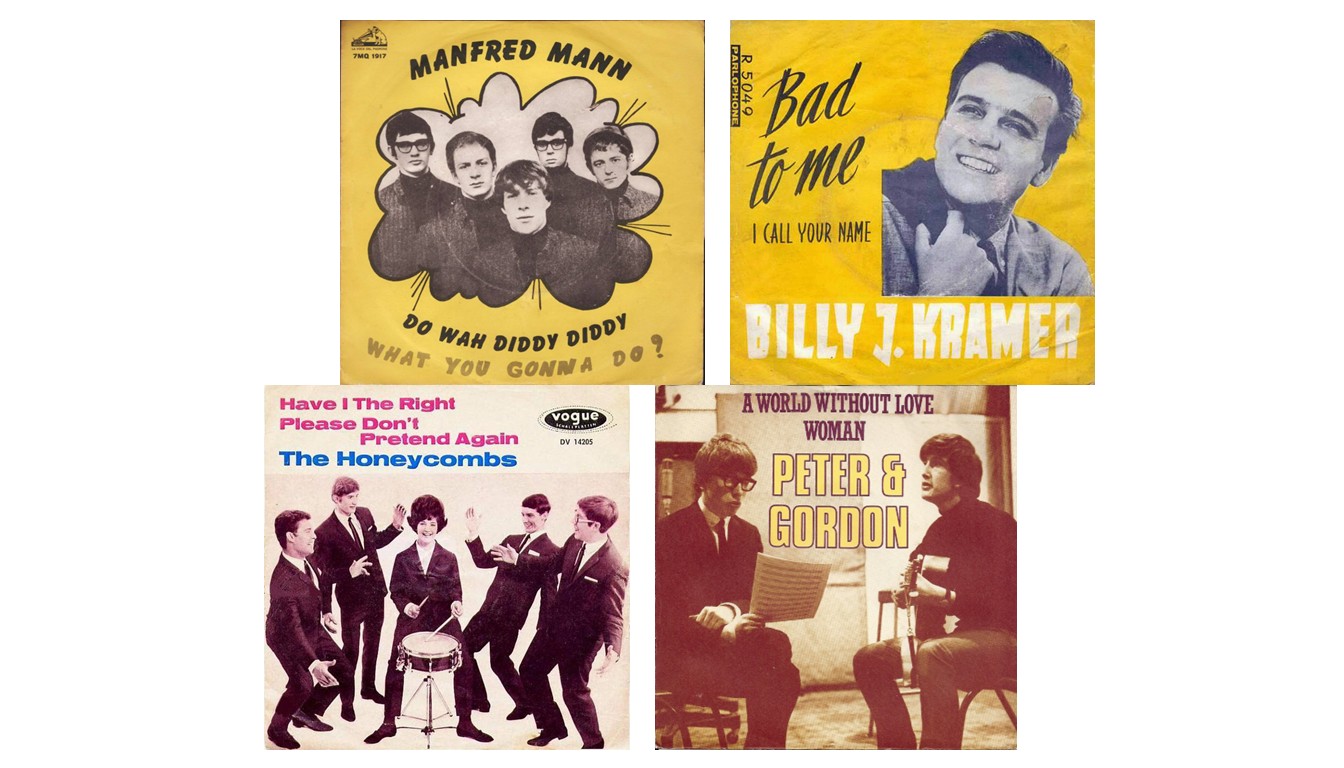
In this episode of the 1964 British Invasion series we cover four bands, all able to top the UK chart with popular singles, two of them also reaching the top of the US charts that year. We start with the first British Invasion song not performed by The Beatles, to reach No. 1 on the Billboard Hot 100 chart in 1964.
Peter and Gordon – World Without Love
When your mom gave George Martin music lessons and your sister dates Paul McCartney, you already half made it in the music business. Now all you need is for Paul to drop a leftover tune in your lap and you are on your way to the top. Peter Asher’s mother Margaret, was a professor of oboe at the Guildhall School of Music and Drama, where in 1948 she instructed the future famed producer to play the oboe. In 1963 Peter’s sister Jane, an actress in her own right, met Paul and the two became a regular couple. Paul stayed at the Ashers’ home on Wimple Street for three years.

Peter Asher and Gordon Waller became friends at school. They began playing guitar and singing together, performing at school concerts and eventually at local coffee bars and folk music clubs. During one of their dates at the Pickwick Club in London, they were spotted by Norman Newell, recording manager for EMI. He saw in them a way to cash in on the success of American folk acts like The Kingston Trio and Peter, Paul and Mary. At their audition, Peter and Gordon ran through their material for Newell. He heard the potential, but wanted something more popular and upbeat for their first recording.
Peter Asher described how their first hit ‘A World Without Love’, came to be: “Paul had played Gordon and me that song at some point, just in passing. It was really just half a song. It didn’t yet have a bridge.” Later on, when the need for a hit came up, Peter asked Paul to finish the song. The Beatle, resurrecting the song that he first wrote when he was 16, delivered the goods just before the recording date.

The song’s lyrics became a private joke between McCartney and his songwriting mate John Lennon. Paul later described John’s reaction to the song: “The funny first line always used to please John. ‘Please lock me away –’ ‘Yes, okay.’ End of song.” Lennon said of the song, “I think that was resurrected from the past. He had that whole song before the Beatles. That has the line ‘Please lock me away’ that we always used to crack up at.”
Renown session guitarist Vic Flick recalls the recording session: “This was the first time I used my Vox electric 12 string guitar. It was terrible to play, with a high action and not a very good sound. Still, it was a new sound and added to the character of the recording. I have the memory of the organist having his organ being brought into the studio by four road workers he cajoled into lifting it from his van. The workers were looking around in amazement at the big Studio 2 at EMI and tripping over the cables.”
The song indeed features a fine organ solo, played by Harold Smart. When the song was presented on the popular TV show ‘Juke Box Jury’, host David Jacobs was not complimentary: “I just don’t like that organ solo mid-way. Such a good song, such good singing. They should surely have re-recorded it without the organ.”

But that was not necessary, and the song, organ solo included, topped the UK charts in May 1964, displacing ‘Can’t Buy Me Love’ by The Beatles (who else?). A month later it topped the chart across the Atlantic. The song was one of seven Lennon-McCartney tunes to reach the top of the charts in the US in 1964. After ‘A World Without Love’, Peter and Gordon followed with a few more Lennon-McCartney songs (Nobody I Know, I Don’t Want to See You Again), none of them captured the top. Peter Asher later talked about these songs: “People often ask me, ‘How did Peter and Gordon get all those Beatles songs?’ It tends to be forgotten that in those days John and Paul were thinking of their future in terms of songwriting as much as performing.”
Billy J Kramer & The Dakotas – Bad To Me
We move to another song penned by the Fab Four songwriting team, this one performed by fellow Liverpudlian Billy J. Kramer and the Dakotas. Kramer was on Brian Epstein’s roster, thus providing him with one of the best hit-making machines in the history of popular music: the Beatles as songwriters and George Martin as producer. In 1963 Kramer had the first taste of success, reaching No. 2 with ‘A Taste of Honey’, a song The Beatles covered on their debut album, Please Please Me.
Later in 1963 the formula was repeated, this time with a No. 1 hit penned by John Lennon. The Beatle spoke about writing the song, explaining the circumstances surrounding his vacation in April 1963, while his wife Cynthia was expecting their first child: “I was on holiday with Brian Epstein in Spain, where the rumors went around that he and I were having a love affair. Well, it was almost a love affair, but not quite. It was never consummated. It was my first experience with a homosexual that I was conscious was homosexual. We had this holiday together. We used to sit in a cafe in Torremolinos looking at all the boys, and I’d say, ‘Do you like that one? Do you like this one?’ I was rather enjoying the experience, thinking like a writer all the time. I remember playing him the song ‘Bad to Me.’ That was a commissioned song, done for Billy J. Kramer, who was another of Brian’s singers. From Liverpool.”

The song was recorded at Abbey Road Studios, with Paul McCartney observing from the control room. George Martin contributed his production magic, propelling the song to the top of the UK singles chart. By this point, Brian Epstein knew he had a star producer who could turn any act into a bona fide star. Martin later discussed that topic: “Brian was a great ego booster. He brought me these artists and expected me to make hits with them—and when I did, he wasn’t at all surprised. I was. Though I couldn’t perform what these musicians were doing, I had a formula in the studio, a way of getting the sounds. And though I was a virgin as far as rock and roll was concerned, I quickly immersed myself in it. The Beatles taught me a lot.”

Beat Instrumental Magazine reviewed the song on its release, writing, “My gold-plated cert of the month which should go straight into the top notches chart-wise. Great time, appealing lyrics from the Lennon-McCartney team aided by a dynamic treatment from The Dakotas gang.” A year after its success in the UK, the song was released in the US, earning Billy J. Kramer and The Dakotas an appearance at The Ed Sullivan Show on June 7, 1964. Here goes:
The Honeycombs – Have I The Right?
June 1964 was also the month another band released a debut single that made it to the top of the charts. The Honeycombs started as The Sheratons in 1963 and after their original drummer left, found a replacement in Anne Margot “Honey” Lantree. She was an assistant in a hair salon when she fell in love with the drums, spotting the drum kit owned by The Sheratons’ drummer that was stored in a music room above the salon. Not many British pop groups in the early 1960s could claim to have a female drummer among their members. Maybe none.

In February 1964 the group was spotted by Alan Blaikley and Ken Howard, then at the very beginning of their songwriting career. They would later write hits such as ‘The Legend of Xanadu’ by Dave Dee, Dozy, Beaky, Mick & Tich. Howard and Blaikley liked what they saw and heard, and offered the group one of their songs called ‘Have I the Right?’. Things clicked into place when the band auditioned with producer Joe Meek. The band’s rhythm guitarist, Martin Murray, previously worked at Meek’s studio as a session guitarist. The audition turned into a recording session, showcasing Meek’s brilliant use of the recording studio located in his apartment. The legendary home studio was the spot where he previously recorded the chart toppers ‘Johnny Remember Me’ by John Leyton and ‘Telstar’ by The Tornados.
After the band recorded the playback and the vocals, Meek applied his non-traditional techniques once again and asked the band members to stomp to the beat on the wooden stairs to the studio. He recorded the stampede using five microphones he had fixed to the banisters with bicycle clips. He then added a tambourine that was beaten directly onto a microphone. He finished things up by speeding up the tape and compressing the sound, making the song an immediate attention grabber when played on the radio. Dennis D’Ell, the group’s singer, could never reproduce his recorded vocal on stage after Meek’s treatment.

When the song was offered to Pye Records, the label’s managing director Louis Benjamin decided to take the band on only after they changed their name to The Honeycombs, a word play on the drummer’s nickname and her short-lived hairdressing career. Lantree did not have it easy with the music press, who saw the band as a gimmick for having a female drummer. She responded to Beat Instrumental in October 1964: “Why shouldn’t a girl play drums? I’m fed up with being looked at as something of a novelty or just a gimmick to get attention for the group. I want to be judged on the sound I make, and on the experience I’ve gained from pounding the drums every minute I could over the past 15 months.” She also had this to say about Joe Meek: “We owe him a groat deal. Now we’ve done a lot more work with him on material for our first LP, we realize that he’s got a thousand Ideas in his head.”
‘Have I The Right?’ was not an immediate hit on release, but it was picked up by pirate station Radio Caroline, a perfect home for the unique sounding song. It reached the top of the UK charts in August 1964 and became an international hit for The Honeycombs in multiple countries, plus a respectable No. 5 in the US.
Manfred Mann – Do Wah Diddy Diddy
Last in this review is a band unique for their love of jazz music. Before and after they became a favorite 1960s act in the UK and the US with radio-friendly popular hits, Manfred Mann was a group of musicians who preferred to play jazz-influenced music and took pride in their musicianship and original compositions. The band started when keyboardist Manfred Mann and drummer Mike Hugg formed a sextet named Mann-Hugg Blues Brothers. A lineup change stabilized on a quintet with Paul Jones, a blues singer at heart. After they signed with HMV Records, producer John Burgess changed their name to Manfred Mann and took them into more popular territories. Like many other acts of the British Invasion, that formula included covering American songs, giving them an upbeat, easy on the ear treatment, and feeding them back to American audiences.

The band got its break when the producers of the popular TV music show Ready, Steady, Go! asked for a new theme song. The show, geared towards the Mod subculture in England, wanted a change from the tune used thus far, Wipe Out. The instrumental by the Surfaris did not fit the style of the show, which consisted mostly of R&B and soul music. The theme song commission offer was made to The Animals first, but that did not work out, and Manfred Mann were quick to provide the goods. They came up with “5-4-3-2-1”, a song that not only reached the top 5 in the UK singles chart, but also made the band a household name, the band smartly namechecking themselves in the song lyrics. Following the release of the song, Beat Instrumental magazine wrote, “the Manfred Mann group is more intelligent, less inhibited than most of the R and B purveyors.”
From that point on, Manfred Mann’s singles policy was to put out a cover song as the leading single, with an original tune on the B-side. And they started this tradition straight at the top, with a song that, like many other British Invasion hits, came from the Brill Building factory of songs. By 1964, the songwriting team of Jeff Barry and Ellie Greenwich were already responsible for some of the biggest hits coming out from the Brill Building, including “Da Doo Ron Ron” and “Then He Kissed Me” by the Crystals, “Be My Baby” by The Ronettes, “Chapel of Love” by The Dixie Cups and “Leader of the Pack” by The Shangri-Las. Girl groups were their specialty, but not all the songs they wrote made it to the top. “Do-Wah-Diddy” was given to The Exciters, but it only reached #78 in the charts. It would have likely be forgotten to the world, but singer Paul Jones found in it something that suited his voice, and he brought it to Manfred Mann. The band was not very keen on performing the song, but it had a hit potential that they could not ignore. They changed the song title to “Do Wah Diddy Diddy”, Manfred Mann (the keyboardist, not the band) worked his magic on the organ, and the song became the band’s first chart topper.
The single was released in July 1964, climbing quickly to the top of the UK chart, where it spent two weeks. A month later it accomplished the same feat in the US, capturing the top of Billboard’s Hot 100 for two more weeks. Manfred Mann were one of four British acts to capture the top of that US chart in 1964, along with The Beatles, Peter and Gordon and The Animals.

In an interview for the October 1964 issue of Beat Instrumental, keyboardist Manfred Mann said: “One of our big worries, in all honesty, is that R and B may get too popular. I mean, consider the trad scene. Everybody got in on the band-wagon, the whole scene became swollen and it died. We just want our sort of music to carry on for a long, long time.” Manfred Mann would go on to form multiple incarnations of Manfred Mann the band, creating some of the most interesting music of the 1970s with Manfred Mann Chapter Three and Manfred Mann’s Earth Band. Keeping with the tradition of the band’s 1960s hits, he made fantastic covers with his later outfits with songs like “Blinded by the Light” and “Spirit in the Night”, written by Bruce Springsteen.

Leave a Reply