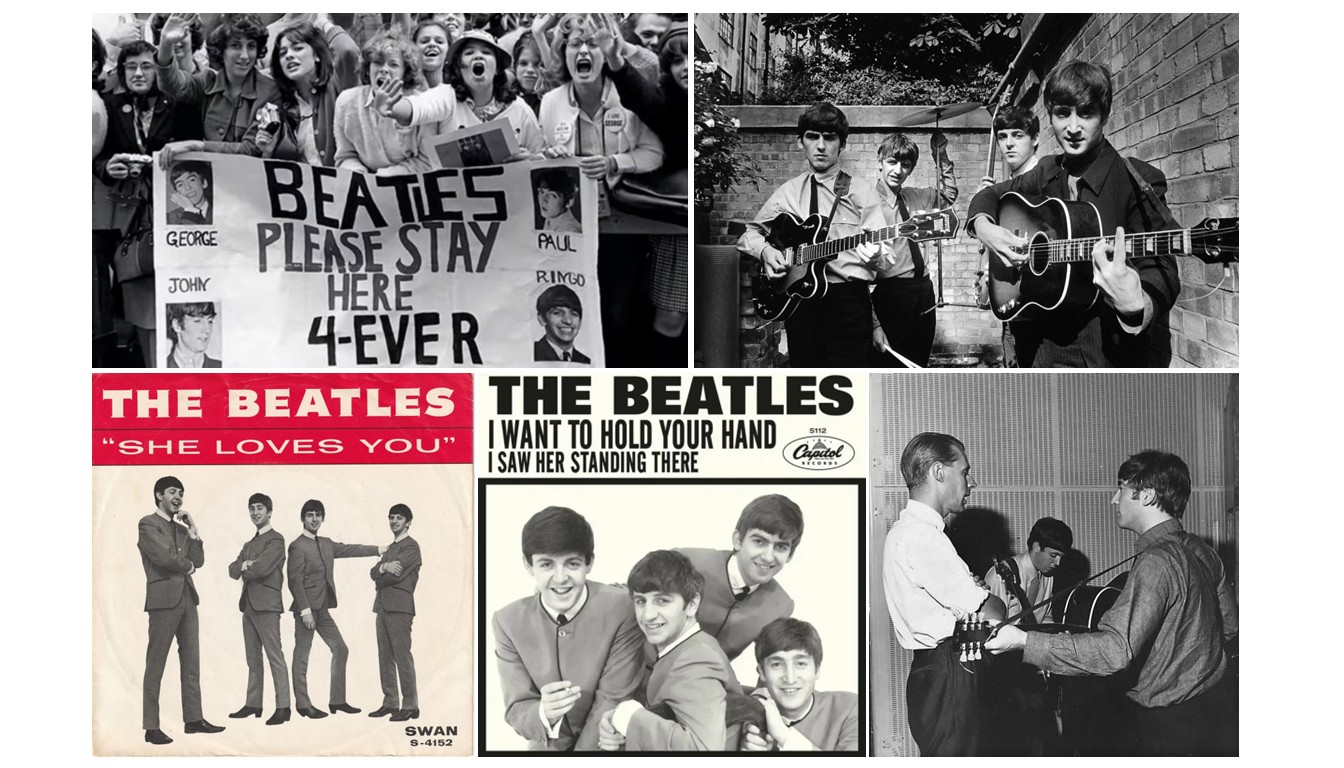
At the end of 1963 American youth were in need of some form of escape from the grim reality that followed the assassination of their beloved president. The baby-boomers, who entered high-school when the young 43-year-old Kennedy won the election, were primed for a distraction. In an interesting turn of events, that distraction came in the form of popular music made across the pond. In this article series we will review British music that made a huge impact on the US charts in 1964, known as the British Invasion.

Up until 1964, British pop artists had only brief moments of success in America. In 1956 Lonnie Donegan, the king of skiffle, got into the Top 10 with ‘Rock Island Line’. Cliff Richard, hugely popular in his home country, had toured the US, released movies and appeared on the Ed Sullivan Show, but was only able to produce one minor hit with ‘Living Doll’. Only three artists were able to reach the top of the US charts in the previous decade: Vera Lynn with ‘Auf Wiedersehen’ in 1952, Acker Bilk with ‘Stranger On The Shore’ in 1961 and the Tornadoes with ‘Telstar’ in 1962.
The Beatles, in particular, mysteriously remained a British and European phenomena in 1963. Their top singles in the UK that year, ’Please Please Me’, ‘From Me To You’ and ‘She Loves You’, were either rejected, did not enter the chart or sold a dismal amount of copies in the US. When Please Please Me was at the top of the British charts, their label EMI offered the record to Capitol, their US arm. Managing director Sir Joseph Lockwood remembers: “They wouldn’t take it at any price.” The reason given by Dave Dexter at Capitol, who had the job of listening to all records from EMI to decide if they were suitable for the American market: “I couldn’t count the number of times a British artist was a smash over there and then came over here and died.”

Producer George Martin also tried his best. He approached Capitol to take their singles, but again they refused: “We don’t think the Beatles will do anything in this market”. After his four fabs topped the British charts with She Loves You, he tried once again and told Capitol, “For God’s sake, do something about this. These boys are breaking it, they’re going to be fantastic throughout the world. So for heaven’s sake, latch on to them.” Again, Capitol told EMI that the Beatles were not made for America.
This all changed in 1964 when the Beatles broke into the American music market meteorically. The British Invasion was in full swing, starting a period of two years when British acts held the number one position a full year out of the two. And the song that started it all was…
The Beatles – I Want to Hold Your Hand
The song that marked the beginning of the British Invasion started life at the residence of Paul McCartney’s girlfriend, Jane Asher. Paul stayed with the Ashers, where John Lennon was a frequent visitor. The two spent quality songwriting time in the piano-equipped basement. In 1980 John Lennon recalled: “We wrote a lot of stuff together, one-on-one, eyeball to eyeball. Like in ‘I Want To Hold Your Hand’, I remember when we got the chord that made the song. We were playing on the piano at the same time. And we had, ‘Oh you-u-u… got that something…’ And Paul hits this chord and I turn to him and say, ‘That’s it!’ I said, ‘Do that again!’ In those days, we really used to absolutely write like that – both playing into each other’s nose.”

It may not sound like it, but the song had the unlikely influence of experimental music. Robert Freeman, the photographer who took the cover photo for With The Beatles, adds this interesting piece of information: “John was intrigued by a contemporary French album of experimental music. There was one track where a musical phrase repeated, as if the record had stuck. This effect was used in ‘I Want To Hold Your Hand’ – at my suggestion – ‘that my love, I can’t hide, I can’t hide, I can’t hide’.”
On October 17th 1963 The Beatles took that gem into the recording studio and after a 3-hour session and 17 takes had a single on their hands. The session is notable for being the first for the Beatles with an updated recording desk. Producer George Martin: “With the success of the Beatles adding weight to my continual demands, the EMI bosses decided to join the world of modern recording, and we got four-track. It had taken a long time.” Abbey Road engineer Ken Townsend: “With four-track one could do a basic rhythm track and then add on vocals and whatever else later. It made the studios into much more of a workshop”.

The session started with a foretelling from John, who said to George Martin: “You’d better come on down here and have a listen to our next number-one record.” Even John could not have imagined at that point that this song would not only conquer the top spot on the UK chart, but a month later would achieve the same feat across the pond. The four-track system came handy when Martin and engineer Norman Smith utilized one track for bass and drums, another track for vocals, and combined John Lennon and George Harrison’s guitars on another. The fourth track was reserved for additional effects. Martin and Smith used a compressor effect on Lennon’s rhythm guitar part to give it the sonority of an organ. Another effect was the heavy use of handclaps, a common practice for adding excitement to the rhythm of the song. Geoff Emerick, who was assistant engineer at the time, remembers: “As I watched the four Beatles gathered around a single mic, clowning around as they added the part, it was apparent to me how much fun they were having, how much they loved doing what they were doing.”

‘I Want To Hold Your Hand’ sold one million copies on British advance orders, and when it entered the UK charts, within a week it reached the top, replacing the Beatles’ previous hit, ‘She Loves You’.
The seeds for The Beatles success in the US were sawn the same month that the band recorded ‘I Want To Hold Your Hand’, when the host of America’s biggest television entertainment series The Ed Sullivan Show, visited Britain in October 31 1963 and experienced the phenomena known as Beatlemania first hand: “My wife Sylvia and I were in London, at Heathrow Airport. There was the biggest crowd I’d ever seen in my life. I asked someone what was going on, and he said, ‘The Beatles’. Who the hell are the Beatles? I asked. I went back to my hotel, got the name of their manager, and arranged for them to do three shows.”
Manager Brian Epstein decided on a different strategy with the new single. This time he insisted that Capitol Records spend the required funds to promote the song. The label ended up spending $40,000 on posters, ‘The Beatles Are Coming!’ stickers and even Beatles wigs for their sales reps. This was an unheard-of amount of promotion money back then, when $5,000 was considered an expensive campaign.

Although the single was scheduled for release at the end of January 1964, American DJs at various radio stations got hold of the UK-issued single and started paying it in December 1963. Listeners began phoning straight away and the switchboards were jammed. The song proved to be so popular that it was played every day, once an hour. Capitol decided to bring forward the release date to December 27th 1963. It sold a quarter of million copies in the first three days, and 10,000 copies an hour in New York City alone. The demand forced Capitol to pay competitor labels Columbia and RCA to print the needed copies.
The song entered the Billboard Hot 100 chart on January 18 1964 and within two weeks, on February 1, became the first Beatles single to conquer the US charts, where it stayed for seven weeks. This was the British Invasion’s beachhead.

Later in the year, on August 28 1964, after the Beatles played a show at Forest Hills Tennis Stadium in Queens, New York, they stayed the night at the Delmonico Hotel and had a visitor. Bob Dylan came over and offered the Beatles their first taste of weed. When he learned that the four lads have never been experienced, he asked in amazement, “But what about your song, the one about getting high?’ And when I touch you, I get high, I get high …’?” “It goes, “I can’t hide, I can’t hide …” explained John.
Notice the cigarette Paul is holding in his right hand. You will not find it on the cover of the single’s 20th anniversary re-release in 1984. It was air-brushed, echoing concerns over legislative requirements for non-smoking areas in private workplaces in the US. At least they spared the iconic cover of Abbey Road alone.
The Beatles – I Saw Her Standing There
The B-side of the ‘I Want To Hold Your Hand’ US single was one of the earliest songs Lennon and McCartney wrote together. At the end of 1961 Paul started dating seventeen-year-old Iris Caldwell. She was the sister of singer Rory Storm, whose group the Hurricanes had none else but drummer Ringo Starr. Iris was a trained dancer and Paul had many occasions to witness her moves on the dance floor. He started writing a song titled ‘Seventeen’, with the opening lines ‘She was just seventeen, never been a beauty queen’. A good rhyme, but when he presented it to John Lennon, his songwriting buddy winced. Paul continues the story: “So we both sat down and tried to come up with another line which rhymed with seventeen but which meant something.”

John saved the day with the line ‘you know what I mean’, which could be interpreted by their girl fans as ‘what does he mean?’, or more likely ‘I know exactly what he means’. In 1962, ’I Saw Her Standing There’ became part of the Beatles’ live routine. When it came time to record their first album, George Martin wanted to capture their live set in the studio, and the song was one of the collection of songs they recorded in the legendary February 1963 marathon session that yielded the album. As with many other studio recordings, Paul counted the song in ‘I-2-3-4’, but instead of deleting it in the final product, this time they decided to keep the count in, start the album with the song and give it a live performance feel.
Paul later shared a secret with Beat Instrumental magazine about his bass part: “Here’s one example of a bit I pinched from someone: I used the bass riff from ‘Talkin’ About You’ by Chuck Berry in ‘I Saw Her Standing There’. I played exactly the same notes as he did and it fitted our number perfectly.”
For a B-side US single the song did not do too bad – it entered the Billboard Top 100 chart in February 1964, peaked at no. 14 at and remained in the chart for 11 weeks.
The Beatles – She Loves You
On March 21 1964 ‘I want to Hold Your Hand’ was finally knocked off the top of the Hot 100 Billboard chart after holding the crown for seven weeks. The Beatles did not lose sleep over this tragic event, for the song that did the evil deed was their next US single, She Loves You. This was an even sweeter achievement, given that the song failed to make a dent in the American market only a few months earlier.
She Loves You was written in June 1963 when the Beatles had a day off during a tour of Britain. Ensconced in a hotel room, Paul and John sat on separate beds, playing acoustic guitars. Their previous three singles all had a ‘Me’ in their title: Love Me Do, Please Please Me, From Me To You. This time they pivoted to a third party and the word ‘You’. Paul relates the story: “The most interesting thing about it was that it was a message song, it was someone bringing a message. It wasn’t us any more, it was moving off the ‘I love you, girl’ or ‘Love me do’, it was a third person, which was a shift away. ‘I saw her, and she said to me, to tell you, that she loves you’, so there’s a little distance we managed to put in it which was quite interesting.”

The song is filled with all manners of tidbits to excite the British youth. John: “I don’t know where the ‘yeah yeah yeah’ came from but I remember when Elvis did ‘All Shook Up’ it was the first time in my life that I had heard ‘uh huh’, ‘oh yeah’, and ‘yeah yeah’ all sung in the same song”. The ‘wooooo’ falsetto had been tested before on their previous single, ‘From Me to You’. It was inspired by the Isley Brothers’ recording of ‘Twist and Shout’ from 1962. Paul and John tested the song on Paul’s father, who suggested that they change the ‘yeah yeah yeah’ to a proper ‘yes yes yes’. Grammatically correct, perhaps, but many notches down in testosterone level. The lads ruled out their elder. In fact, they found the phrase so catchy that they opened the song with it, an unusual modification of a typical pop song structure.
She Loves You not only has an unusual start, it also ends in the same manner. George Martin explains: “I was sitting in my usual place on a high stool in studio two when John and Paul first ran through the song on their acoustic guitars, George joining in on the choruses. I thought it was great but was intrigued by the final chord, an odd sort of major sixth, with George doing the sixth and John and Paul the third and fifths, like a Glenn Miller arrangement. They were saying ‘It’s a great chord! Nobody’s ever heard it before!’ Of course, I knew that wasn’t quite true!”. But ignorance is bliss, and the chord was indeed unusual for a pop song. Paul continues: “We said ‘All right we’ll try it without’ and we tried it without and it just wasn’t as good and – this is what I mean about George – then he conceded. ‘You’re right, it’s great.’”

The band recorded the song on July 1 1963. For engineer Norman Smith the session started with very low expectations: “I was setting up the microphone when I saw the lyrics on the music stand. I thought I’ll just have a quick look. ‘She Loves You Yeah Yeah Yeah, She Loves You Yeah Yeah Yeah, She Loves You Yeah Yeah Yeah, Yeah’. I thought Oh my God, what a lyric! This is going to be one that I do not like. But when they started to sing it — bang, wow, terrific, I was up at the mixer jogging around.” Smith quickly shifted to high gear, adding his magic touch. He used his favorite compressor effect, this time applying it separately to the drums and bass, instead of together as was the usual practice. This allowed each instrument to project a more prominent, driving sound. Geoff Emerick was there to witness it: “Both the bass and drums are brighter and more ‘present’ than in previous Beatles records.”

More than any other song, She Loves You became the epicenter of Beatlemania in England. It was released on August 23, quickly climbing to the top of the UK singles chart, where it stayed for four weeks. It then spent seven weeks in the top three before returning to the top for another two weeks. It remained in the charts for 31 consecutive weeks, and was the band’s first single to sell a million copies. It remains the band’s best-selling single in the UK and was the top-selling single of the 1960s in the UK by any artist.
A month after its release in the UK, the single was released in the US. Beatlemania was still a distant phenomenon to the Americans, and the results were dismal. It sold approximately 1,000 copies and did not even make the singles chart. This all changed after the success of ‘I Want To Hold Your Hand’. On its second run in the US charts, ‘She Loves You’ reached the top and stayed there for two weeks. At the end of the year, the two singles occupied the top two positions on Billboard’s Year-End Hot 100 singles of 1964
Sources:
A Hard Day’s Write: The Stories Behind Every Beatles’ Song Paperback, by Steve Turner

Leave a Reply