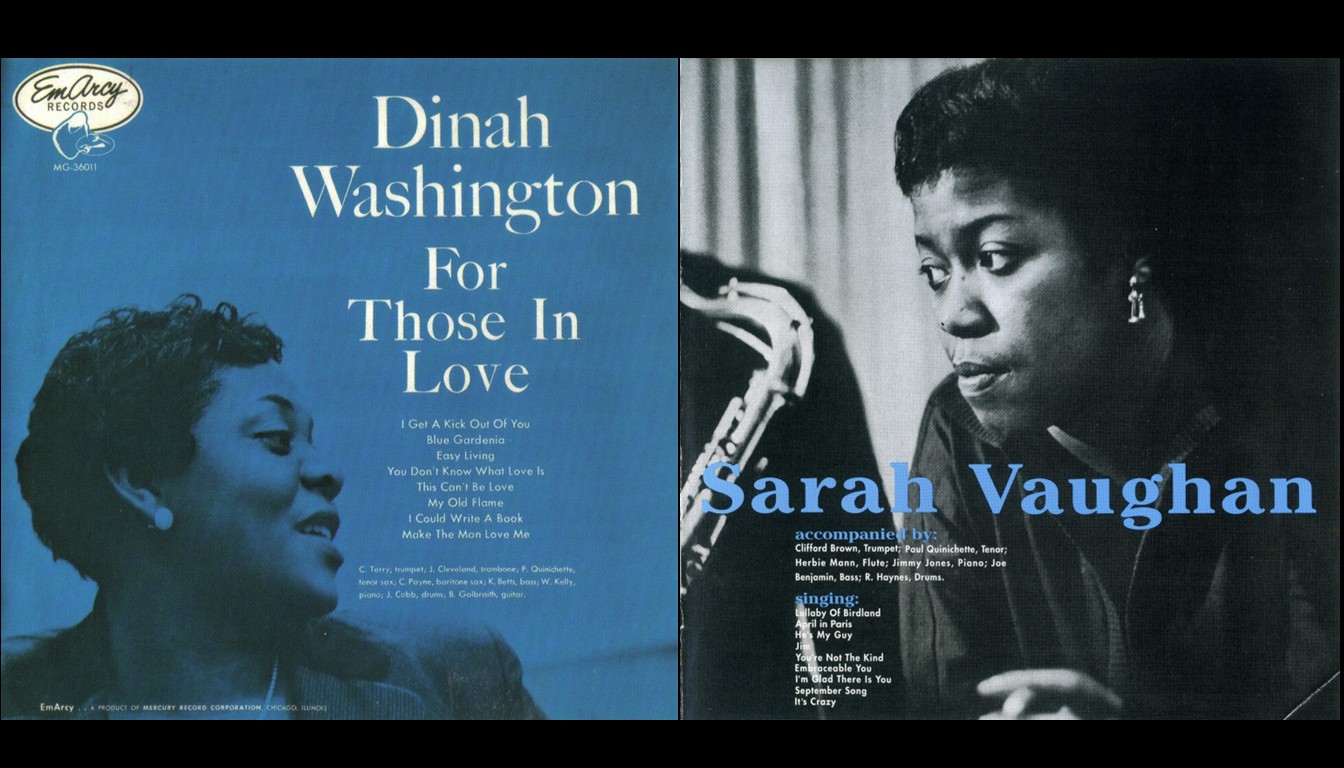
This article is dedicated to two jazz singers who were on a similar trajectory in 1955. Both were signed to the EmArcy label, the jazz subsidiary of Mercury Records. They both split their career between popular and jazz recordings, and shared the same producer with Bob Shad. And curiously, they both released fantastic albums that year featuring the young and legendary trumpeter Clifford Brown.
1955 opened for Dinah Washington with a review of her latest album ‘After Hours with Miss “D”’. Downbeat magazine noted that this was her first jazz album, and indeed she was accompanied by some of the best musicians of the time, including Clark Terry on trumpet, Paul Quinichette on Tenor saxophone and Ed Thigpen on Drums. While the review found the musicians performing at a level lower than expected, it summarized the review with, “the album is worth hearing for her ringing clarion calls.”

True to its title, the album was recorded after hours, to capture Dinah Washington when she performed best. The album liner notes explain: “Frequently, after the end of a tiring session, she has suddenly decided that she feels like ‘wailing’. This can happen at any time of day, but most often it occurs somewhere between two and six in the morning.” The sloppiness of the accompaniment mentioned by Downbeat may be explained by the fact that the musicians were called into the studio late at night without the faintest idea what tunes or arrangements they were summoned to play.
The album indeed marked a departure into jazz territories for Dinah Washington, who thus far focused on a repertoire of rhythm n blues and pop songs. In 1954 she also recorded a fine album with the Clifford Brown and Max Roach tentet title Dinah Jams. Both albums are highly recommended. Here is a taste:
The arrangements on the recording of jazz standards improved dramatically in 1955 when a new young arranger joined forces with Dinah Washnton. Quincy Jones, then only 22 and just starting his career as an arranger, remembers how it all started: “I met her at the Apollo Theater and she became a great friend to me. She had heard of the four-horn arrangements I was writing for James Moody, so she hired me to write arrangements with the same instrumentation for her road band.” Coming back from the road, Washington asked him to write the arrangements for her next album. Her label, Mercury Records, hesitated, asking for a proven brand name arranger. Dinah Washington was not to be intimidated. Quincy Jones remembers her telling the heads at Mercury, “Here’s a name, for your ass: Dinah Washington, and Quincy Jones is my arranger.” That settled things.

In March 1955 the two went into the studio with a great cast of musicians that included Clark Terry and Paul Quinichette in the horn section, plus a rhythm section made of Wynton Kelly on piano, Keter Betts on bass and Jimmy Cobb on drums. The resulting album was titled ‘For Those In Love’, one of the finest in her discography. Dinah Washinton and Quincy Jones went on to make ten albums together.
Quincy Jones’ arrangements provide a wonderful backing to Dinah Washington on this set. From the first moments of the album opener, I Get A Kick Out of You, it is evident that Washington is embarking on a fresh style for her, in the best tradition of great jazz singers such as Billie Holiday, Frank Sinatra and Ella Fitzgerald.
The interplay between musicians and singer on this album is worth mentioning. Washington is well-aware of the talent backing her and gives ample space for the instrumentalists to shine. Tenor saxophonist Buddy Collette commented: “A tune might be three minutes, but she’ll figure out a way to open it up where she could hear all of her favorite people on her records. Most artists wouldn’t do that. They will be too self-centered or selfish. But she would surround herself with all-star people, and she’d sing and then she’d stand back and let everybody play. She had a big love for her musicians.”
Collette was not the only one impressed with Dinah Washington. Quincy Jones added his positive view of her musical abilities in the studio: “The fact that Dinah Washington is a musician herself made things much easier. We had just asked her for keys on those tunes, and when we ran down the arrangements, she read the music almost at sight.”

The album’s liner notes emphasized the career shift for the singer and her focus on jazz: “Simultaneous with her continuance of her work in the pop and blues fields, Dinah is now engaged in the fourth phase of her career, represented by the singing of memorable standard tunes which she selects herself, accompanied on records by an all-star line-up of great jazz musicians.”
In July 1955 Dinah Washington performed at the second annual Newport Jazz Festival, again backed by Max Roach and his band. The performance was a triumph, garnering enthusiastic reviews in various publications. Variety wrote that she, “Sent the congregation like no other vocalist except possibly Jimmy Rushing on Sunday night.” Downbeat added: “She took two encores and could have stayed on all night had there been time.”

We’ll end this part of the article with what Quincy Jones had to say about Dinah Washington as a singer and an interpreter of songs. You can tell that his appreciation of her talent only grew over the course of ten albums he made with her: “Dinah had a voice that was like the pipes of life. She could also do something a lot of singers then and now could not do: She could take a melody in her hand, hold it like an egg, crack it open, fry it, let it sizzle, reconstruct it, put the egg back in the box and back in the refrigerator, and you would’ve still understood every single syllable of every single word she sang. Every single melody she sang she made hers.”
One night in 1955 when Dinah Washington was singing at Week’s club in Atlantic City, another Mercury Records singer was in the audience. Dinah invited her onstage, and the two sang together, clearly enjoying the experience. The other singer was Sarah Vaughan, who also had a stellar year in 1955.

After spending the first part of her career as a jazz singer in the 1940s, Sarah Vaughan crossed over to the world of pop in 1948 with the hits ‘Its Magic’ and ‘Nature Boy’, covering songs that became famous by Doris Day and Nat King Cole. She then signed to one of the major labels, Columbia Records, where for the next five years she focused on pop ballads. Although she enjoyed the success that came with these pop singles, she longed for the ability to express herself in the style she grew up on: “There’s nothing necessarily wrong with being commercial, but there’s a point beyond which you can’t go without being ridiculous. There are some tunes I just won’t do. Music is always more important to me than getting with each new hit.”
In 1953, Vaughan signed a contract with Mercury Records that stipulated she would record commercial material for Mercury and jazz-oriented material for its subsidiary, EmArcy. She called that two-contract arrangement, ”one for pops and one for me.” At the end of 1954 she released a popular song with Mercury titled ‘Make Yourself Comfortable’. It was her highest chart position to date, reaching no. 6 on Billboard’s Top 100. A month later she told this story to Downbeat magazine: “A guy at Birdland was standing at the bar. He came over and said, ‘I’m not buying any of your records anymore! For the first time, you have a hit. You’re going to change! I feel it. And I never thought you’d do a thing like that.’ I just looked at him. The man was really serious. Now what can I say? I guess he hadn’t heard any of the EmArcy sides. Of course, I’ll never change. I couldn’t.”

Indeed, those EmArcy sides that Sarah Vaughan held dear contain some of the best vocal jazz performances of that period and of her career. She was paired with producer Bob Shad, who also worked with Dinah Washington. Shad knew how to dress up the arrangements behind talented jazz artists who wouldn’t otherwise be able to reach a large audience, and market them to non-jazz listeners. In an interview he gave in 1956, he said: “We’ve taken people like Clifford Brown and recorded him with Max Roach and the small group. They are just swinging. They’re playing completely uninhibited music. And then we take the same artist and we record him with Neil Hefty and Strings. We’ve reached two complete markets, the jazz market and a pop market. The pop consumer suddenly realizes there’s an artist called Clifford Brown. He’s brought closer to jazz by the strings. And immediately he’s looking for something else with Clifford Brown and he buys a jazz record.”
The interviewer went on to mention Sarah Vaughan, and Shad confirmed that she was able to reach a bigger market. When the interviewer commented that, “Sarah not only has the opportunity to record, as perhaps she prefers with jazz musicians, but also has the opportunity to pay her rent and make some money”, Shad replied, “Yes, we’re no different than anyone else. We still pay the food bills.”

In 1955 Sarah Vaughan released a self-titled album that she recorded in December 1954. Many consider it her top jazz album, and Sarah Vaughan herself said it was her favorite and best work. As with Dinah Washington, Bob Shad invited trumpeter Clifford Brown to join the recording session, which took place at Fine Sound Studios in New York. All musicians on this set are excellent, including Vaughan’s steady trio of Jimmy Jones on piano, Joe Benjamin on bass and Roy Haynes on drums. Add Paul Quinichette on tenor saxophone and Herbie Mann on flute and you have the making of a great ensemble and a wonderful album.
The album opens with a great rendition of a jazz standard, giving all musicians an opportunity to shine. From the album’s original liner notes: “The set opens with a tune to which it is hard to bring any new ideas. Yet Sarah, adding a little wordless introduction and coda, and trading four-bar phrases with the horns as she bops her way through one chorus, brings fresh life to the much-recorded George Shearing tune ‘Lullaby of Birdland’.
The music press was unanimous in its praise of the album. Billboard wrote in its ‘Review and Ratings of New Popular Albums’ column (it was either classical or popular, a jazz category did not exist back then): “Here are nine examples of Sarah Vaughan’s vocal gifts. Her individual phrasing, her highly distinctive mannerisms are in the grooves. For the dealer with any jazz trade at all, this package is virtually a must.”

Downbeat magazine raved about the album in its May 1955 review, giving it five stars. It wrote: “The selection of numbers is well balanced, and the accompaniment is almost everywhere in context. There is a wonderfully sustained mood of relaxation and emotional warmth. As for Sarah herself, she is obviously finding her new split contract (whereby she records pops for Mercury and jazz for EmArcy) a satisfying arrangement. She sings more freely here than even in most of her night club appearances. There is less of the emphasis on virtuoso effects and more on the kind of after-hours singing Sarah excels at.”
Sources:
Q: The Autobiography of Quincy Jones
Queen: The Life and Music of Dinah Washington, by Nadine Cohodas


Leave a Reply