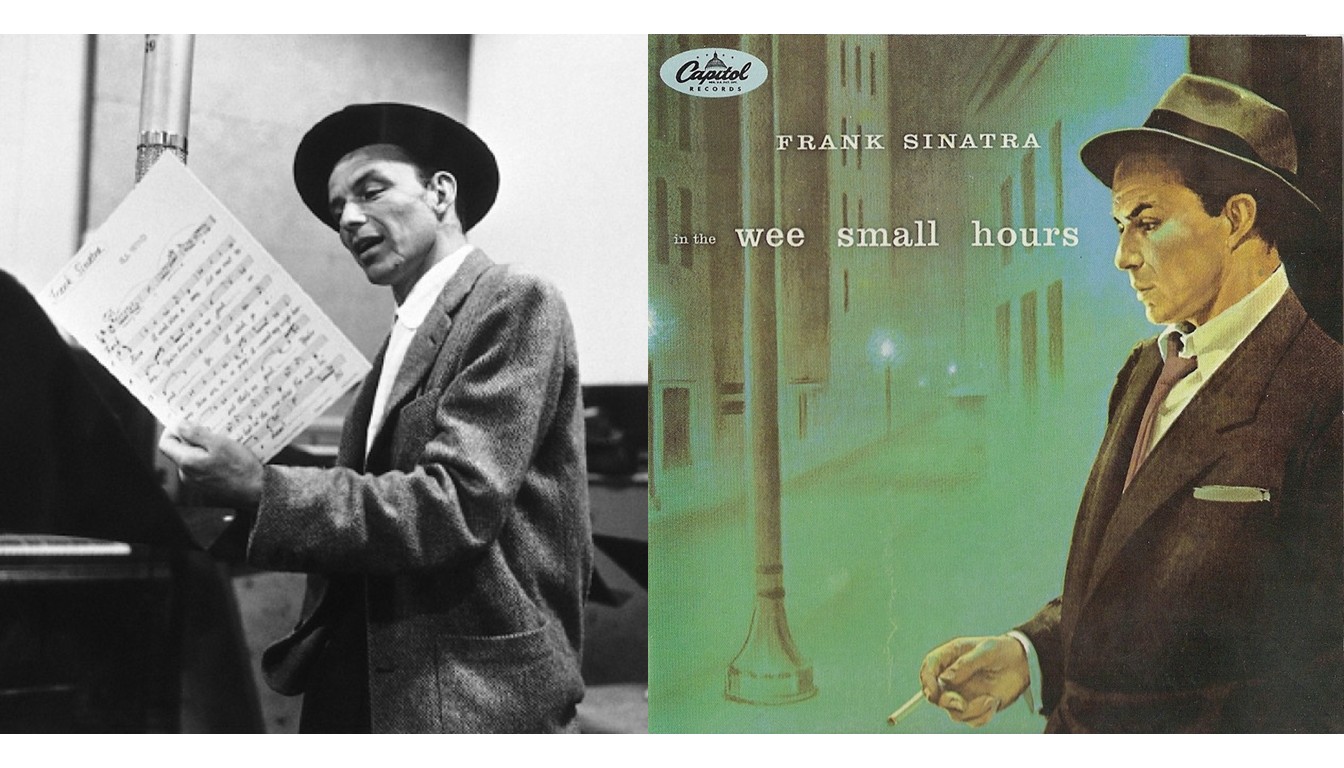
In 1955 Frank Sinatra was two years into his contract with Capitol Records. When the label signed the singer in 1953, Sinatra was deep in a five-year slump. His last studio album with Columbia Records was released in 1950, after a series of lukewarm albums and songs. Sinatra was heading towards a has-been status when Capitol’s vice president Alan Livingston, confident of Sinatra’s talent but unsure about his prospect for success, offered him a one-year contract. Little did he know that Sinatra would go on to record 300 songs with the label over the next eight years, and produce some of his best albums. 1955 in particular was a great year for Sinatra, with fifteen recording sessions for Capitol, yielding two iconic albums: In the Wee Small Hours and Songs for Swinging Lovers.
In 1953, for his first recording session with Capitol Records, Sinatra loyally insisted on using the services of Axel Stordahl, his musical director during his tenure with Columbia Records. The results were not dissimilar to his output just before he left that label, and Alan Livingston knew that a different approach was needed. As writer David Halberstam summarized it, Sinatra of the 1940s, “had produced music that was quite pleasant to listen to and comfortable to dance to but seemed to hold no mysteries, no genuine emotion.” Livingston was impressed by the work of Nelson Riddle, who wrote the arrangements for one of the label’s big stars, Nat King Cole. The label found success with his singles, including “Mona Lisa” and “Unforgettable”, both scored by Riddle. But the arranger was an unknown entity to Frank Sinatra, and some cunning on the part of Capitol Records’ execs was needed.

For his second session at Capitol in April 1953, they invited Nelson Riddle to the studio. The arranger remembers: “I heard that they put Frank with Billy May, but that Billy was out of town with his band, doing live dates down south. So I went in, and did two sides like Billy May would do them (“I Love You” and “South of the Border”), and two sides like I would do them (“I’ve Got the World on a String” and “Don’t Worry ‘bout Me”).” Alan Dell, a house producer for Capitol, picks up the story: “Frank came in, and saw a strange man on the podium, and he said, ‘Who’s this?’ I said, ‘He’s just conducting the band—we’ve got Billy May’s arrangements.’ They went into ‘I’ve Got the World on a String’ and he said, ‘Hey, who wrote that?’ and I said ‘This guy—Nelson Riddle.’ Frank said ‘Beautiful!’ and from that, the partnership started.” Sid Avery, a photographer present in the studio that day, remembers it in more vivid terms. When Sinatra listened to the playback he exclaimed, “Jesus Christ! I’m back, baby, I’m back!”

The partnership between Frank Sinatra and Nelson Riddle would become legendary, producing the most memorable songs and albums during the singer’s contract with Capitol Records. But as fruitful and artistic as it was, easy it wasn’t. Riddle remembers: “Working with Frank was always a challenge. There were times when the going got rough. Sinatra was a perfectionist who drove himself and everybody around him relentlessly. You always approached him with a feeling of uneasiness, not only because he was demanding and unpredictable, but because his reactions were so violent. But all of these tensions disappeared if you came through for him.”

It may not be known as a common fact, but Frank Sinatra was very instrumental in the process that led to the writing of musical arrangements for his recording sessions. He talked about that aspect of his involvement: “Once we choose the songs that will be in a particular album, I’ll sit with Bill Miller, my pianist, and find the proper key. Then I will meet with the orchestrator, and give him my thoughts on what I feel the background should be, from either eight measures to eight measures, or four measures to four measures. Should we use woodwinds, or brass, or strings behind the vocal? Usually, we wind up doing it the way the arranger feels it should be done, because he understands more than I do about it.” Sinatra had the utmost respect for Nelson Riddle, recognizing a true partner with immense talent in creating arrangements that suited his voice and vocal delivery: “He’s got a sort of stenographer’s brain. If I say to him at a planning meeting, ‘Make the eighth bar sound like Brahms,’ he’ll make a cryptic little note on the side of some scrappy music sheet, and sure enough, when we come to the session, the eighth bar will be Brahms. If I say, ‘Make like Puccini,’ Nelson will make exactly the same little note, and that eighth bar will be Puccini all right, and the roof will lift off!”

In a span of one month in 1955 Sinatra and Riddle recorded an album that would become a defining statement for the singer and one of the most revered records of his career. In contrast to his previous albums, this time around Sinatra spent significant time planning the album. The process would become a blueprint for all his albums with Capitol to follow. He talked about it in detail: “First, I decide on the mood for an album, and perhaps pick a title. Or sometimes it might be that I had the title, and then picked the mood to fit it. But it’s most important that there should be a strong creative idea for the whole package. Then I get a short list of maybe sixty possible songs, and out of these I pick twelve to record. Next comes the pacing of the album, which is vitally important. I put the titles of the songs on twelve bits of paper, and juggle them around like a jigsaw puzzle until the album is telling a complete story, lyric-wise.”

Fifteen of the sixteen songs that make the album “In the Wee Small Hours” were recorded in four recording sessions held in February and March of 1955. One more song was added from a recording that took place in March 1954. Sinatra was recovering from his separation from film star Ava Gardner and most songs of the album reflect the state of mind he was in at the time. Riddle said of the songs they recorded for the album: “It was Ava who did that, who taught him how to sing a torch song. That’s how he learned. She was the greatest love of his life, and he lost her.” A quick glance at the song titles tells a story: “Glad to Be Unhappy”, “I Get Along Without You Very Well”, “When Your Lover Has Gone”, “I’ll Never Be the Same”. You get the idea. The metamorphosis in Sinatra’s style compared to his 1940s output was, as David Halberstam wrote, profound. He now sang “so well and so privately that he achieved a musical conversation with his audience. He seemed to understand better than anyone the conundrum of love—how hard it is for two people to be at the same emotional place at the same time.”

The story of how the title song came to be is worth telling. Songwriting duo Dave Mann and Bob Hilliard were engaged in a game of poker late one night. At 3am Mann, who was losing badly, called it quits. Hilliard said, “why don’t we write a song?” Mann: “It’s the wee small hours of the morning, what the hell are we gonna write about now?” Hilliard: “You answered your own question – the wee small hours.” A few sketches ensued, at which point Mann folded the lead sheet and put it in his pocket. Next day the two are walking leisurely to their place of work, the Brill Building. A car stops next to them and who jumps out but Frank Sinatra and his buddy Nelson Riddle. The two are in pursuit of songs that fit their concept of melancholic songs about love and other unlucky endeavors. What does Mann do in that predicament? Reaches out to his pocket and pulls a lead sheet of a song about the wee small hours of the morning. The rest is history – the song became the title of the album, its opening song, and the one that sets the mood for the rest of it, including the iconic album cover showing Sinatra with a snap-brim fedora and a cigarette in his hand.
Sinatra’s delivery on this song is very effective, setting the stage for an album best listened in the… wee small hours. He talked in detail about the importance of song lyrics: “I’ve always believed that the written word is first, always first. You must look at the lyric, and understand it. Find out where you want to accent something, where you want to use a soft tone. The word actually dictates to you in a song—it really tells you what it needs. I figure speech is the same way. Syncopation in music is important, of course, particularly if it’s a rhythm song. It can’t be ‘one-two-three-four/one-two-three-four,’ because it becomes stodgy. So, syncopation enters the scene, and it’s ‘one-two,’ then maybe a little delay, and then ‘three,’ and then another longer delay, and then ‘four.’ It all has to do with delivery.”
Trumpeter Harry “Sweets” Edison, a mainstay on many Frank Sinatra recordings, talked about his experience playing Nelson Riddle’s arrangements: “I met Nelson Riddle in the early 1950s, and in those days, I was reluctant to go into the studios. I wasn’t equipped to do studio work. My reading wasn’t that fast. Nelson Riddle was the most patient man I’ve ever been with. I would get to a date a half-hour before, and he took time to show me how things would go. I had so much fun playing with Sinatra. It was a compliment to me for him to request me all the time.” Riddle accommodated Edison in his arrangements, many times abstaining from writing any musical parts out for him. Instead, he set the trumpeter apart from the horn section and gave him his own microphone. Here is a fine example of Edison’s contribution on the classic standard Mood Indigo:
Nelson Riddle has his own story to tell about Harry Edison during a Frank Sinatra recording session: “Harry Edison showed up at a Sinatra date once with a policeman on each arm. He’d run several red lights, and the cops nailed him. When they asked, ‘What’s all the speed, Mr. Edison?’ he said, ‘I’m on my way to a Sinatra recording date.’ ‘Sure you are.’ So Harry said, ‘All right, come with me, and I’ll show you.’ And the three of them marched into the recording session, and there was Frank and everyone else. So they released him, laughed, and walked away!”
A feature article in Music Views magazine from May 1955 sheds more light on the recording sessions from the perspective of a non-musical guest. Writer Rita Kirwan was invited to the studio as part of a handpicked audience. She witnessed one of the four-hour sessions that took place between 8pm and 12am: “Sinatra takes a gulp of the lukewarm coffee remaining in the cup most recently handed to him, and then he lifts the inevitable hat from his head a little, and plops it right back, almost as if he’d wanted to relieve pressure from the hat band. The studio empties fast; just music stands and chairs remain. Sinatra hops onto one of the chairs, crosses his legs and hums a fragment of one of the songs he’s been recording. He waves to the night janitor now straightening up the studio and says, ‘Jeez. What crazy working hours we’ve got. We both should’ve been plumbers, huh?’”

Nelson Riddle worked hard to find suitable musical contributions to complement Sinatra’s style. The singer would come up to him with suggestions that pushed the arranger beyond his comfort zone. Riddle remembers: “On one song he wanted a Puccini sound behind him on. Well, anybody with half a thorough musical knowledge would immediately know what that was. But I had to go to the library and open a Puccini score, because I had studiously avoided operatic music. I found that what he meant by a ‘Puccini sound’ was that the melody is doubled in octaves in the orchestra—and that is what he wanted.” But Riddle knew his craft when it came to setting up the mood from the first moment of a song. Listening to “In The Wee Small Hours”, every song starts with an arrangement that fits the song like hand to glove. Riddle: “Most singers require an introduction, so you have the first say as far as setting the mood. If you can find something within that introduction that has mileage in it, you can use it in certain breaks in the melody later on. That keeps it interesting. Also, it gives the overall orchestration a subtle cohesiveness which nevertheless is felt, so it seems to be a particular arrangement written especially for this song, whatever the song is.” Here is one of these openings with a mileage in it:
While the album represents an early collaboration between the two, it is interesting to hear how tightly Riddle and Sinatra worked with each other. Riddle had to learn on the job how to find his place alongside a star performer: “In working out arrangements for Frank, I suppose I stuck to two main rules. First, find the peak of the song and build the whole arrangement to that peak, pacing it as he paces himself vocally. Second, when he’s moving, get the hell out of the way. When he’s doing nothing, move in fast and establish something. After all, what arranger in the world would try to fight against Sinatra’s voice? Give the singer room to breathe. When the singer rests, then there’s a chance to write a fill that might be heard.”
Riddle had to find the right rhythm and tempo for each of the numbers, while keeping a cohesive feel on the album: “Most of our best numbers were in what I call the tempo of the heartbeat. That’s the tempo that strikes people easiest because, without their knowing it, they are moving to that pace all their waking hours. Music to me is sex—it’s all tied up somehow, and the rhythm of sex is the heartbeat. I usually try to avoid scoring a song with a climax at the end. Better to build about two-thirds of the way through, and then fade to a surprise ending. More subtle. I don’t really like to finish by blowing and beating in top gear.”

One more inside story from the recording sessions comes from guitarist George Van Eps, who is knows for inventing the seven-string guitar by adding a bass string to the common six-string guitar. He played on a number of Frank Sinatra albums in the 1950s, and worked with many jazz singers including Peggy Lee, Rosemary Clooney and Tony Bennet. He recalls: “We were recording ‘Last Night When We Were Young’ for the In the Wee Small Hours album. The coda was mainly strings and horns—very low key—and there was a very short guitar solo in the mid-guitar range, which is the baritone range. The phrase was a total of six notes, written as quarter and eighth notes. We rehearsed the arrangement, and Frank sang along with it. When we were finished, Frank noted that there was something wrong with the coda. He came over to me very slowly (he had to carefully climb over other musicians), and he just said ‘I’m gonna tell Nelson that the guitar solo should be played slower, but I wanted to tell you first so you can prepare for it.’ Then he went back to the podium, and told Nelson that he’d like the guitar solo to be played much slower. Frank had respect for Nelson—he didn’t go over his head. He asked him first, but he warned me also, which is fair at both ends. So Nelson called over to me, ‘George, we’re going to slow the solo way down. You take your time with it, and then I’ll follow you.’ So I played the solo in half-time; it was much more relaxed, very laid back. That was good musicianship, and it was Frank’s idea. Frank was loaded with things like that.”
In The Wee Small Hours was released in April 1955, originally issued on two 10-inch LPs with eight songs each. That was the year when 12-inch LPs came big into the music market, and later in the year the two albums were combined to create Frank Sinatra’s first 12-inch album. It was a success on its release, staying 18 months in the albums chart and peaking at no. 2. Sinatra had a fantastic year in 1955, also starring in a number of films including “Guys and Dolls” and “The Man with the Golden Arm”. In August 1955 he made the cover of Time magazine

The album is one of Sinatra’s most enduring in his discography. It influenced many artists years after its release with its collection of songs linked together in mood and storylines to create a concept album. Tom Waits had mentioned “In The Wee Small Hours” as one of his favorite albums. The cover painting inspired the cover of Tom Waits’ album “The Heart of Saturday Night”. He picked it first in his list of 20 most cherished albums of all time, saying: “Actually, the very first ‘concept’ album. The idea being you put this record on after dinner and by the last song you are exactly where you want to be. Sinatra said that he’s certain most baby boomers were conceived with this as the soundtrack.”
Sources:
Sinatra- The Life , by Anthony Summers & Robbyn Swan
Sessions with Sinatra: Frank Sinatra and the Art of Recording, by Charles L. L. Granata


Leave a Reply