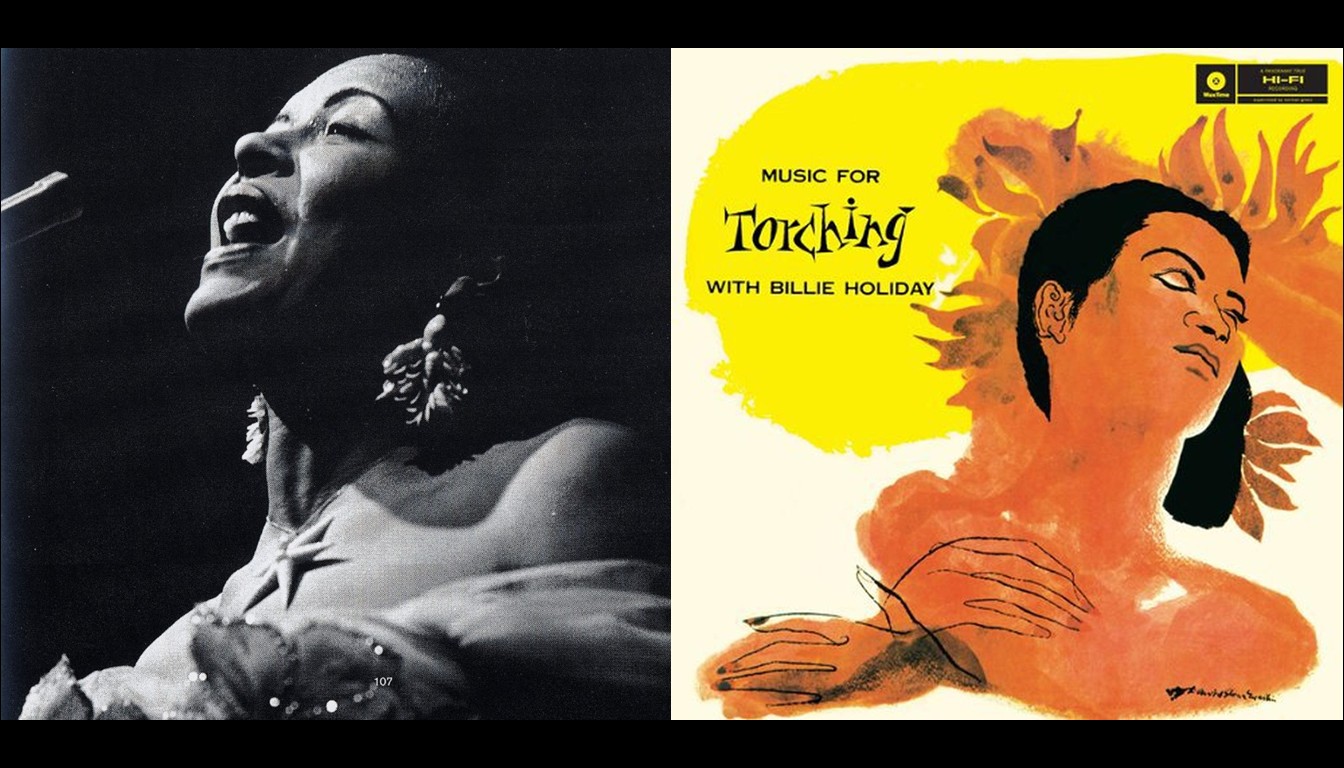
On Valentine’s Day 1955 Billie Holiday went into a recording studio in New York for a session organized by Norman Granz, head of Clef Records. A year later that label would become the foundation from which Verve Records emerged. The musicians assembled for this session included Charlie Shavers on trumpet, Tony Scott on clarinet, Budd Johnson on tenor sax, Billy Taylor on piano, Billy Bauer on guitar, Leonard Gaskin on bass and Cozy Cole on drums. Seven songs were recorded, three of them written by Irving Berlin. The album was released in 1958 under the title ‘Stay With Me‘ and most music magazines reviewed it after Holiday passed away in July 1959.

On January 7, 1960, Downbeat magazine singled out her recording of the song Everything Happens to Me, writing, “It is the heart of the album, a performance of such transparent honesty that it becomes difficult to listen to. She isn’t just singing a lyric about bad luck; she is testifying. Despite the vocal decline, this is essential Holiday.”
In February 1960 Metronome magazine compared the recording to later performances Holiday made before her death: “It is a relief to hear her in such robust company after some of the thinner recordings of her final months. There is a ‘live’ feel to this set. In Ain’t Misbehavin’, Billie shows a flash of the old humor, playing with the melody in a way that suggests she was having a rare good day in the studio.” The review concluded with the note, “It is a record of a survivor, released at a time when we are all too aware that she didn’t survive. It belongs on the shelf of anyone who values the ‘spirit’ of jazz over the ‘perfection’ of the conservatory.”
A week after the recording, a Downbeat club review from February 1955 observed Holiday in a live setting: “Miss Holiday now sings around the beat rather than on it, reshaping even familiar material into something startlingly personal.” Another critic said that compared with Billie Holiday, all other women singing about love, “sound like little girls playing house.”

Billie Holiday’s crown achievement in 1955 came in August when she recorded two sessions in Los Angeles with a stellar cast featuring Harry “Sweets” Edison on trumpet, Benny Carter on alto & tenor saxophone, Jimmy Rowles on piano, Barney Kessel on guitar, John Simmons on bass and Larry Bunker on drums. The sessions yielded enough material for two albums, ‘Music for Torching with Billie Holiday’ and ‘Velvet Mood’. Norman Granz aimed to capture Holiday in an cozy, after-hours setting. He found that setup most suitable for the singer in her late career, maintaining a relaxed atmosphere compared to her peak during the swing-era. In a 1954 interview Billie Holiday said that unless she has a great arranger like Gordon Jenkins to work with in a big band setting, “I prefer a small group, because it’s more intimate, and you can hear yourself and you can hear the band.”
A day before the first session Billie Holiday and pianist Jimmy Rowles rehearsed over 20 songs. Rowles first met Billie Holiday fifteen years earlier when he was in Lester Young’s group. The only decent piano he could find was at bassist Art Shapiro’s home, where Shapiro turned the tape recorder on. Some of the in-between discussions were captured on tape. During a run through of the standard ‘Nice Work If You Can Get It’, Billie asks to write the lyrics underneath the keys to the song, because, “I won’t remember it tomorrow. See I’ll be in a different mood. That’s why I can never sing the same way. I can’t do it because I don’t always feel the same. I just can’t do it. I can’t even copy me.” When practicing the song “I Don’t Want to Cry Any More”, written by composer Victor Schertzinger for the 1940 film ‘Rhythm on the River’, Billie is heard reflecting on her connection to the songs, saying, “When I sing a song it’s got to mean something to me, something I’ve had to live. Otherwise I can’t sing. But a tune like this, man.”
Music for Torching with Billie Holiday was released in October 1955 on Clef Records. It immediately received high praise from music publications and is considered one of her best late-career albums. Downbeat reviewed it twice in November and December, writing in the first review, “This is the best Billie Holiday LP in some time. The accompaniment is ideally suited to Billie’s present vocal needs. The backgrounds are simple, tasteful, and consistently swinging in a relaxed, understated way. Edison and Carter have several excellent solo spots.”

Benny Carter had a long history of recordings with Billie Holiday, starting in 1936 on a session led by Teddy Wilson. Jimmy Rowles, who would go on to play many sessions with Benny Carter including recordings with Peggy Lee, had nothing but praise for the talented saxophonist and arranger: “He shows up and everybody had best cool it. He’s got a charisma, a strong personality. He could almost whip Joe Louis if that’s how mad he got. He’s the only man in the world who could tell Ben Webster to go sit in the corner. When I was learning to play, I played his records and studied his solos, because he’s a teacher. When he picks up his horn, you better watch out. Lady loved him. Respect. She’d tell one guy, ‘Oh you motherfucker, but then to Benny, ‘Uh, Benny, would you mind . . .’”
The Downbeat reviews focused mostly on Billie Holiday herself, admiring the vocal style she adopted when playing with small combos: “There is still that occasional ‘cracking’ and the range is increasingly limited, but her unique ability to reshape a phrase and her incomparable rhythmic sense are still very much present. As is true of almost all Billie’s work, the emotional impact of her singing more than compensates for the vocal technicalities she has lost over the years.” The review of the album in Downbeat’s December issue focused on the significant difference between her vocal delivery of the past and present: “As for the singing, I suppose that the nostalgic will repeat automatically that this isn’t the Billie of 15 and 20 years ago. Of course it isn’t. Nobody stays the same, least of all in the art of self-expression. This is a Billie who has experienced a lot of pain and some joy in the years between and a Billie whose life-perspective has changed. She sings more reflectively and less hopefully but with no less depth and warmth. When she’s right—and she’s absorbingly right on these sides—no one yet is able to touch Billie as the most emotionally striking singer in jazz, 20 years ago or today.”

The British Jazz Journal magazine summarized the album well: “The youthful lilt of the 1930s is gone, replaced by a dark, sometimes harsh quality. In Music for Torching, the tempo is almost always a slow crawl, allowing Billie to hang onto notes until they nearly break. The small group accompaniment is superb—Rowles and Kessel are particularly empathetic. While not for those who demand ‘pretty’ singing, this is a masterful display of jazz phrasing.”
During the sessions in August 1955 Billie Holiday recalled a story that she related to her studio musicians when they were impressed by her knowledge of music keys they were playing: “When I first started, I got insulted. My first job, I didn’t get the job at Ed Small’s. I was a little kid and I went in there. I was about thirteen. I get in there and I’m all ready to sing and this cat asks me, ‘What key you singing in?’ I said ‘I don’t know, man, you just play.’ They shooed me out of there so fast, it wasn’t even funny.” She learned her lesson well.

The rest of the tracks recorded in August 1955 were released a year later in 1956 on the album Velvet Mood. Downbeat magazine was consistent in its praise of the music produced on these sessions: “There has been much discussion about the ‘deterioration’ of the Holiday voice in recent years. While it is true that her range is smaller and the sound is sometimes thin or strained, those who focus only on the technical flaws are missing the point of jazz singing entirely. Billie is a musician in the truest sense; she uses her voice as an instrument, and her phrasing here is a masterclass in timing and emotional intelligence.”. It singled out the tracks are What’s New? and I Hadn’t Anyone Till You, ending the review with this gem: “If I weren’t a fortunate, nonpaying reviewer, I’d pay $10 just for What’s New?”
The rave reviews by Downbeat magazine must have been particularly satisfying to Billie Holiday. In November 1955 she wrote a letter to her close friend Rev. Norman O’Connor. In it she mentioned her latest album: “My new album for Granz is out and it’s called ‘Music for Torching’. Who knows, it may get a good review from Deadbeat.” Mission accomplished.
Sources:
The Complete Billie Holiday on Verve 1945-1959 book, 1992
Wishing on the Moon: The Life and Times of Billie Holiday, by Donald Clarke

Leave a Reply