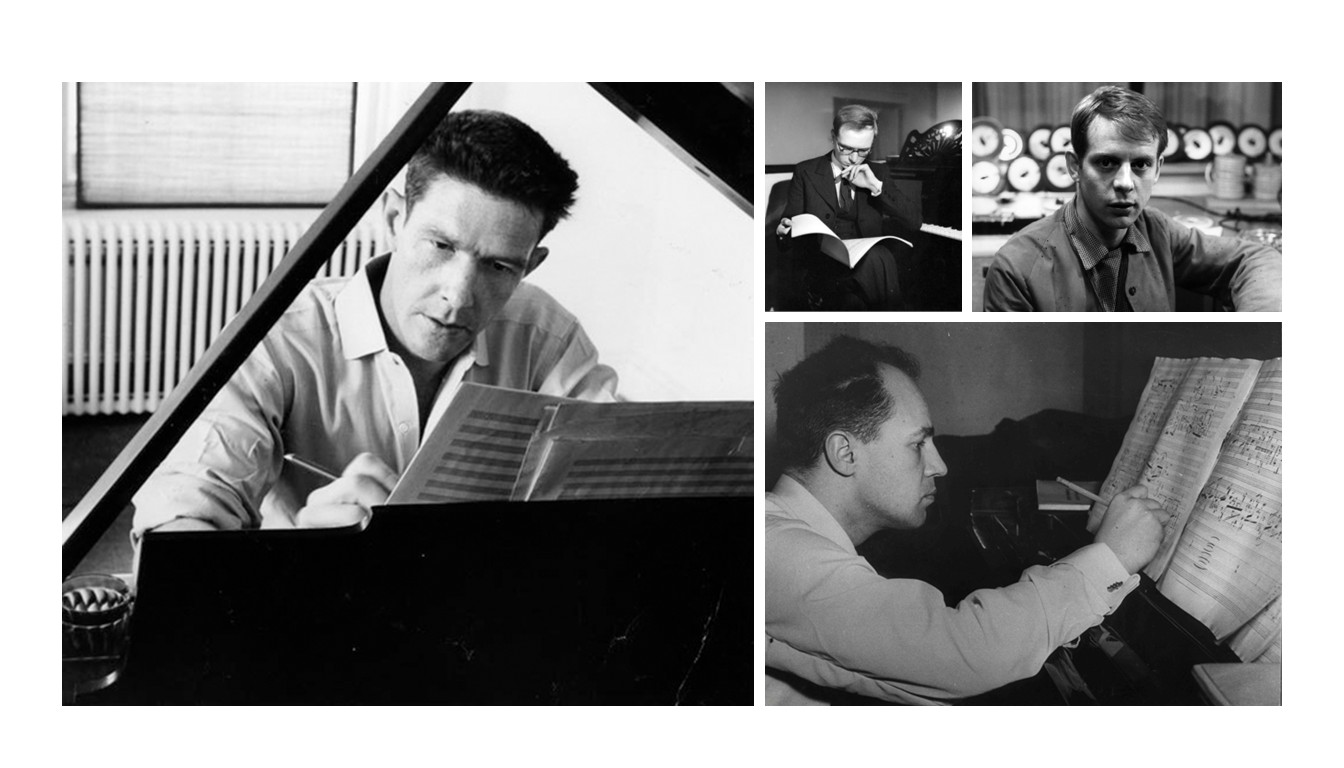
1950 was a pivotal year for a number of modern classical music composers, some of them at the very beginning of their career. They experimented with new methods of composing techniques, and implemented mathematical concepts to break long-established rules of melody, harmony and rhythm. We start with an American composer and then move to the continent.
John Cage – String Quartet in Four Parts
In 1950 John Cage was at a transitional phase of his musical career. In the previous 20 years he composed percussion scores and invented compositional theories, worked with modern dance groups and Eastern music and most famously, invented the prepared piano technique. In the next 20 years he would devote much of his time to experimentation with chance in his compositions. But in 1950, between these two distinct phases, Cage completed one of his calmest and most meditative compositions, String Quartet in Four Parts.
Cage did not compose for string quartets often. Apart from an early quartet in 1936 and three more compositions in the 1980s, String Quartet in Four Parts is the only other work he created for that ensemble. Before he started working on it, he told his parents that he wanted to compose a work that would praise silence without actually using it. Work on the quartet commenced from the summer of 1949, while Cage travelled to Paris with his partner, dancer and choreographer Merce Cunningham. During his stay in the city of lights, he met Pierre Boulez and the two struck a friendship that continued after Cage left Paris via letter correspondence.

In a letter from May 1951 Cage wrote Boulez: “In Paris I began the String Quartet. The quartet uses gamut of sounds, some single and some aggregates, but all of them immobile. There are no superpositions, the entire work being a single line. Even the tempo never changes. The sound of the work is special due to using no vibrato.” If this sounds to you like a challenging, although intriguing, listening experience – you are correct on both accounts. The work indeed praises silence without actually using it
In the string quartet Cage introduced a new compositional technique he called gamuts: a collection of made-up chords, each with a distinctive timbral quality. Cage described them as a group of stones or shells he might pick up on the beach, random notes with unique sound characters. They can include whistling harmonics and scraping strings with the wood of the bow. Rhythmically, the quartet is organized in an arbitrary arithmetic sequence that determines a structure of phrases. To the listener’s ear it sounds like unpredictable sequence of notes. Cage referred to the quartet as “a single melodic line without accompaniment”, or “a single line in rhythmic space.”

Back in the early 1930s, when Cage studied with Arnold Schoenberg at UCLA, he told his master teacher that he had no feeling for harmony. Schoenberg warned him that one day he would hit a wall through which he wouldn’t be able to pass as a composer. Cage was undeterred, replying, “I will devote my life to beating my head against the wall.” His system of gamuts, utilized heavily in String Quartet in Four Parts, was one way he found in facing that wall. To him the inclusion of traditional harmonies was a matter of taste, from which a conscious control was absent. When he completed the composition, he was elated by his discovery of this new way of composing. In one of his letters, he wrote: “This piece is like the opening of another door; the possibilities implied are unlimited.”
The quartet has four movements, inspired by the Hindu imagery of the seasonal cycle. The four seasons—spring, summer, autumn, and winter—are each associated with a particular force: creation, preservation, destruction, and quiescence. Cage added descriptions to the movements:
Quietly Flowing Along – Summer
Slowly Rocking – Autumn
Nearly Stationary – Winter
Quodlibet – Spring
Here is the first movement, Quietly Flowing Along, performed by LaSalle Quartet:
Shortly after completing the string quartet, Cage continued experimenting with the same techniques of gamuts and set rhythmic structures. He used very similar sonorities made of single tones, intervals and aggregates, each created independently of the others. Later in 1950 he completed composing his work Six Melodies for violin and piano, which he called a postscript to the String Quartet in Four Parts. The violinist is instructed in the score to play without vibrato and with minimum weight on the bow.
Pierre Boulez – Polyphonie X
We move to John Cage’s pen pal in 1950 and one who was also experimenting with new compositional techniques. Pierre Boulez was at the beginning of his career that year, having published mostly piano and vocal works in the late 1940s. In 1950 he turned his attention for the first time to a purely orchestral composition. In a letter to John Cage he wrote: “As you see, the work is on a pretty large scale. I want here before all else to rid of the idea of a musical work meant for the concert hall, with a definite number of movements. My idea is a book of music comparable in dimensions to a book of poems.”
Boulez’s starting point was Arnold Schoenberg. The twelve-tone method that Schoenberg invented had been in practice for a couple of decades, with compositions like his Variations for Orchestra and Piano Concerto already well-known. Schoenberg’s serial technique of composition with twelve notes became one of the most influencing methods to young and upcoming composers. Boulez took the pitched serialism that was Schoenberg’s focus, and expanded it to integral, or total, serialism, wherein many parameters of a piece’s construction are governed by serial principles, rather than only pitch. The new method promoted total control over all sound parameters through the use of series. All sound parameters of a composition become serialized: duration, pitch, dynamics, timbre, articulations.

Boulez later said of that period: “All my attention that year has been given to widening the scope of the series and making it homogeneous. With the thought that music has entered into a new form of its activity – serial form – I have tried to generalize the notion of series.” In 1950 Boulez started working on his composition Polyphonie X, where he particularly focused on rhythmic serialism, a musical technique that uses a repeating series of durations to organize rhythm. It’s a type of serialism, but one that applies that concept to the rhythm of the notes instead of their tone. In a 1974 interview with Dominique Jameux, Boulez expanded on his thoughts of that concept: “What I aimed at here was a complete realization of all the possible ways in which not only the series but the rhythmic cells could evolve. I made use of rhythmic cells rather than durations because it seemed a better idea, more musical, to work with groups rather than with units of time.”
Boulez explained the title of that composition: “X is simply X, neither a letter of the alphabet, nor a number, nor yet an algebraic symbol. It is rather a graphic symbol. I called this work Polyphonie X because it contains certain structures that intersect in the sense of augmentations and diminutions arising from their encounter, as well as similarly conceived rises and falls in the sound, and finally a series of rhythmic cells that intersect in like manner. It is moreover these cells which comprise the main ingredient of the work on the structural level.”
Polyphonie X is written for seven groups of instruments, each group made of related instruments: two groups of woodwinds, one of brass, two of percussion – pitched and unpitched, and two groups of strings. On an invitation from Heinrich Strobel, director of musical services at the Südwestfunk in Baden-Baden and artistic director of the Donaueschingen Festival, Polyphonie X was premiered at that festival in 1951 under the direction of Hans Rosbaud. It caused a riot due to its radical approach to composition.

Boulez later withdrew Polyphonie X, stating that it suffered from “theoretical exaggeration”. In a 1952 letter to Belgian composer Henri Pousseur, he wrote: “I fear I let myself go a little too far, in terms of virtuosity of pointillist technique, without referring to overall compositional sensibility. In other words, the details are not fully integrated within a perceptible whole. This is perhaps the most serious fault with which I reproach myself: by limiting myself to analysis and variation, I am falling into greyness and automatic process.” In 2011, when asked about the potential of revisiting the work, Boulez told Claude Samuel: “It’s unsalvageable! It was suggested, on the anniversary of Donaueschingen, that the piece be reworked, but I looked at it and said, ‘No, it’s not possible’. I cannot enter that chamber where I was at the time; it’s impossible. I’d be asphyxiated immediately.”
Serialism, and particularly integral serialism, are an interesting intersection of mathematical science and music. They explore a systematic and mathematical approaches to composition. For many, the result is inaccessible and emotionally detached. You be the judge:
Olivier Messiaen – Quatre Études de rythme (Four Rhythm Studies)
We remain with France and serialism and come to one of the major proponents of this compositional method. In 1949 and 1950 Olivier Messiaen composed four pieces for piano, collectively titled Quatre Études de rythme (Four Rhythm Studies). They were intended as a set, but each piece was initially published separately, until they were published as a set in 2008. The second movement, “Mode de valeurs et d’intensités” (Mode of Durations and Intensities), became influential to composers who were interested in the serialism of musical parameters other than pitch.
In that movement Messiaen limited the scope of various modes to a set of values: a melodic mode (36 sounds), a duration mode (24 values), an attack mode (12) and an intensity mode (7 nuances). He then applied a set of rules to the notes: each given sound always appears with the same duration, the same intensity and the same attack. As a result, there is an impression that the piece is monotonous, but upon studying it other composers learned a whole new system of composing.

As you listen to the work, the difficulty of playing it becomes quickly evident. It is not only challenging rhythmically, but is unusual for the leeway Messiaen leaves for the interpreter. Because of the music’s radical and experimental nature, it is not always clear how it should be played. Tempo, for example, is marked only by generalized indications, and in the most difficult passages Messiaen offers no help at all. For many performers the true reference point was Messiaen’s own recording of the work, made on 30 May 1951. The recording is unique for being the only one of Messiaen as a solo pianist.
Pianist and musicologist Peter Hill wrote a deep analysis of the movement, and offered this interesting view on the method of serialism: “What fun there is in the piece comes from a feeling of a high-wire aerial ballet, with the flickering motifs in the treble dancing in opposition to the sostenuto gong-strokes in the lower registers, with momentary oases of stillness colored by harmonies of surprising eloquence. Seen in this light, the piece is an ‘étude’ in the sense of a challenge from theorist to composer: how far is it possible to generate music from a fantastically detailed set of a priori rules?”
Karlheinz Stockhausen – Choral, Drei Lieder, Chöre für Doris
We end this article with the youngest composer, one who would very soon encounter Messiaen’s “Mode de valeurs et d’intensités”, a composition that would have a profound influence on him. In 1950 Karlheinz Stockhausen was still enrolled in music studies. From 1947 to 1951, he studied music pedagogy and piano at the Cologne Conservatory of Music and musicology, philosophy, and German studies at the University of Cologne. At the university he met piano student Doris Gertrud Johanna Andreae, his future wife. She was his muse from the moment they met, and even before they got engaged in 1951, Stockhausen dedicated some of his compositions to her.
Stockhausen was a member of the conservatory choir, and his very early works while still a student were written for choir and solo voice. In 1950 he wrote three vocal works, leveraging the twelve-tone system. He ordered a sequence of unique notes to create melodic and harmonic movement, but compared to other works using his system, they have a much more tonal feel. A year later Stockhausen would go deeper into serialism based on Messiaen’s work, and start ordering his duration and dynamic values along with the pitches in the composition Kreuzspiel.

Choral (Chorale) is a short a cappella choral composition for which Stockhausen wrote both the words and music. It has four vocal layers that are sang as a rhythmic unison, but the individual layers have different melodic shapes, resulting in interesting chord harmonies.
Chöre für Doris (Choruses for Doris) is a three-movement a cappella choral set to German translations of poems by French poet Paul Verlaine and dedicated to Doris. After its completion, Stockhausen decided to try his hand with something a little more ambitious for the first time, and wrote the Drei Lieder for alto voice and chamber orchestra. It was Stockhausen’s first composition for instrumental ensemble or solo voice. In the summer of 1950, he began attending the Darmstadt Summer Courses for New Music. He considered Drei Lieder worthy enough to be submitted for performance at the summer course, but it was rejected because the jury had found the text “too brutal, and the composition to be too old-fashioned.” Stockhausen was undeterred and replaced the text of the first song with a German translation of a poem by Charles Baudelaire. The composition later did him justice when he successfully used it as his audition piece for admission to Frank Martin’s composition class at the conservatory.
All three vocal works were left unpublished for 20 years, until Stockhausen revisited his early works and published them in 1971. They were performed for the first time at the Journées de Musique Contemporaine festival, on the request of French composer Maurice Fleuret.
Sources:
The Boulez-Cage Correspondence, by Jean-Jacques Nattiez, Robert Samuels
Leave a Reply