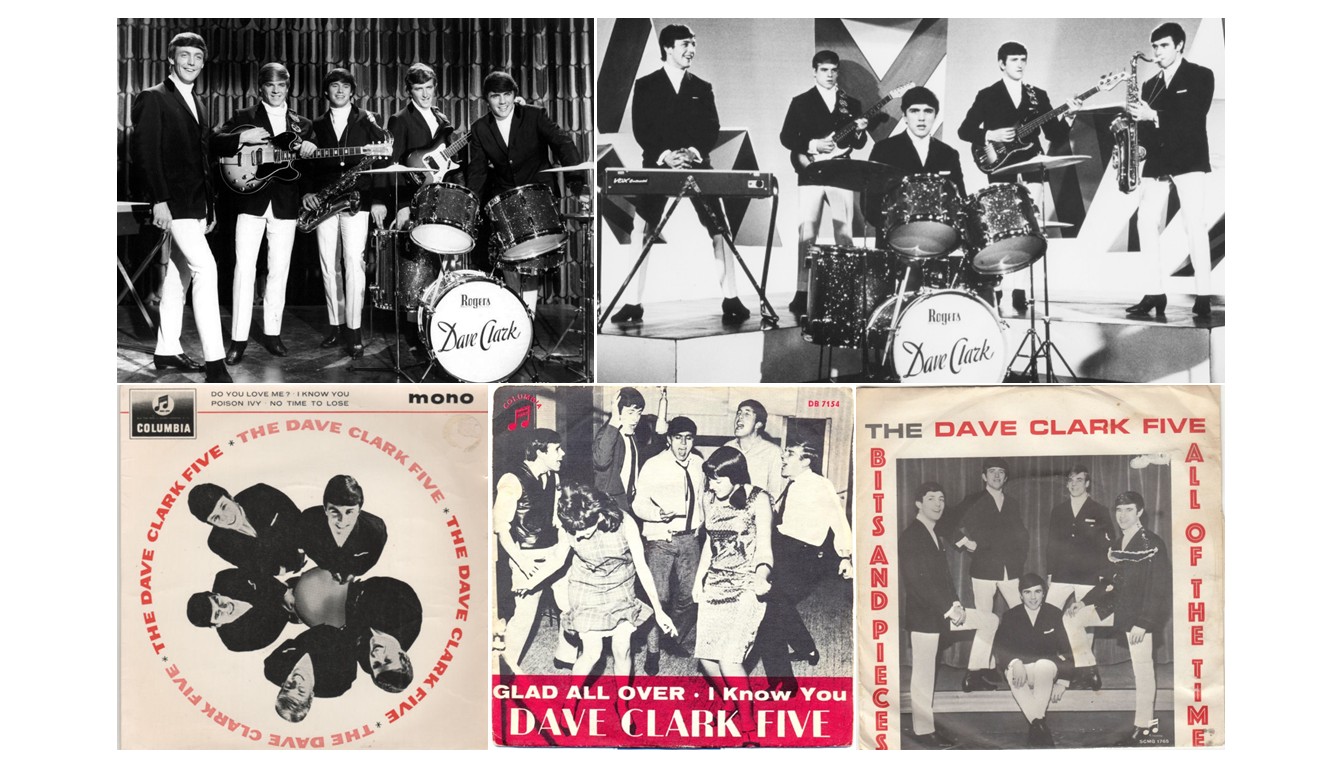
After the phenomenal success of the Beatles in the US charts during the early months of 1964, the road was paved for additional British beat bands to follow. One such band produced the second most top 20 US singles after the Beatles, and was considered a formidable rival of the Fab Four in 1964 – The Dave Clark Five.
Following the onslaught of The Beatles singles ‘I Want to Hold Your Hand’ and ‘She Loves You’ at the beginning of 1964, the American chart gates opened to a myriad of British artists. One of the very first singles to follow was ‘Glad All Over’ by a band that introduced the Tottenham Sound, London’s answer to Liverpool’s Mersey Beat. The Dave Clark Five started, like many early 1960s British bands, as a skiffle group. By 1962 the classic lineup of the band was in place, unique for its time with the inclusion of keyboards and a saxophone. Sax player Denis Payton was influenced by American instrumentalist King Curtis, known for the song Yakety Yak by The Coasters, a song the Dave Clark Five used to perform live. The combination of keyboardist Mike Smith’s Vox Continental electric organ, Dave Clark’s tribal drumming and Payton’s sax distinguished the band from the standard guitar-based groups of their time.

Working hard on their live set, the Dave Clark Five played at U.S. Army bases. Dave Clark remembers: “We didn’t have any money, so we’d play all the gigs and do the American airbases on the weekends. It was a hard gig. You’d play for four hours with a break in-between and they’d feed you with hamburgers. They were wonderful, the American burgers, not like the British wimpy burgers.” They progressed to playing the Mecca Ballroom circuit of dance halls, being awarded the Mecca Gold Cup as the “Best Band in the Country.”
Glad All Over
After releasing a number of unsuccessful singles in 1962 and 1963, the band exploded with a hit that became their defining song. If you know only one song by The Dave Clark Five, it is Glad All Over. It was co-written by Mike Smith and Dave Clark, who said this when asked how long it took to write it: “Minutes. When I say minutes, I mean well under an hour. I always felt that the really good songs were written very quickly. An inspiration would come and you’d finish it very quickly. I’m talking about the actual writing of the song, not the production. The songs that you actually spent days or weeks on, never ended up being the album tracks.”

The song is famous for its stomping rhythm and the presence of drums in the mix. The idea for Glad All Over started when the band used to play a cover of the song Half Time by the Routers. Dave Clark remembers: “It was an instrumental, but in the middle, you’d just stop and play the drums with a stomping type thing, and get the audience stomping and we’d get all the lights going along.”
The band was lucky to have an engineer who was able to use the rudimentary recording equipment at his disposal to produce a great sounding single. Dave Clark talked about sound engineer Adrian Kerridge: “He was amazing. When we first started recording, I told Adrian I wanted that live sound. Whether it was that distortion or whatever, you want to recreate that excitement. He was good at that.” Kerridge remembers how he was able to get a fantastic vocal delivery from Mike Smith, who was struggling to control the volume level of his singing mic: “I didn’t want to use a pop shield on the mic because I didn’t want to kill the top end. So after some thought I put a candle between his lips and the microphone, and if he blew it out, he knew he was popping. He learned very quickly how to modulate his voice to prevent that from happening, and soon he was able to sing close up to the microphone without a single pop. After that, his vocals got very punchy and right on the nose.”

Glad All Over had the honor of ousting The Beatles’ I Want To Hold Your Hand from the top of the UK chart in January 1964. It ended up becoming the second-highest selling single of 1964 in the UK, after the Beatles’ Can’t Buy Me Love. In the US The Dave Clark Five became the first British band after The Beatles to place a song in Billboard’s Hot 100 chart top 10 list. The song was later adopted by fans of English football club Crystal Palace as their anthem.
Bits and Pieces
It took The Dave Clark Five only two more months to repeat the formula and introduce another stomping song to their audience. Mike Smith remembers: “David said, ‘Let’s make sure it’s not just a one-hit wonder.’ I went home, wrote Bits and Pieces.” This time the production made the foot stomps even more pronounced, and together with the drum sound, the effect was such that audiences in dance clubs were stomping the floorboards so hard that fearing club managers banned the song. Denis Payton’s ala King Curtis growling baritone saxophone is again at the forefront.

Both hits were recorded at the famed Lansdowne Studios, established in 1957. Dave Clark: “The studio was in a block of Victorian apartments, within the basement, and it used to be a squash court. The echo chamber was the stairwell of the whole building. It had forty-foot ceilings with a staircase that went to the top and a lift that came down, and the echo chamber was the stairwell! You got an amazing sound. The only downside was if someone decided not to use the lift and walked down in the middle of a take, you had to go back and redo it!”. In the US the song became an even bigger hit than Glad All Over, making it to no. 4 in Billboard’s Hot 100 chart.
Do You Love Me
Cashing in quickly on the success of these two hits, Dave Clark Five released in the US one of their earlier UK singles, a cover of a 1962 song by the Contours called Do You Love Me. Dave Clark remembers the origins of that cover when the band played at American air bases: “They’d have songs playing on the jukebox and they’d ask us, ‘Can you play that next week?’ And we’d say, ‘Well, I don’t know. They’re not released in England. So give us a copy and we’ll learn them.’ And then we’d learn them and play them. ‘Do You Love Me’, ‘You’ve Got What It Takes’, ‘Stay’… all these great, great American records. That’s how we came to play some of those songs. But I was always a great believer that if you’re playing somebody else’s songs, like ‘Do You Love Me’ — which The Contours did a great job with — you’ve got to make it your own and give it your own interpretation.”

In the UK the song was the band’s first charting single back in 1963, although it only reached the modest no. 30 spot. Seven months later, when released in the US, the band’s success propelled the single to the respectable no.11 spot on the Billboard chart.
The US success of these singles in the early months of 1964 started a fantastic steak of activity for the Dave Clark Five. They made three extensive tours in three years, and ended up appearing on the Ed Sullivan show 18 times, more than any other British band in the 1960s. In 1964 alone they released 8 singles in the US, including ‘Can’t You See That She’s Mine’, ‘Everybody Knows (I Still Love You)’ and ‘Any Way You Want It’, all making the top 20.
Mike Smith made an observation about the British Invasion phenomena: “The interesting thing was, most of the English bands, like The Beatles and ourselves, were listening to American music. But it was American black music we were listening to, like The Contours, The Isley Brothers, Lightnin’ Hopkins – those kind of people. And, of course, in America, those artists weren’t being played on white radio stations. And we would get the exports in England and we thought, ‘My God, this is amazing stuff! This is different.’ We did our versions of American songs or wrote songs that we thought were like those songs. So we were actually returning to America what they already had.”

Because
We end the review with a ballad, a rare occurrence in Dave Clark’s repertoire in 1964. Released in the UK in May 1964, ‘Because’ was a B-side to the more energetic, more typical Dave Clark Five song, ‘Can’t You See That She’s Mine’. Dave Clark was looking for a change of pace on their next US single, and tried to convince their American label Epic to release that UK B-side to a US A-side. He tells the story: “We had four or five hits in a row in America and I sent them a song called ‘Because.’ I thought it would make a nice change. And Epic Records refused to release it. I insisted and they still refused, so I said ‘Then you’re not getting any more records, it’s as simple as that.’ I got a telegram from the president of Epic saying, ‘You’ve got 48 hours to change your mind or else it will ruin your career.’ So I sent a telegram back and said ‘Release it,’ and it became one of the biggest selling singles of our career. He later sent a telegram back to me saying, ‘I was wrong. Congratulations.’” In the US ‘Because’ climbed to no. 6 in the Hot 100 Billboard chart in July 1964.

Leave a Reply