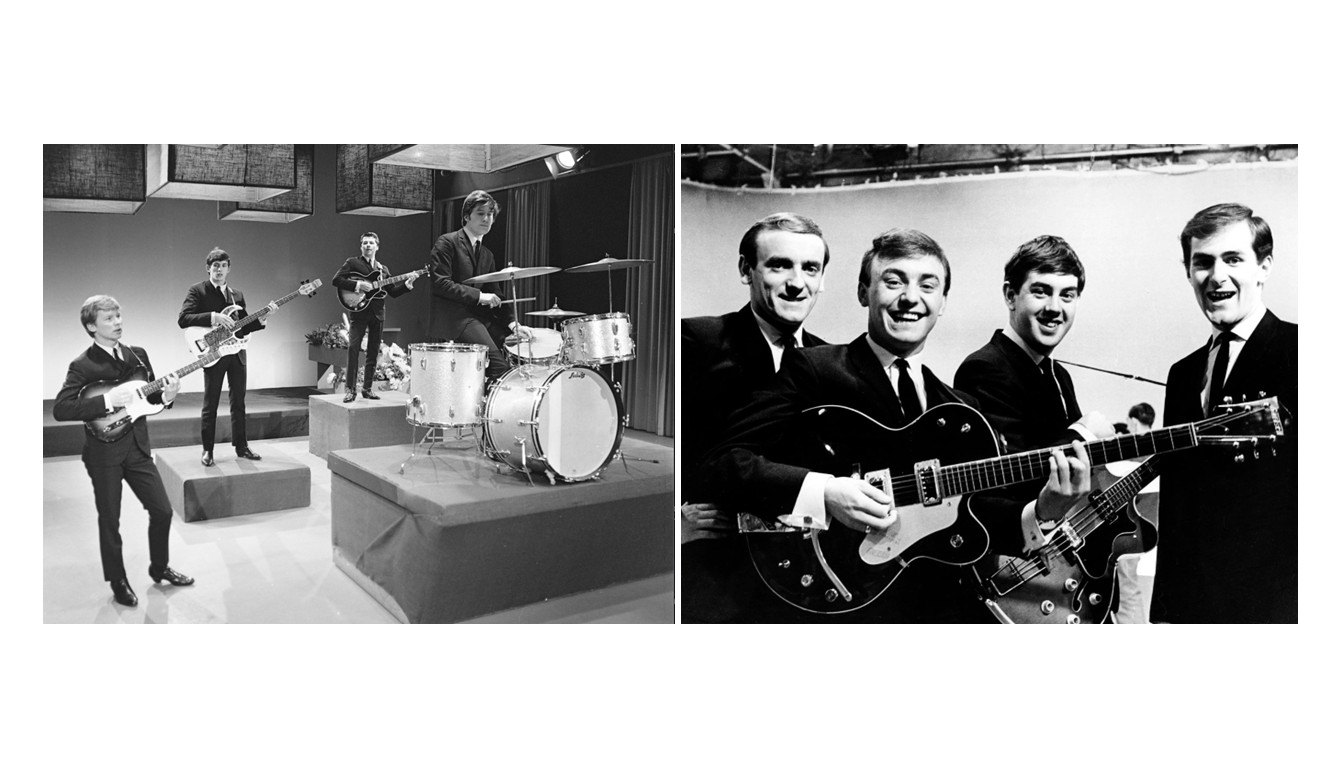
This episode in the 1964 British Invasion article series is dedicated to two bands from Liverpool who defined the Merseybeat genre that took the UK and later the US by storm that year. Mersey is a reference to the River Mersey in northwest England, which flows into the Irish Sea at Liverpool.
We start with a group who performed regularly at The Cavern Club, played in the night clubs of Hamburg, Germany, had Brian Epstein for a manager and George Martin as their producer. They are also NOT The Beatles.
Gerry & The Pacemakers
Gerry Marsden and his brother Freddie started their first group in Liverpool when Gerry was fourteen. It was a skiffle band called The Red Mountain Boys. They changed their name to Mars Bars, hoping that the chocolate company will sponsor them, only to be served a cease and desist letter by the giant corporation. Gerry Marsden said of that period: “In those early days we were happy just making a bit of extra cash each week. We knew absolutely nothing about real show business, and never dreamed of recording.”
The band made one more name change to Gerry and the Pacemakers and from time to time shared the stage with the Silver Beatles, before that other band dropped the ‘Silver’ from their name. Gerry Marsden remembers a funny episode: “In Litherland Town Hall, which is in Liverpool, we played regularly together and we said, ‘I know what we’ll do tonight. We’ll just all go on.’ And we called it The Beatmakers. That was a great night. I wish we would have had a tape recorder to tape it.”

Their fortune took a bright turn in 1962 when they signed a management deal with Brian Epstein, becoming his second signing after The Beatles. The manager told Pop Weekly magazine in April 1963: “They both have the same marvelous talent for writing songs, they both have wonderful personalities and they are all eager to really get moving when they’ve got some spare time! They work hard—and like the Beatles they have a hard core of fans in the North who support them thru’ thick and thin!” Epstein was all compliments when he talked about the band’s leader: “Gerry Marsden was one of the biggest stars in Liverpool, with a smile as wide as he was short, a huge generous personality and a fascinating voice, full of melody and feeling.”
How Do You Do It?
More importantly, Epstein brought with him producer George Martin, who came to see them performing at a ballroom in Birkenhead. After watching their performance Martin told Epstein, “Forget about the usual edition – Let’s arrange a recording date.” Martin suggested they record the song ‘How Do You Do It?’ as their first single. A few months earlier he tried the same song with The Beatles, but the Fab Four were adamant about releasing an original song, Love Me Do, as their debut single. No such resistance came from the Pacemakers, who made the best out of the Mitch Murray song. Pianist Les Maguire gets a nice short spotlight in the middle of the song. Marsden: “Maguire was more of a jazzy pianist. Like his solo in ‘How Do You Do It?’ is very jazz orientated.”

The song was released in the UK in April 1963 and quickly climbed to the top of the chart, where it stayed for three weeks.
I Like It
Gerry and the Pacemakers’ surprising success with their first single was a fine reason to include them in the famous 1963 tour with Roy Orbison headlining along with The Beales. The caravan of musicians also included David MacBeth, Louise Cordet, Tony Marsh, Terry Young Six, Erkey Grant and Ian Crawford. Gerry Marsden, unused to the grueling pace of life on the road, later said: “My whole system rebelled at first. All the travelling up and down the country practically killed me. I used to stagger to bed every night swearing I would never get up again.”

But the band had the luck of being handed hits by Mitch Murray, who at the time was on a roll. He also wrote hit songs for other British Invasion bands like Freddie and the Dreamers and The Dave Clark Five. Murray came up with another upbeat song, one that American magazine Cash Box called a year later, “a happy-go-lucky jumper that Gerry Marsden solo vocals in ear-arresting style.” The song, titled I Like It, again topped the UK singles chart in June 1963. Marsden quickly became a pop idol, garnering the following compliment from John Lennon: “He’s really explosive, on or off-stage! Lots of northern girls class him as another Joe Brown or another Tommy Steel. He’s got a fabulous sense of humor.”
You’ll Never Walk Alone
The band’s next single was of a very different style, taken from the 1945 Rodgers and Hammerstein musical Carousel. In the play a carousel barker named Billy Bigelow commits suicide, and to comfort his lover Julie, her cousin Nettie sings her a ballad titled You’ll Never Walk Alone. In a serendipitous turn of events, Gerry Marsden happened upon the song in the film adaptation of the musical: “It was raining and we had just done a lunchtime show at the Cavern, so I went to the pictures to watch Laurel and Hardy and the second film was Carousel. I was falling asleep in the cinema and this song came on and I instantly woke up. I thought beautiful lyrics, great melody, great build-up – I’m going to tell the band and put it in the show. I told the lads we’ve got a great ballad to sing called You’ll Never Walk Alone and they weren’t sure at first, but when we finished it they all clapped.”

The pressure on the Pacemakers after their two consecutive No. 1 hits was high. Brian Epstein and George Martin told the group: “If you could get a third one nobody will ever equal that.” Marsden was confident in the song, but the manager/producer combo thought it too slow for a chart topper. As with the Beatles, Martin gave way to the group’s instinct and again they hit the jackpot. A third no.1 with the first three singles. That record held up for twenty years, when another Liverpool band, Frankie Goes to Hollywood, equaled it in 1984 with ‘Relax’, ‘Two Tribes’ and ‘The Power of Love’.
Liverpool soccer fans quickly adopted the song as an anthem, singing it at the start of their team’s home games. Football defender Tommy Smith remembers how Gerry Marsden presented Liverpool manager Bill Shankly with a recording of the song: “Shanks was in awe of what he heard. Football writers from the local newspapers were travelling with our party and, thirsty for a story of any kind between games, filed copy back to their editors to the effect that we had adopted Gerry Marsden’s forthcoming single as the club song.”

When the band was invited to perform the song at Ed Sullivan’s show in the US, they were augmented by the Liverpool football club on stage. Marsden: “I said to Ed let’s bring the boys on stage and we’ll all sing You’ll Never Walk Alone. We did the song to 66 million people throughout the States and as we were walking off the set, Shankly said to me: ‘Gerry my son, I’ve given you a football team and you’ve given us a song.’”
Years later George Martin said this about Marsden and the song: “He always got a great reaction from audiences when he performed it, and it was Brian’s idea to record it. For the first time, I backed Gerry with a large string orchestra, which was a great departure for him. He had been a very jolly rock-and-roll star, doing little two-beat songs, and suddenly here was this big ballad with which his voice could hardly cope. All the same, I think it was largely that record which was responsible for the song becoming the universal football crowd song it is today.”
Don’t Let the Sun Catch You Crying
The next two songs in this review present Gerry and the Pacemakers at their best, performing original material. While both songs failed to capture the top of the charts in the UK and US, they showcase fine songwriting and mature arrangement and performance. After three no. 1 hits, the pressure was at its peak. Marsden remembers: “I suddenly realized that the audience was waiting to see the number one recording artist in the country, and I was supposed to go out there and prove that I was. I suddenly knew what it was like to be really worried.” But Marsden stayed focused and put his efforts into finding an outlet to his own songs: “Determined not to get in a rut, I made it a point or ensure each record was different from the last. At least no one will be able to criticize me for jumping on the bandwagon with the ‘Merseysound’.”

The result was ‘Don’t Let the Sun Catch You Crying’, a song first performed by the same Louise Cordet who previously toured with the band. Her version failed to chart, and the band decided to record their own take. George Martin is at his best here, influenced by Frank Sinatra’s arranger Nelson Riddle. In an article about George Martin, Paste magazine wrote about his arrangement: “Martin used hovering, unresolved string parts that didn’t push heartache on the listener but rather evoked the anxiety that makes heartbreak possible. When the wistful woodwinds added an element of melancholy, the listener could find one’s own sorrow without being manipulated by the arrangement.”
The single was released in the UK in April 1964 and climbed to the 6th spot. It became the band’s first US single, spending 12 weeks on the Billboard Hot 100 and reaching No. 4. It was the Pacemaker’s biggest US hit, after which US distributors released their aforementioned back catalog of 1963 UK hits.
Ferry Cross the Mersey
The band concluded their phenomenal 1964 peak year with one of their most lasting songs. Trying to capitalize quickly on the meteoric success of the Beatles film A Hard Days Night, Brian Epstein tried to follow up with one more musical film, this time set in Liverpool. As a film, Ferry Cross the Mersey ended up a flop, unable to overcome the critical reception it met on release. But the soundtrack, featuring a number of Liverpool artists, fared much better. Gerry Marsden wrote the title song, and he later reminisced: “Brian said, ‘The Beatles have done A Hard Day’s Night and I think we’ve got one for you.’ And a guy called Tony Warren, who was the original writer for Coronation Street, which is a big soap opera, rang up and said, ‘I’ve got a book for Gerry, just written, called Ferry Cross The Mersey. Would he do it?’ I said, ‘Of course.’ We didn’t have videos in those days. So you’d just put as many songs as you could, add a little fun and send it all over the world. And that’s what it was.”

The song took a little longer than usual for Marsden to write: “Ferry took me a bit of time to try and get the feeling and the movement of the ferry. And why should it cross the Mersey? Then one day I heard the intro in my head. I thought, ‘Ah, that’s the sound.’ So I stopped my car. Rung my mom. Told her to put my tape on. Dashed home. And did the song in like five minutes. I’d been trying to write it for a couple of months.” The song is sometimes misspelled as “Ferry ‘Cross the Mersey”, but ‘cross’ here does not mean ‘across’, but simply the verb. The song made it to the top 10 on both sides of the Atlantic.
The Searchers
The next band in this review turned to American songwriters for material, putting a fine spin on minor US hits. They were able to capture the UK charts and feed these songs back to the American market. The Searchers were formed in 1957 in Liverpool by guitarist John McNally and guitarist/singer Mike Pender, inspired by the success of Lonnie Donegan. They took their name from the 1956 John Ford western film The Searchers. In 1961 they settled on their classic lineup, also including singer/bassist Tony Jackson and drummer Chris Curtis. They performed regularly in Liverpool clubs The Iron Door and The Cavern, and took their influences from American rock n roll artists such as Elvis Presley, Buddy Holly, Little Richard, Jerry Lee Lewis, and The Everly Brothers. Mike Pender remembers the early days: “The Iron Door was our home for a long time. Les Ackerly, the manager we had for a short time before we went to London, run The Iron Door. He ended up calling it ‘The Iron Door the Home of The Searchers’ because we played so often there.”

Sweets for My Sweet
The Iron Door was also a makeshift studio for the band’s first demo recording that set in motion their huge success in the early 1960s. On a recommendation by Les Akerley, the band recorded a number of songs in the club with the aim of securing a recording contract. Drummer Chris Curtis: “He let us have the club for an afternoon and we got a weeny tape recorder and recorded the whole act. He took it to Decca who didn’t want it, but then he took it to Pye. Tony Hatch jumped at it. ‘Sweets For My Sweet’ was on the tape and he asked us to record that for our first session.”

The song was written by the legendary Brill Building writing duo Doc Pomus and Mort Shuman. The original version had a Latin feel and was performed by Atlantic Records star band The Drifters, who reached No. 16 on the Billboard Hot 100 chart in 1961. The Searchers sped up the tempo, eliminated the Latin percussion and replaced the piano with guitars. The result was a debut single that quickly captured the top of the UK singles chart in August 1963, winning accolades from their peers. Dusty Springfield considered the Searchers’ recording of the song to be, “the best record to come out of Liverpool” as of July 1963. Searchers singer Tony Jackson said of the success of the song, “Brilliant. But I did think I would have liked to re-record it. A slower version like The Drifters did.”
Needles and Pins
The success of Sweets for My Sweet prompted producer Tony Hatch to compose a follow up tune of the same vibe. He came up with the sugary Sugar and Spice, which easily climbed to #2 in the UK charts. The band’s label, Pye Records, was happy to keep this streak of bubble-gummy songs. The band, however, had other ambitions in mind. During their early stint at The Star Club in Hamburg they heard Cliff Bennett and The Rebel Rousers perform a song called ‘Needles and Pins’. Mike Pender remembers: “What a great song, what great words. It’s one of those songs that people associate with. Like a love story, you meet someone, you break up, you see her again. It’s all that isn’t it?” They later found that the song was recorded by Jacky DeShannon, after Sonny Bono and Jack Nitzsche wrote the song for her and applied a wall of sound production.

Pender said of that original version: “She’s got a unique voice, a bit of hoarseness there as well as a true American twang. I remember saying to Chris, ‘We can do that totally different’ and I think we did. You have to do that with a song because if you find a song that was already recorded by somebody, you have to make people stand up and say ‘Well you know I’ve heard it by so and so, but the version by The Searchers is really good.’” The Searchers’ recording became the best-known version of the song, unique for the lead singing performance and the guitar sound. Pender, who sang the lead vocal on the tune, recalls: “I added that little ‘pin-za’ as opposed to ‘pins’. When we did the session, I remember singing it and at the end of the take, I said to the producer, ‘I’m sorry. I said pin-za instead of pins.’ He said, ‘No, man, leave it in. It’s good.’ I don’t know why I sang pin-za. It’s just something that came out. People in America, they call out, ‘Hey, Mike, what about pin-za?!’”.

Needles and Pins has a distinct guitar sound that later became a template for bands like The Byrds and other early folk-rock groups. While many assume that the guitar sound was produced with a 12-string guitar, it is actually a recording of two 6-string guitars played in unison by Mike Pender and John McNally, who recalled: “We upped our trebly tones on the guitar. That created an overtone, which gave it a harmonic and a bit of echo, so it wound up sounding like a twelve-string guitar. It came about by mistake, as most good things do.” Later in 1964 Mike Pender did get a 12-string Rickenbacker guitar, after watching George Harrison play the instrument on TV performing Hard Day’s Night with The Beatles.
Chris Curtis summed it up: “If you haven’t got the listeners in the first few seconds, you haven’t got them, and we had them with that. That opening A chord on ‘Needles and Pins’ will never be topped. It must have been a good riff as the Byrds have used it countless times – upside down, this way, that way.”
After recording the song, The Searchers had to fight an uphill battle with Pye management, who wanted more pop songs about sweets and sugar. The band insisted, saying, “No. We’ve got to change slightly. Let’s change and do something a little bit different and a little bit heavier, something with a story, with more soul in it.” They won that battle and scored their second #1 hit in the UK early in 1964. In the US the song climbed to #13 on the Billboard chart.
Love Potion Number Nine
The Searchers’ biggest US hit followed the template of finding American minor hits, applying their unique arrangement and harmonies and turn them into bigger hits. This time their source was another legendary songwriting duo, Jerry Leiber and Mike Stoller. The two had produced the original version of Sweets for My Sweet by the Drifters, and this time wrote a song for The Clovers. Their original version of Love Potion No. 9 climbed to #23 in the US in 1959.

Lyricist Jerry Leiber later dispelled the myth about the kind of potion he had in mind: “In anticipation of the advent of esoteric stimulants in the sixties, some have seen ‘Love Potion No. 9’ as a comedic forerunner to LSD. Bullshit. That stuff wasn’t for me. Booze was always my thing. My most meaningful stimulant was cognac. I wrote by the glow of a burning Camel cigarette in one hand and a brandy snifter in the other. Smokes and Courvoisier were the dependable companions to my creative process. All this is to say that ‘Love Potion No. 9’ does not represent a disguised advocacy for other kinds of drugs in the pre-hippie era.”
Whatever was in that potion, it helped the Searchers climb to no. 3 on the Billboard Hot 100 chart in December of 1964, a fitting close to a fantastic year for the band. Mike Pender talked about the charm of the song for American audiences: “It’s got that sort of American thing about it and mentions American streets, so they took it to their hearts and went out and bought it. It’s one of those songs that always goes down well.”

Leave a Reply