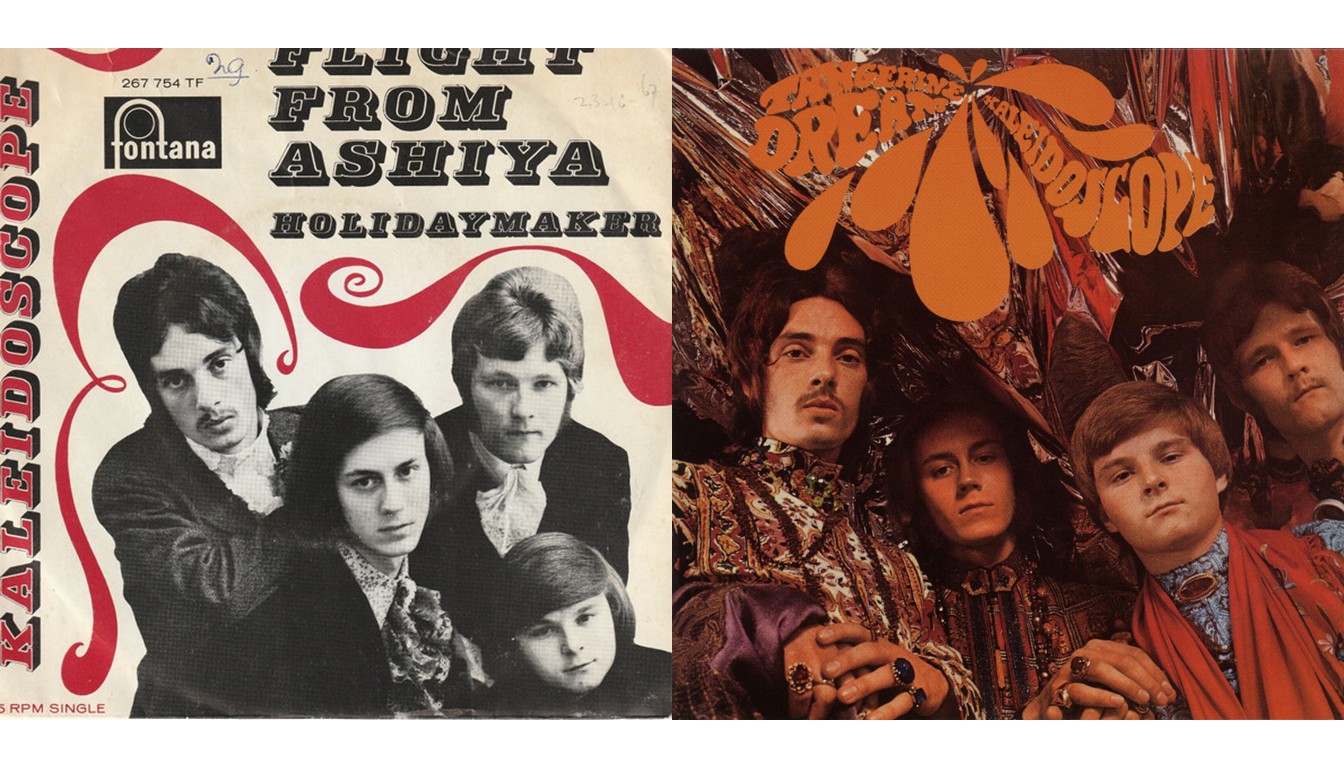
Peter Daltrey vividly remembers the songs that formed a new direction for music in his mind. As a member of The Key, a band that started as The Sidekicks in 1963, he recalls listening to The Beatles album Revolver in 1966. Like countless musicians at the time, he regarded the album as a revelation. Yet his recollections suggest that its influence went far beyond musical arrangements or studio experimentation. It fundamentally altered how he thought about writing lyrics: “I was never entirely happy writing endless soppy love songs. Tomorrow Never Knows was the catalyst.” Equally important were The Bee Gees, particularly their ability to combine melodic sophistication with strange, evocative storytelling. Songs such as “New York Mining Disaster 1941” and “Lemons Never Forget” convinced Daltrey that pop music could embrace mystery and surrealism without sacrificing accessibility.
The band quickly changed their name again, aptly choosing to call themselves Kaleidoscope (unaware of an American band of the same name). The year was 1967 and for a quartet of lads living in London, a change of apparel was in need. Gone were the Cuban heels, frilly fronted shirts and tight trousers, and in came caftans and beads. Daltrey’s memories of London go back to a point of time when everything changed. Before Carnaby Street became an international symbol of Swinging London, he and guitarist Eddy Pumer would eat lunch there while working nearby in Hanover Square. It was simply another dirty back street. Then, almost overnight, boutiques appeared everywhere and Carnaby Street became the center of a worldwide youth explosion. Despite becoming associated with British psychedelia, Kaleidoscope were largely outsiders to the famous London underground scene. They never played the legendary UFO Club or the Roundhouse, venues that launched many contemporaries. Instead, they developed their reputation playing colleges and universities: “We were so focused on what we were doing, that we didn’t get to see a lot of other bands.”

In December 1966 Kaleidoscope signed a contract with Fontana Records, a subsidiary of Philips Records, on the strength of a demo of the song Holidaymaker. On 24 February 1967 they entered Philips’ Stanhope Place studios for their first recording session under their new name. For musicians accustomed to recording in primitive facilities, the experience bordered on the surreal: “We were stunned. The engineers were friendly, cooperative and willing to experiment. When the session ended, we stepped out into daylight feeling as though we had returned from another world. It was like travelers returning from a voyage of discovery.”
No discussion of Tangerine Dream is complete without producer Dick Leahy, A & R manager at Fontana Records. Among others, he was responsible for signing Dusty Springfield, the Pretty Things and The Walker Brothers. Daltrey credits Leahy as a crucial collaborator: “Dick Leahy was the producer on all the songs released by Kaleidoscope. Dick was an up-and-coming producer at the time. He was very keen on pushing boundaries.” Leahy encouraged experimentation while respecting the band’s own ideas. The band came prepared to the studio, never relying on studio improvisation. Peter Daltrey wrote the lyrics, Eddy Pumer composed melodies. Together they refined each composition before introducing it to the rest of the group. Daltrey remembers: “As a band we never wrote in the studio.” The sessions became places to decorate songs with unusual guitar sounds, vocal effects and imaginative production touches rather than to invent them from scratch.

Perhaps no song better illustrates the creative relationship between Kaleidoscope and Leahy than “Flight From Ashiya.” The inspiration came from an unlikely source: the title of a novel sitting on a bookshelf in Daltrey’s parents’ home. The book, written by Elliott Arnold, tells the story of U.S. Air Force’s Air Rescue Service mission to rescue a life raft of Japanese civilians stranded at sea. Something about those words suggested an aviation disaster, prompting Daltrey to invent an entirely new narrative unrelated to the original book. The song impressed Leahy immediately. According to Daltrey, the producer heard it during an office visit and demanded studio time that very evening: “He just freaked out.” If was that good that it ousted Holidaymaker, originally marked as the band’s first single. Leahy overturned that decision instantly, insisting “Flight From Ashiya” become the A-side instead. Daltrey remembers Leahy’s excitement. The producer believed he had discovered “the new Beatles.” Whether or not that was realistic, his enthusiasm permeated the recording session, including the opening piano chord that crashes into the song like impending catastrophe.
One of the remarkable qualities of Tangerine Dream is its literary atmosphere. Rather than chronicling everyday romance, Daltrey increasingly filled his lyrics with invented worlds, mysterious characters and dreamlike landscapes. “The Sky Children” is another fine example. The lyric emerged almost spontaneously during a walk along the Dorset coast in the summer of 1966. Daltrey recalls: “This particular morning some words began insinuating themselves in my reverie. Lots of words. A lyric. But the verses kept piling up so it became difficult to remember them. I didn’t have a pen and paper with me. When we eventually got back to our digs I splurged out the words onto paper, editing them later. That is how the lyric of The Sky Children came to be written. What inspired them I’ll never know. I had never even heard of Tolkien and only vaguely knew of Edward Lear but of course, as a child I had grown up with English fairytales and the Brothers Grimm.” That fleeting morning became one of the album’s most enduring songs.
“The Sky Children” is the song that closes Kaleidoscope’s 1967 album “Tangerine Dream”, released in November that year. A month before the release the band appeared on the French television programme Le Petit Dimanche Illustré. They endured what Daltrey remembers as hours of confusion beneath hot studio lights. Only later did they discover that the apparently grumpy pianist sitting nearby was none other than Serge Gainsbourg, accompanied by France Gall and actress Mireille Darc. Here is a clip with their performance of Holidaymaker:
In August 1967 Fontana Records issued a press release for the forthcoming album. In it they described the four members of the group:
Peter Daltrey is the word magician who leads Kaleidoscope with a quietness that covers up a turbulent mind full of truly fantastic poetic brilliance. He is very serious, but when he laughs, he laughs wholeheartedly. He’s no phoney. He is 21 and lives in Harrow and is no relation to Roger D. of The Who.
Eddie Pumer is the musical brains of the outfit, and some of his lead guitar work on the L.P. is nothing short of amazing for someone aged only 19. He also provides the harmonies above Peter’s lead voice, and has quite a thing about Julian Bream’s guitar work. He comes from Acton.
Danny Bridgman is a real Londoner, and could be described as a Cockney Hippie, if you’re looking for labels. He is 21, comes from White City and tends to stick a mental tongue out at you. He is very funny and plays drums masterfully. He also eats chocolate biscuits at recording sessions, but offers them around.
Steve Clark, who plays bass, tends to refuse Danny’s biscuit offerings, but doesn’t hold his friend’s tastes against him. His playing on the L.P. is just about the finest testimony to his talents one could hope for. He lives in Southall and is very quiet and very genuine.

While the album received favorite reviews in the music press and BBC radio gave “Flight From Ashiya” generous airplay, sales never materialized. The culprit, according to Daltrey, was painfully mundane. Fontana simply could not distribute records effectively. Fans wrote letters explaining they wanted to buy Kaleidoscope’s records but couldn’t find them in local shops. “A kid with five shillings in his pocket,” Daltrey said, “if it’s not there, will buy something else.”
The album is a psychedelic gem from the heyday of that genre. Yet the musicians themselves never consciously set out to create one. “We didn’t have particularly conscious targets of producing a psyche album,” Daltrey explained. Instead, psychedelic textures naturally entered the recordings through imaginative production techniques and the musical environment surrounding them: strange guitar sounds, manipulated vocals, unexpected sonic embellishments. At the time these were products of curiosity rather than marketing. Peter Daltrey summarized it well: “The music we had made was very much of its time. That time was the fluorescent summer of 1967—a truly magical few months of total artistic freedom when all the various genres knew no boundaries. Everything was possible no matter how outlandish and colorful.”
Sources:
Kaleidoscope – Tangerine Dream, Repertoire Records 2005 CD booklet
Leave a Reply