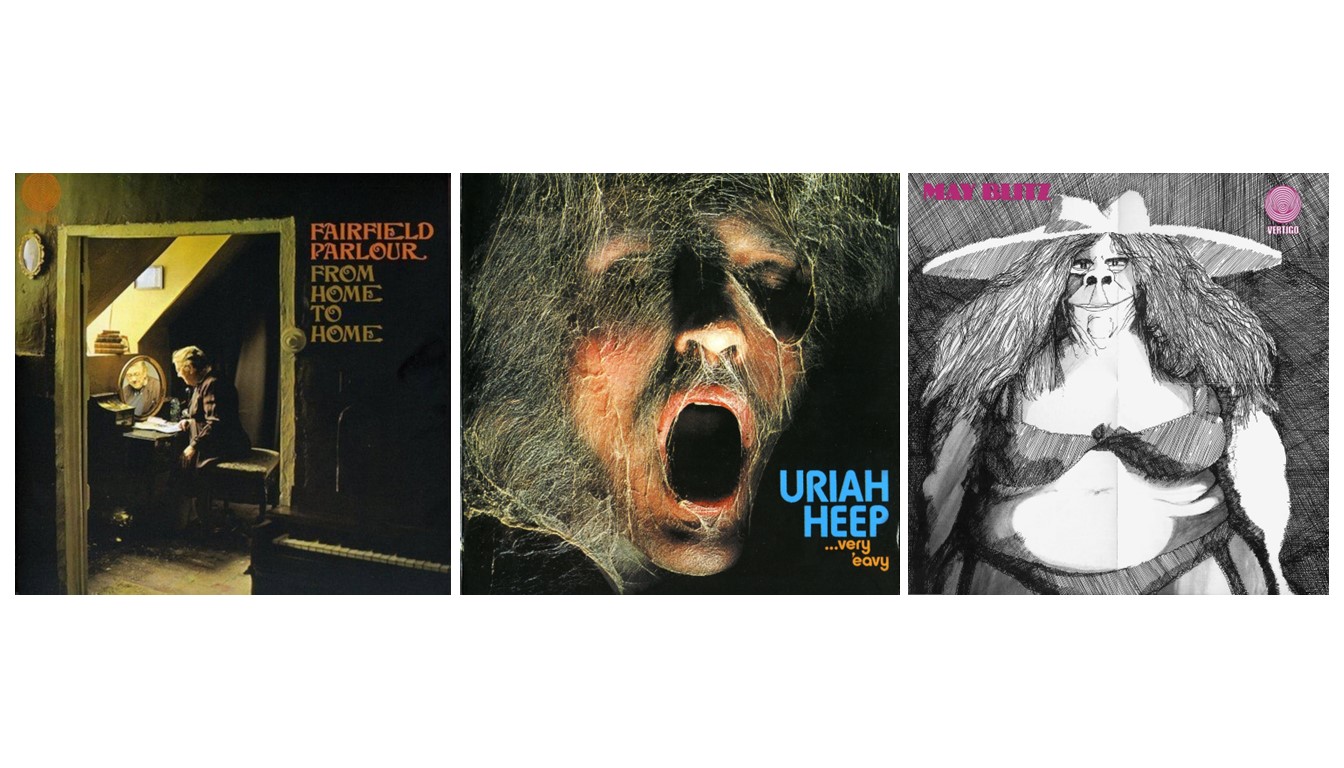
After dedicating the previous review of Vertigo Records to Black Sabbath, in this article we remain with two more hard rock bands, and end with a softer folk-influenced album on the other side of the Vertigo label music spectrum.
Uriah Heep – …Very ‘Eavy …Very ‘Umble
In 1969 Gerry Bron, known for producing hits with Manfred Mann (‘Ha! Ha! Said the Clown’), was managing a number of bands and looking to sign them with an appreciative record label. Olav Wyper and his newly-found label Vertigo Records were a perfect fit. The label’s sympathies were with progressive acts such as Colosseum that Bron managed. Another band under his management was named Spice, and it consisted of young and enthusiastic hard rock musicians. Guitarist Mick Box and singer David Byron started the band in 1967, recruiting drummer Alex Napier and bassist Paul Newton to form a quartet. Box remembers their early humble beginnings: “I used to live over a butcher’s shop. It sounds ridiculous now, but back then we couldn’t afford the electricity to plug in and play. We snack downstairs into the shop, hid behind the butcher’s counter and practiced. It was freezing cold!”

While the band was recording their debut album on Vertigo, they went through significant changes that immediately set them on a trajectory for success. The first was a name change, suggested by Gerry Bron. 1970 marked the 100th anniversary of Charles Dickens’ death, and Britain celebrated it with book, movies and TV show releases. One of them was a film adaptation of David Copperfield, in which the character of Uriah Heep, the insincere flatterer, caught Bron’s attention. The band agreed to adopt it as their new name.
The second change was the addition of guitarist, keyboardist, singer and songwriter Ken Hensley. Mick Box talked about adding the Hammond organ to Uriah Heep’s sound palette: “We’d actually recorded half the first album when we decided that keyboards would be good for our sound. I was a big Vanilla Fudge fan, with their Hammond organ and searing guitar on top, and we had David’s high vibrato vocals anyway so that’s how we decided to shape it. The Hammond organ seemed to fit every nuance of our music because it could be romantic, it could be aggressive, it could be loud, or soft. It could be everything you wanted it to be, so it was the perfect instrument to add the flavor to what we do.”

Even though all band members have been around the music scene for a number of years, this was their first professional experience in a recording studio. Mick Box: “We didn’t really know what we were doing. I remember the first thing the engineer did was put my cabinet facing the wall, with a microphone between it and the wall, a few inches apart, and when I started paying it was all muffled. I thought ‘What is this all about? I’ve got no sustain, I’m used to having this all coming up my backside!’. There was so much innocence then. If an engineer had told me to stand at the back of the studio in a fire bucket and play a solo, I probably would have!”
Uriah Heep’s debut album …Very ‘Eavy …Very ‘Umble (Very ‘Umble was Uriah Heep’s catch phrase in Dickens’ book) was released in June of 1970. It starts with the track Gypsy, which was also released as a single. One minute into the song Mick Box unleashes one of heavy rock’s best-known guitar riffs, backed by Ken Hensley’s fantastic Hammond sound. The song became the band’s anthem for many years: “The funny thing was that we wrote Gypsy at Hamwell Community Centre, Shepherds Bush, and Deep Purple were rehearsing in the room next door to us. You can imagine the kind of racket we were both making between us!” Ken Hensley wrote in the album’s original sleeve notes: “I particularly enjoy Gypsy and they let me do a little slide-guitar here and there to keep me quiet!”.
Uriah Heep was unique among their heavy rock peers in 1970, Black Sabbath, Led Zeppelin and Deep Purple, in featuring all band members when singing harmonies. Mick Box commented: “I think we were the first band to bring harmony into our music and use it as another instrument. All the harmony work in those bands in the late-’60s was just to sing along in three-part harmony to the chorus, wasn’t it? But with us, in Gypsy, for instance, we already had the band harmonies that kind of became our trademark.”
The story of the album’s spooky front cover is told in the 2003 CD release on Sanctuary Records: The album hit the racks in a striking sleeve that featured a cobweb-covered human being screaming as if in torment. Look very closely and you’ll see the subject is none other than David Byron. Bron had set up a photo session at which a cobweb machine had been hired to create the olde-world effect. Box wasn’t too enthusiastic about the results so went off to the pub and upon returning in a ‘suitably refreshed’ state decided it might be amusing to spray the contents of the device all over his singer.

“I tapped him on the shoulder and I went ‘Ssshhssssshhh!’ with this glue all over his face,” guffaws Mick at the memory. “I found it absolutely hilarious and the photographer was quick enough to pick up his camera and snap away. And of course they were the pictures that we used. The cover looked fantastic, it really caught the eye.”
“David wasn’t too pleased because it took him about two weeks to get the glue out of his hair, eye-brows and everything else!” he continues. “But we got our album cover, and the pair of hands on the back actually belong to the tea-boy…it’s his claim to fame.”
Uriah Heep’s debut failed to enter the top 100 charts in the UK and US, but fared better in European countries like Germany and Italy. Reviews were mostly unkind, with NME finding it, “too loud, too repetitive, too predictable and the distortions intended to blow your minds, you ‘eavy freaks you, are simply offensive to the ear.” Rolling Stone magazine outdid it, starting their review with these pearls of wisdom: “If this group makes it, I’ll have to commit suicide. From the first note you know you don’t want to hear any more. Uriah is watered down, tenth-rate Jethro Tull, only even more boring and inane.” Well, the group made it, so…

David Byron – lead vocals
Ken Hensley – piano, organ, mellotron, slide guitar, vocals
Mick Box – lead and acoustic guitars, vocals
Paul Newton – bass guitar, vocals
Alex Napier – drums
May Blitz
After discussing Black Sabbath and Uriah Heep, we continue our foray into Vertigo’s heavy rock underground and come to May Blitz. The power trio, styled after Cream and The Jimi Hendrix Experience, formed when two young Canadians, bassist Reid Hudson and guitarist James Black, recruited the far more experienced drummer Tony Newman. Newman was previously part of Sounds Incorporated, famous for touring the world as the Beatles’ opening act, including the 1965 concert at New York City’s Shea Stadium. He then joined the Jeff Beck Group, with whom he recorded the album Beck-Ola before joining May Blitz.
The band played all original material and toured heavily in Britain and Europe. In August of 1970 Newman told Beat Instrumental magazine: “We prefer concerts because we feel that our music is the kind that needs an attentive audience. Their reaction can tell us a lot about ourselves and what we should be doing. I love the atmosphere at concerts. It’s great feeling the heat coming from the crowd—the good vibrations.”

May Blitz’s self-titled debut consists of seven tracks, produced by the band and engineer Barry Ainsworth. The talented engineer went on to work on albums by Deep Purple, Flaming Youth, Hawkwind, and Beggars Opera. Tony Newman had only compliments to say about him: “You can have the best engineer in the world, but if you can’t communicate with him, you end up accepting something only half as good. Barry Ainsworth knew exactly what we wanted as soon as we asked for it.”

The album’s cover art was drawn by artist Tony Benyon, who also created another cover for Vertigo, Patto’s self-titled debut album the same year. His artwork was quite revolutionary and he encapsulated the band’s quirky characters in his abstract drawings. The inner-gatefold contained liner notes by four club managers, praising the group. Quotes ranged from “With the high standard of professional musicianship these days it’s seldom that a group makes me forget the time and place anymore. May Blitz did that!” to “It is a projection of primeval sexuality previously embedded in the subconscious but now manifested in May Blitz, the quintessence of the ‘70s new virility.” Got that?
My favorite track on the album is the opener ‘Smoking the Day Away’, featuring a wonderful instrumental section mid-song.
James Black — guitars, lead vocals
Reid Hudson — bass, backing vocals
Tony Newman — drums, vibes, congas, bongos
Fairfield Parlour – From Home to Home
We dedicate the last album review to a wonderful band usually known as Kaleidoscope, who in 1970 released on album on Vertigo Records as Fairfield Parlour. Kaleidoscope released two albums on Fontana Records, both of them classic psychedelic artifacts of the late 1960s. Despite garnering good reviews in the music press, the albums failed to chart and the record label became impatient. The band signed with BBC Radio One DJ David Symonds as manager, left Philips (Fontana’s parent company) and started anew with a different musical direction. Lead singer and keyboardist Peter Daltrey talked about that move: “We jumped at the chance to try something new. Ed (Eddy Pumer – guitar, keyboards) and I were writing differently. Gone were the battalions in baby blue and in came the lonely old spinsters cutting up pictures of wedding dresses and photos of Marlon Brando. A name change was therefore suggested.”

The band renamed themselves Fairfield Parlour, shrugged off the psychedelic sounds they excelled at, and embraced the esthetics of progressive folk, going strong in Britain at the time. They also added new textures to their sound palette, as Daltrey recalls: “We wanted to augment our sound with additional instruments. Ed could play virtually anything. Dan (Dan Bridgman – drums, percussion) bought a marimba, a sort of ethnic wooden xylophone. Steve (Steve Clark – bass, flute) brought in his recorder and then took up the flute. And I bought an antique harmonium in Chelsea.”
Another important instrument that the band adopted was the temperamental mellotron: “The instrument’s unique sound came as a result of its dodgy technology, with each note playing a tape of strings or woodwind. The instrument was notorious for going out of tune and being badly affected by changes in temperature. But a wonderful sound to a group used only to drums and two guitars.”
With Symonds’ encouragement, the band self-financed and recorded an album. Daltrey remember how impressed they were with the results: “A memorable series of sessions, culminating in an all-night mixing session at Olympic Studios in Barnes. Dave liked to crank up the decibels; the album never sounded so good. We were suffused with its rich, folky sound, overwhelmed by the size of the production and left the darkened studio aglow.”

In an ironic turn of events, the band re-signed to Philips, this time to a different, newly-formed sub-label that was much more sympathetic to the type of music they were making. Vertigo Records wasted no time releasing a single titled Bordeaux Rose in April 1970. New Musical Express gave it a fine review: “A British underground unit that’s already made a profound impression on the college circuit. An intriguing fusion of progressive thinking and old-world enchantment – with flute, strings and acoustic guitars providing a delightful pseudo-classical touch. Pungent harmonies and a solid beat.”
The song had all the making of a great success: “Bordeaux Rose was played to death on the radio. It was very highly rated, great predictions for it. We got on Top of the Pops. If you went on in those days the following week your record would go up at least five places on the chart. It was almost guaranteed as you had exposure on Britain’s only pop TV program.” But the band was not destined to reach chart or sales success. Avid radio listeners and TV watches who were looking for the single in stores were dismayed to find no product to buy. Philips’ distribution failed to provide the needed merchandise, and with critical time lost to capitalize on a hot single, the song did not reach its potential.
The band had one more shot at fame in August 1970 at the main live musical event of that year in Britain: The Isle of Wight festival. Fairfield Parlour was selected not only to open the third day of the prestigious festival, but to also write and perform its theme song. An agreement was stipulated that the song would be played at least once between every act over the weekend. With that in mind big things were predicted for the single. Peter Daltrey and Eddy Pumer wrote the song ‘Let the world wash in’. This time the record company delivered the goods and printed up thousands of copies, each in a souvenir picture sleeve. But success eluded the band once more. For some obscure reason, the marketing folks at Philips decided to release the single under the pseudo name of I Luv Wight, promising to reveal the true identity of the band at the festival. When they got to the festival, they found that Rikki Farr, who acted as MC for the event, played the single once and threw it into the audience in disgust, never to be played again.
Lack of success aside, the song is a favorite of its composer: “I consider the song to be one of the finest that Ed and I ever wrote. Written to order and delivered on time. A song that has, in my humble opinion, stood the test of time. Lennon’s classic, Across the Universe, is a little too obviously the influence for the song, but nonetheless, the resulting track is warm and sincere. It is one of my favorite recordings of the band, featuring a full, well-produced sound, focusing quite correctly on the chorus.”

Just ahead of the festival, on the 14th of August 1970, Fairfield Parlour released the album ‘From Home to Home’. Melody Maker described it as, “a gentle, lyrical, happy-sad album and very English with fine harmonies floating above solid and unflashy playing on keyboards, acoustic guitars, flute and occasional touches of mellotron. At times there’s an early Fairport feel — maybe because singer, Peter Daltrey sounds faintly similar to Ian Matthews.” For the band it was one of the peaks of their recording career: “On the final mixing session at Olympic Studios in Barnes, Dave presented us with a mix of ‘Emily Brought Confetti’ that almost left us in big-girl-blouse tears. The massed vocal harmonies — all of which we had done ourselves — would have done all the angels proud. The playback was at Dave’s usual earthquake-inducing level and we all drove home in a daze, convinced we’d produced the greatest piece of music ever committed to tape.”
My favorite tune on the album is the opener ‘Aries’, written by Peter Daltrey from his real-life experience:”There are a few tracks scattered through my recording career that are autobiographical and Aires is one of them. Whitey was a friend of mine. We did find a motorbike and as far as I know he did die when he was riding it. It was a great opener for the album and encompasses the mood.”
Peter Daltrey: vocals and organ
Eddy Pumer: guitar
Steve Clark: bass
Dan Bridgman: drums
Sources:
Uriah Heep – …Very ‘Eavy …Very ‘Umble 2004 CD release booklet
Leave a Reply