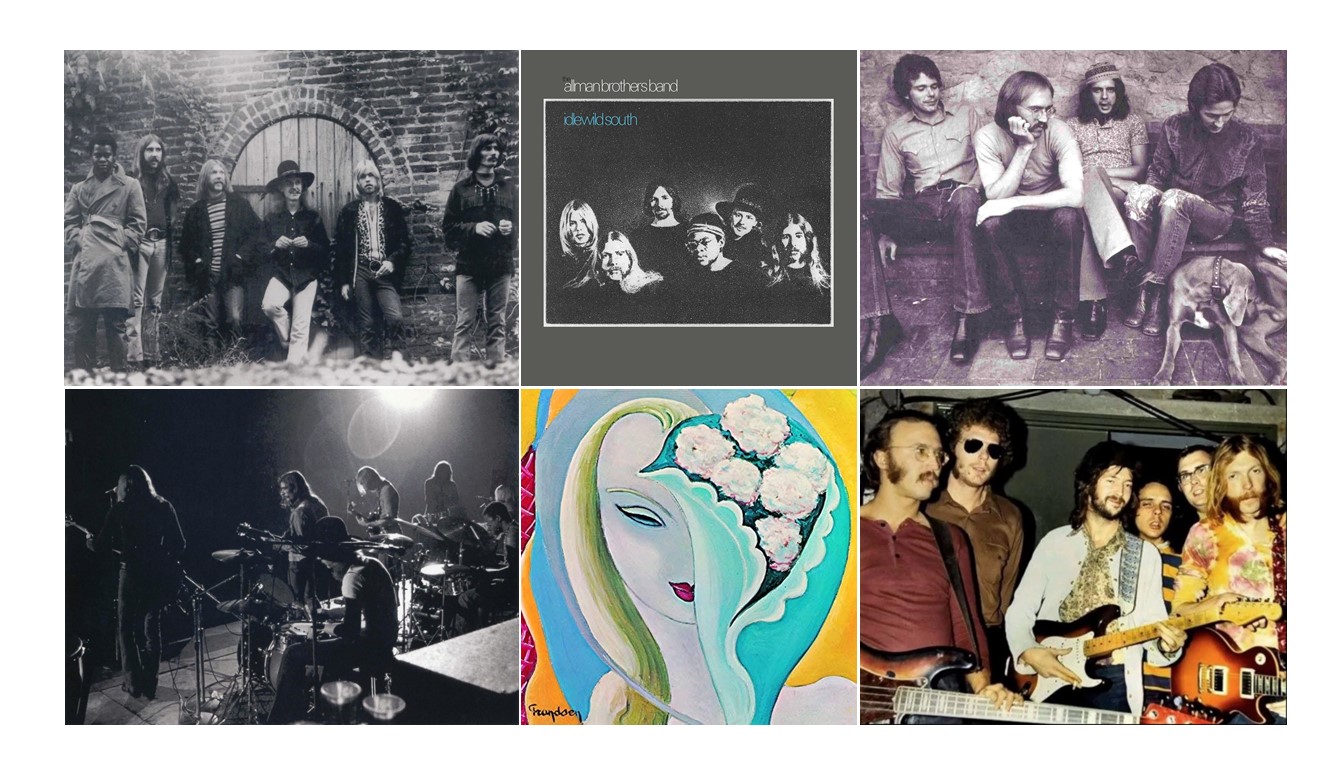
With this article I am starting a new mini-series in the “A Year in Music – 1970” category, this time dedicated to blues rock albums from both sides of the Atlantic. Many of these albums are now considered rock classics, but there is a heavy influence of blues across all of them. Expect heavy doses of electric guitar solos by some of the best masters of the instrument. And we start with two bands, two of the greatest guitar heroes of all time and two albums produced by a legendary sound man.

The Allman Brothers Band spent New Year’s Eve 1969 in style. For $165 a month, they rented a cabin on a lake west of Macon, Georgia. It was a one-room structure that they normally used for rehearsing. That night the bathtub was full of beer and wine, and dubious substances were abound on the premises. With a fire going strong in the fireplace they formed a circle at midnight and sang ‘Will The Circle Be Unbroken?’ Linda Oakley, bassist Berry Oakley’s wife, remembers: “That was a pivotal moment, a testament of love. Everybody knew that this was destiny. We were family and we were brothers.” A night to remember, it had to be immortalized. The band called the cabin ‘Idlewild South’, in honor of the New York City Airport, now known as JFK. That was also the title of the band’s next album, released in September 1970.

The band toured non-stop in 1970, zigzagging across the US for 300 days out of the year. Idlewild South was recorded in fits and starts at multiple studios over a period of six months. None of this had a negative effect on the music and recording quality, in no small part due to the involvement of producer Tom Dowd.
The legendary Atlantic Records sound man and producer remembers: “The first time I heard the Allman Brothers Band was in Macon. I was there to visit Capricorn Records and I walked by the rehearsal space and heard the most incredible sounds coming out. I got to Phil Walden’s office and asked him who in the hell was rehearsing in the studio. He said, ‘That’s the Allman Brothers,’ and I said, ‘Get them the hell out of there and give them to me in the studio. They don’t need to rehearse; they’re ready to record.’”

Idlewild South is a classic album not only for the great music it features, but also for the fantastic sound Tom Dowd was able to capture on tape in the studio. Drummer Jai Johanny Johanson (Jaimoe) remembers how meticulous Dowd was during the recording sessions: “He would walk around in there, with his little meter and he would go around to each instrument and listen to what it sounded like. He’d go back to the center of the floor, walk around some more, and then go back into the control room. Instead of going in there and turning knobs and trying to make things sound the way he thought they should sound, he simply brought the sound that was in the studio into the control room – nobody else did that.”
Tom Dowd understood that the band performed best when all members were in the room playing together. Very little overdubbing was applied to the recorded tracks, and on most recordings there were five or six musicians playing live in the studio. Jaimoe: “The idea was to capture that part of the Allman Brothers, which was spontaneity and elasticity.”

The album produced two singles, including one of the band’s classic tracks. Gregg Allman remembers in detail how he composed the song: “On Midnight Rider, which is the song I’m most proud of in my career, I had all but the last part—so, as I like to say, I had the song by the nuts, I just had to reel it in. The third verse is really important, because it’s kind of the epilogue to the whole thing. Basically, you state the problem in the first verse, you embellish on the problem in the second verse—like ‘let me tell you what a bitch she really is’—and then you usually have some music, to let you think about them words for a while and also get lifted up by that music. “

Gregg Allman got some help with the lyrics of the song from the band’s roadie Kim Paine, who contributed the lines
I’ve gone by the point of caring
Some old bed I’ll soon be sharing
Payne recalls the urgency to put things down on tape immediately after the two worked out the song: “Gregg was intent on getting this on tape before he forgot it all. So we went back down there and just broke in; I smashed a window on the door and reached in to unlock it. Then I was running around trying to figure out how to turn the board on and he was running around yelling into mics looking for a live one. I finally found what looked like a wall light switch hidden under the board, and boom, all these lights came on, microphones are live, and needles are jumping. We laid down one track with Gregg just playing an acoustic guitar and singing and he went back the next day and added some more. I would imagine that tape is somewhere.”
The crown achievement of the album, and maybe the most celebrated song in the band’s career, is ‘In Memory of Elizabeth Reed’, one of the best instrumentals in rock’s history. Guitarist Dickey Betts used to spend time at Rose Hill Cemetery, writing tunes amid the graves. The song came to him at one of these outings and when he finished writing it, he needed a name. The song was written for a woman he was involved with, but he vetoed using her name in the title: “It couldn’t have anything to do with her name, because it was all cloak and dagger, as she was Boz Scaggs’s girlfriend. She was Hispanic and somewhat dark and mysterious—and she really used it to her advantage and played it to the hilt.” What is a songwriter to do in such a predicament? Simply look around: “There was a grave right by ‘my spot’ that said, ‘In Memory of Elizabeth Jones Reed, mother of…’ and listed all of her children. The spot had provided me with so much peace and inspiration that I decided to name the song after her. Duane told some crazy shit about that graveyard. I don’t wanna tell all—but that’s the part that matters.”

This is a fine example of the influence of jazz on rock musicians at a time when the emerging jazz rock scene usually demonstrated the reverse influence. Dickey Betts talked about that topic: “From the beginning we were influenced by the jazz players. Just go back and listen to ‘Elizabeth Reed’ and I think that will be clear.”
The tune features the sublime dual guitars playing by Duane Allman and Betts, who commented: “Neither one of us was timid, and we just rolled together. Duane had that real clear sound – although it had more of a blues edge to it – and my style had that country kind of thing, but they worked together.”

You may observe some similarities in style on that song to the sound of Santana. Betts acknowledged: “In Memory of Elizabeth Reed has that Latin kind of feel to it, that’s for sure. Carlos Santana and I have been compared a lot over the years. It’s not on purpose on my part. I guess we both like that Latin flavor salsa appealing music. Of course, he is more prevalent than I am with that feel.”
1970 was a fantastic year for Duane Allman. In addition to The Allman Brothers Band’s Idlewild South, he participated in a number of classic recordings by other musicians. The first was originally planned as his own solo album, but the idea was shelved when he decided to focus his energy on forming The Allman Brothers Band. Instead the project became the debut solo album of American blues musician Johnny Jenkins, with many of The Allmans playing on it. One track in particular stands out, as Gregg Allman points out: “Duane, Berry, Butchie, and Jaimoe all appeared on an album by Johnny Jenkins called Ton-Ton Macoute! My brother played his ass off. His Dobro work on ‘I Walk on Gilded Splinters’ was just flat-out evil, man, and that’s why we still do that song to this very day.” The song was originally written and performed by Dr. John on his classic 1969 debut Gris-Gris.

The album’s Producer Johnny Sandlin remembers vividly recording that track: “The music for ‘I Walk on Gilded Splinters’ was recorded live in the studio with only the vocals and background vocals over-dubbed. I’d never heard a dobro played with such intensity and the drum and timbale track from Butch and Jaimoe was classic.” Indeed that percussion groove caught the ear of artist Beck in 1994 and he featured it on his hit Loser. Sandlin: “Butch and Jaimoe are playing behind Beck through the technology of sampling.”
Duane Allman’s other guest appearance in 1970 is now the stuff of a legend and a story worth telling. In the spring of 1970 Eric Clapton found himself with no active band. After his work with Cream and Blind Faith, he toured with Delaney & Bonnie and Friends in Europe and the United States until March 1970. A number of ‘Friends’ from that tour immediately joined Joe Cocker and Leon Russell’s caravan of musicians known as Mad Dogs and Englishmen, which lasted to the end of May 1970. They included bass player Carl Radle and drummer Jim Gordon. Towards the end of the tour Clapton received a call from Radle: “Carl rang me and said, ‘Are you interested in a band?’ I thought, ‘Why not?’ So they came over to England and lived in my house at Ewhurst for several months and we evolved into Derek and The Dominos. I was looking for a musical context into which I could fit and they seemed to provide it.”
The group included Clapton and three American musicians: Radle, Gordon and keyboard player Bobby Whitlock, one more member of Delaney & Bonnie and Friends. They shared a love of the blues and with no grand plan started playing long improvised jams. Clapton was in heaven: “I was in absolute awe of these people, and yet they made me feel that I was on their level. We were kindred spirits, made in the same mold. To this day I would say that the bass player Carl Radle and the drummer Jimmy Gordon are the most powerful rhythm section I have ever played with. They were absolutely brilliant. When people say that Jim Gordon is the greatest rock ’n’ roll drummer who ever lived, I think it’s true, beyond anybody.”

Lots had been written about Clapton’s infatuation with Pattie Boyd around that time. I will leave the juicy parts for the tabloids and focus on the fantastic music that this relationship inspired. Eric Clapton explained the origin of one of the best unrequited love songs of all time. This is how it started: “Someone had given me a book called The Story Of Layla And Majnun, which was a Persian story about being driven mad by falling in love with a beautiful, unavailable woman. I loved the name and I had the main body of a song that was obviously about Pattie.”
Armed with only a few sketches of songs, the group decided to enter a recording studio. Clapton’s manager Robert Stigwood placed a call to Tom Dowd in Miami. The producer was working with the Allman Brothers band on Idlewild South. He recalls: “I put the phone down and apologized, saying to Duane, ‘You have to excuse me. That was Eric Clapton’s manager. They want to come here and record.’ He said, ‘You mean this guy?’ and plays me an Eric solo note for note. I said, ‘That’s the one,’ and he goes, ‘I got to meet that guy.’”
A couple of months later Tom Dowd is ensconced in his Miami Criteria studio with Derek and the Dominos trying to get going on an album that had very little material to boot. He gets another call: “Duane calls: ‘Is he there? We’re gonna be in Miami tomorrow for a concert. Can I come meet him?’ I said, ‘I’m sure you can, hold on.’ I grabbed Eric and said, ‘I have Duane Allman on the phone. His band is playing in the area tomorrow and he’d like to come meet you.’ And he goes, ‘You mean this guy?’ And he plays Duane’s solo off of Wilson Pickett’s Hey Jude note for note. I said, ‘That’s the guy.’”

The night after the Allman Brothers band show in Miami, both bands jammed for hours at Criteria. Allman’s drummer Butch Trucks remembers the immediate connection between Eric Clapton and Duane Allman: “They just went off like a firecracker – you could tell, it was like long-lost brothers had found each other. As soon as they met they sat down and started talking about Robert Johnson. At the time that they met, I don’t think either had met another guitar player that was so immersed into Robert Johnson.”
Long story short, the two gifted guitarists made magic, even if for a brief period of time. Clapton found a soul mate, as he recalled: “Duane and I became inseparable during the time we were in Florida, and between the two of us we injected the substance into the Layla sessions that had been missing up to that point. He was like the musical brother I’d never had but wished I did. Unfortunately for me, he already had a family, but I loved it while it lasted. These kinds of experiences don’t happen every day.”
Duane Allman indeed brought a breath of fresh air into the stagnant sessions of Derek and the Dominos’ album. Bobby Whitlock recalls the energy boost the band got when Allman joined the sessions: “We didn’t have enough material for one album, much less a double album. We didn’t have a plan and when Duane came on the scene, everything exploded and things just started coming.” Tom Dowd adds: “By then, the Dominos had recorded several songs and had arrangements set for others, but right away Duane started fitting in parts and the more he did that, the more songs started to radically change. Duane had unleashed this dynamic entity that was just ridiculous. They were feeding off each other like crazy and running on pure emotion.”

Back to Layla. The song starts with a riff that since became a classic, courtesy of Duane Allman. The song that started as a ballad suddenly exploded in the studio. Clapton: “We spent a lot of time working together on the guitars and Duane was very instrumental in the development of the song. He came up with this riff that was pretty much a direct lift from an Albert King song, ‘As The Years Go Passing By’ from the Stax album Born Under A Bad Sign. It’s a slow blues and there’s a line that goes, ‘There is nothing I can do if you leave me here to cry’, and we used that.”

Indeed the collaboration between both guitar masters on Layla is something to behold. Dowd, who witnessed this magical session first hand, remembers: “I’ve never seen spontaneous inspiration happen at that rate and level. One of them would play something, and the other reacted instantaneously. Never once did either of them have to say, ‘Could you play that again, please?’ It was like two hands in a glove.” Listing the many rich layers of guitar tracks, Dowd shades some light into what made this tune shine: “There’s an Eric rhythm part; three tracks for Eric playing harmony with himself on the main riff; one of Duane playing that beautiful bottleneck; and one of Duane and Eric locked up, playing countermelodies.”
And if you get confused while listening to the track about who is playing what, Duane Allman explained shortly after the album’s release: “Clapton gets more of an open, slidey sound. But here’s the way to really tell: He played the Fender, and I plyed the Gibson. The Fender is a little bit thinnerand brighter, a sparkling sound, while the Gibson is just a full-tilt screech.”
When Derek and the Dominos completed the recording sessions they had a double album on their hands. ‘Layla and Other Assorted Love Songs’ was released to muted response at the end of 1970. That happens when you do not reveal the identity of the group’s leader, who happens to be one of the biggest rock stars of the period. A few weeks before the album release the band performed at the Fillmore East. A recording of the set was released in 1973 and it is a showcase of the excellent musicianship by all band members. The guitar solos are some of Clapton’s best.
Here is the opening track from the album In Concert:
Eric Clapton was interviewed by Howard Smith just before taking the stage with the band for the recording of this concert.
Q: Do you see that band lasting a long time?
A: Yeh. There has to be a pretty good reason for this group to breakup. Most of the times before it was me that left, but this time I can’t leave because I’m at the forefront of the group. I’m responsible in a way, this is the first time I have a responsible part, so I will live up to it.”
Several months later the band was no more. Sex and drugs and rock n’ roll put a quick end to one of the best bands of that era.
Sources:
One Way Out: The Inside History Of The Allman Brothers Band, by Alan Paul
Idlewild South, Super Deluxe Edition booklet
Clapton: The Autobiography, by Eric Clapton
Layla And Other Assorted Love Songs, 1990 20th Anniversary Edition book


Leave a Reply