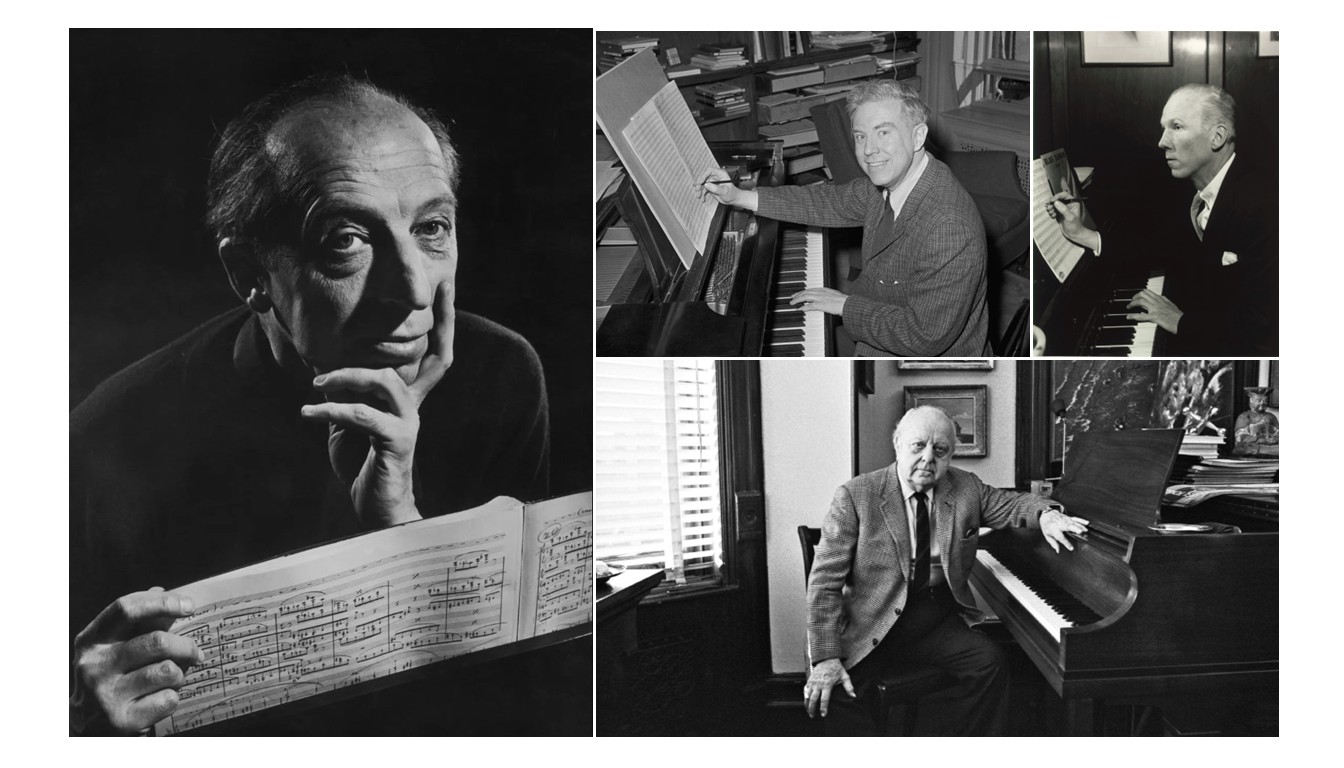
The previous article in this series covering classical music composed in 1950 focused on European composers. We now sail across the pond to the United States, and start with a piece that brought together two of the country’s best artistic talents, composer Aaron Copland and poet Emily Dickinson.
Aaron Copland – Twelve Poems of Emily Dickinson
In August 1940, at the Bennington College Theater in Vermont, Martha Graham staged the premiere performance of Letter to the World. The ballet was dedicated to Emily Dickinson, combining dance and spoken word to paint a portrait of the 19th-century American poet. The performance left a deep impression on composer Aaron Copland, who was captivated by the master dancer and the poems in equal measure. Four years later he would collaborate with Graham on the ballet Appalachian Spring, a work that is considered a creativity peak for both artists.

In 1949 Copland set some of Emily Dickinson’s poems to music. In March he started working on ‘The Chariot,’ perhaps the best-known of Dickinson’s over thousand poems. Copland was captivated by the opening lines of the poem:
Because I could not stop for Death,
He kindly stopped for me;
The carriage held but just ourselves
And Immortality.
He later said, “I fell in love with one song, The Chariot, and continued to add songs one at a time until I had twelve. The poems themselves gave me direction, one that I hoped would be appropriate to Miss Dickinson’s lyrical expressive language.”
In 1949 Copland also wrote the film score for the The Heiress, a story of a young woman who falls in love with man despite the objections of her abusive father. Pianist and musicologist Howard Polack observed that, “Copland may well have realized that with his music for The Heiress he had created a style that could accommodate Dickinson’s poetry and her world.”
Copland spent many hours studying Dickinson’s work. He read everything that was published at the time about her life and work and visited her home in Amherst, Massachusetts. Serious studies of her work did not exist in the late 1940s. The Johnson edition has not yet been published, and the Franklin variorum edition was fifty years to come. Yet even though the material available to him was early and heavily edited editions of Dickinson’s work, Copland obtained a deep understanding of her poetry.

Between March of 1949 and March of 1950, Copland gradually picked more of Dickinson’s poems to set music to. He ended up with twelve songs, amounting to his longest work for solo voice. Copland explained, “Each song is meant to be complete in itself, but I prefer them to be sung as a cycle. They seem to have a cumulative effect.” Each poem is dedicated to a composer friend: David Diamond, Elliott Carter, Ingolf Dahl, Alexei Haieff, Marcelle de Manziarly, Juan Orrrego-Salas, Irving Fine, Harold Shapero, Camargo Guernieri, Alberto Ginastera, Lukas Foss, and Arthur Berger. The cycle introduced new challenges to the composer, as he revealed about Dickinson’s poems: “Her poetry, written in isolation, was folklike, with irregular meters and stanzas and many unconventional devices.”
Shortly after completing the cycle, the work was premiered at Columbia University in May 1950, with soloist Alice Howland accompanied on piano by the composer. The performance was not a success, as evident from a letter Copland wrote to Leonard Bernstein: “The reviews were so bad, that I decided I must have written a better cycle than I had realized.” Stravinsky, on the other hand, remarked that the composition is, “distinctly American and very lovely pastoral lyricism.”

The program notes for ‘Twelve Poems of Emily Dickinson’ included the following text by Copland: “The poems center about no single theme, but they treat of subject matter particularly close to Miss Dickinson: nature, death, life, eternity. It was my hope, nearly a century after these remarkable poems were conceived, to create a musical counterpart to Emily Dickinson’s unique personality.” When asked to pick a favorite, Copland gave an answer in the plural: “I am particularly fond of ‘The Chariot’; ‘Going to Heaven!’ is so different that it’s fun to plan and sing for an audience; I like ‘Sleep is supposed to be’ a lot, and ‘Dear March’ as it breezes along. Encouraged, I could fall in love with all of them!”
In later years accolades for the song cycle continued. Conductor Michael Tilson Thomas said: “I think Copland made, for a whole generation of Americans, the cadential intent of the actual words very clear in the way he set them.” Playwright Edward Albee wrote in a letter to Copland in 1959: “Several of the Dickinson songs affect me profoundly, convince me that you are the first man in I-don’t-know how long since Mahler, really, I guess—who can do full justice to feelings about loss and time: Areas that I feel a need to say something about, too.”
In 1958, Copland started transcribing for voice and small orchestra the songs from the cycle. In 1970 he completed eight of them, with the hope that the arrangement would give the songs a wider hearing. Here is ‘The Chariot’, the song that started this project. Copland explained how the opening lines of this poem drew him to this project: “The idea of this completely unknown girl in Massachusetts seeing herself riding off into immortality with death himself seemed like such an incredible idea! I was very struck with that, especially since it turned out to be true.”
Virgil Thomson – Cello Concerto
The next composer in this review was an accomplished music writer and reviewer as well. In 1952 Virgil Thomson wrote this after watching Aaron Copland perform the Emily Dickinson song cycle with soprano Patricia Heway: “Aaron Copland’s Twelve Poems of Emily Dickinson are Copland at his most characteristic and most reflective. The broken rhythms, the pandiatonic harmony, the subtle spacing of notes in a chord, the open piano writing, the melodic lines that seek wide skips, all color the work with this composer’s personality. So do the seriousness and the poetic penetration with which the texts have been studied, and the frank search for charm with which their thought has been expressed.”

Virgil Thomson is mostly known for his operas ‘Four Saints in Three Acts’ and ‘The Mother of Us All’, both featuring librettos by Gertrude Stein. In 1950 he completed composing one of his own favorite works, which he started working on four years earlier. He later said, “Among my works composed after 1945, one which touches me most is the Cello Concerto, which was my homage to a long-time friend, Luigi Silva.” The virtuoso cellist indeed provided extensive input to the impressive concerto. The three movements are examples of Americana in classical music. The first depicts, as Thomson wrote, “a horse and rider in the pen air.” The second is based on the hymnal tune ‘Death, ‘tis a Melancholy Day’ and the last is titled ‘Children’s Games’, quoting Beethoven’s Piano Sonata no. 6 in F Major.
The cello concerto was premiered by the 23-years old cellist Paul Olefsky and the Philadelphia Orchestra conducted by Eugene Ormandy in Philadelphia, on March 24, 1950. After the New York City premiere at Carnegie Hall, The New York Times wrote, “Mr. Thomson writes gaily, tunefully, and in an unpretentious manner. He has taken care to write as idiomatically as possible for the solo instrument. He avoids lengthy developments or over-extensions of his ideas. Sometimes the connective tissue between the main ideas is thin, sometimes the developments sag a trifle. But the evolutionary symphonic style is not here the composer’s intention. He is entertaining us.”
Elliott Carter – String Quartet No. 1
When composer Elliott Carter read Thomas Mann’s book ‘Magic Mountain’, it left a profound impression on his concept of time in music. In the book, the treatment of time is a major narrative and philosophical concern. The novel’s structure reflects this through its asymmetrical handling of chronology: the first five chapters (approximately half the novel) detail only one year, while the final two chapters compress the remaining six years. Mann’s approach to time was influenced by French philosopher Henri Bergson’s concepts of duration and subjective time experience.
Carter was particularly influenced by a quote from the book’s last chapter ‘By the Ocean of Time’, where Mann writes: “It would not be hard to imagine the existence of creatures, perhaps upon smaller planets than ours, practicing a miniature time-economy. Contrariwise, one can conceive of a world so spacious that its time system too has a majestic stride.”

In 1950 Carter, after 15 years of composing works mostly aimed at a large audience, was looking for an environment with undisturbed quiet to work. He moved with his family from New York to stay in in the Lower Sonoran Desert near Tucson, Arizona. In the desert he met naturalist Joe Krutch, and their daily meetings led to talks about the ecology of that region. Carter learned about how birds, animals, insects and plants adapted to the heat and the limited water supply, and seen road runners, saguaros and ocotillos. It was a kind of “magic mountain,” and it encouraged the writing of his First String Quartet during the fall and winter of 1950 and the spring of 1951.
In an article he wrote about the string quartet, published in the book ‘Collected Essays & Lectures, 1937-1995’, Carter discussed the writing process of the quartet: “Like the desert horizons I saw daily while it was being written, the First Quartet presents a continuous unfolding and changing of expressive characters—one woven into the other or emerging from it—on a large scale.” Carter was inspired by Jean Cocteau’s 1930 film Le Sang d’un poète (The Blood of a Poet), in which the dreamlike action is framed by an interrupted slow-motion shot of a tall brick chimney in an empty lot being dynamited. The chimney scene bookends the entire film, appearing at its beginning and end.
Carter wrote in the article: “A similar interrupted continuity is employed in this quartet, starting with a cadenza for cello alone that is continued by the first violin alone at the very end. On one level, I interpret Cocteau’s idea as establishing the difference between external time (measured by the falling chimney, or the cadenza) and internal dream time (the main body of the work) – the dream time lasting but a moment of external time, but from the dreamer’s point of view, a long stretch.”

The quartet includes four movements: Fantasia, Allegro scorrevole, Adagio, and Variations. However, the score of the composition marks only three movements, separated by pauses. Carter explains: “The reason for this unusual division of movements is that the tempo and character change, which occurs between what are usually called movements, is the goal, the climax of the techniques of metrical modulation which have been used. It would destroy the effect to break off the logical plan of movement just at its high point. Thus, pauses can come only between sections using the same basic material. This is most obvious in the case of the pause before the movement marked Variations. In reality, at that point the Variations have already been going on for some time.”
In the string quartet Carter quotes the opening theme of Ives’s First Violin Sonata, first played by the cello in its lowest register after each of the other instruments has come in near the beginning. A rhythmic idea from Conlon Nancarrow’s Rhythm Study No. 1, for player piano, is quoted at the beginning of the Variations movement.
In 1970, talking about the significance of the First String Quartet in his repertoire, Carter said, “Among the lessons this piece taught me was one about my relationship with performers and audiences. For as I wrote, an increasing number of musical difficulties arose for prospective performers and listeners, which the musical conception seemed to demand. I often wondered whether the quartet would ever have any performers or listeners. Yet within a few years of its composition, it won an important prize and was played (always with a great deal of rehearsal) more than any work I had written up to that time.”
Over the years many quartets have attempted playing Carter’s First String Quartet. Many performers first found themselves disoriented, but as they got used to the piece they found that playing it eventually offered the rewards and musical reinforcements of ensemble work. Carter concludes: “It had a lot of peculiar performances because it offered a lot of new problems. But people will spend years learning a Beethoven Quartet — why should they expect that they can play a modern piece right the first time?”
Leroy Anderson – The Typewriter
We take a 180-degrees turn for our last review, from the very challenging Carter string quartet to music full of humor for large audiences of all ages. By 1950 composer Leroy Anderson had already written a number of popular compositions such as Sleigh Ride, Fiddle-Faddle, The Syncopated Clock and A Trumpeter’s Lullaby, all premiered by the Boston Pops Orchestra, conducted by Arthur Fiedler. In October of that year he completed work on a 1:30-minutes-long piece that featured the unlikely sound of the typewriter as its lead instrument. He conducted the short composition for a Decca Records recording session on September 8, 1953.

In 1970 Anderson explained how the typewriter was recorded: “We have two drummers. A lot of people think we use stenographers, but they can’t do it because they can’t make their fingers move fast enough. So we have drummers because they can get wrist action.” Leonard Slatkin, who conducted the music of Leroy Anderson on many occasions, has played a few typewriters himself on the concert stage. He talked about the difficulty of mastering the ‘instrument’: “You have to tamp down all the middle keys so that only the two outside ones work. And you have to start with your right hand in order to be able to hit the carriage return where Anderson specifies.”
In 1958 Frederick Fennel conducted the piece as part of an album dedicated to Anderson’s music. The liner notes describe the feat humorously, as appropriate for this piece of music: “A typewriter was actually used in the recording of The Typewriter, and Frederick Fennel himself addressed both hands to the keyboard, a bobbing head to the orchestra, and his subconscious to the score, which he had memorized. With special attention to his ‘solo’ passages. At the end of the session, Dr. Fennel was exhausted but satisfied, and the typewriter was returned to its original desk, as good as ever in spite of the probability of more carriage returns in one afternoon than in the course of its entire history as a non-musical office machine.”
Here is a wonderful performance of The Typewriter:
Another notable soloist on the Typewriter was Seiji Ozawa, conductor of the Boston Symphony Orchestra. Maestro Ozawa performed this piece with Boston Pops conductor John Williams in a 1998 televised fund-raising concert. Ozawa appeared in the traditional Boston Pops “Typewriter outfit” – green visor cap and a big stogie.

The Typewriter was used as a theme for many radio programs and some television shows. The 1963 film “Who’s Minding the Store?” features Jerry Lewis pantomiming playing the typewriter part in mid-air.
Sources:
Aaron Copland: The Life and Work of an Uncommon Man, by Howard Polack
Aaron Copland’s Twelve Poems of Emily Dickinson: A Reading of Dissonance and Harmony, by Dorothy Z. Baker
Elliott Carter – Collected Essays & Lectures, 1937-1995
Elliott Carter: Out of the Desert and Into the Concert Hall, By Martin Mayer, The New York Times, Dec. 10, 1978
Leave a Reply