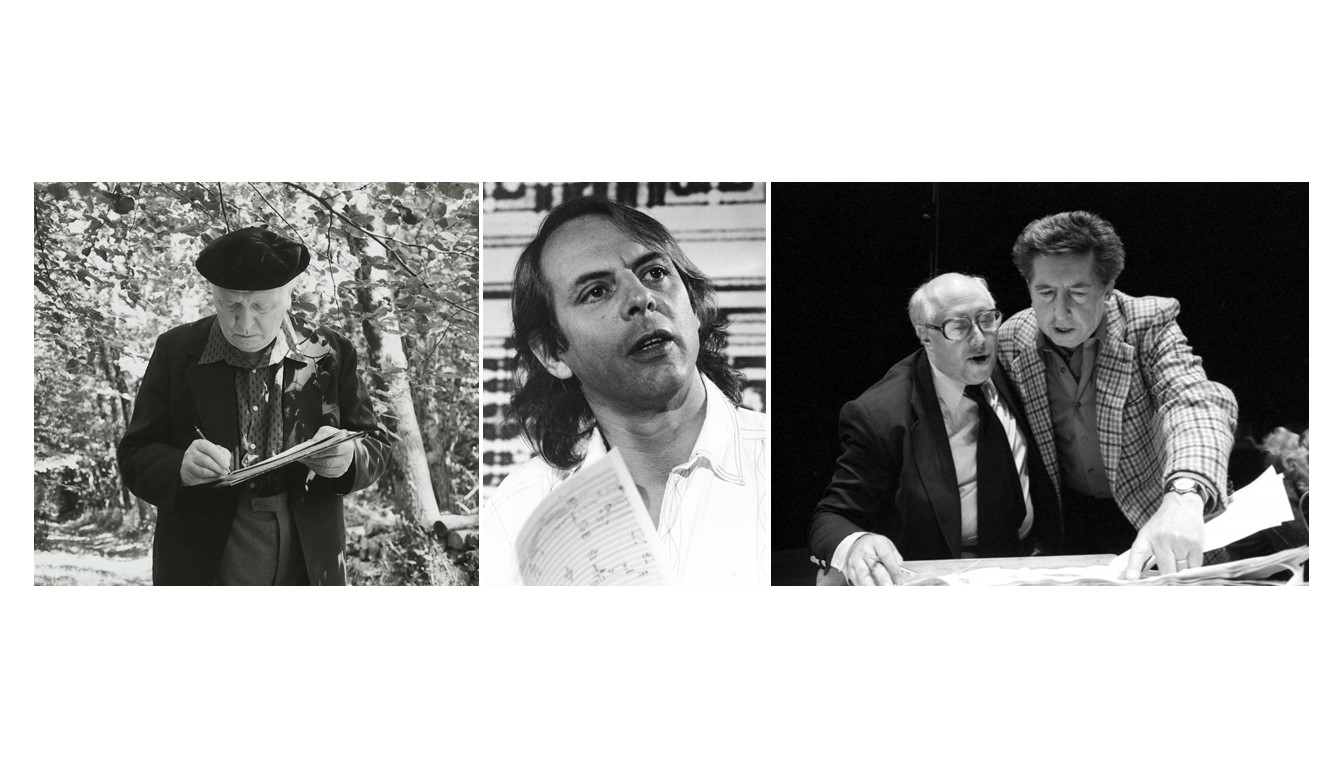
In this article we focus on three European modern classical composers and their activities in the year 1970. All the compositions reviewed here have since become milestone pieces of music in their respective fields. We start with birdsong and a composer who considered himself an ornithologist as much as a composer.

Olivier Messiaen – La Fauvette des Jardins (The Garden Warbler)
In 1944 Olivier Messiaen published the treatise Technique de mon langage musical (Technique of my musical language), where he provided insights into his compositional approach and its inspirations. Among the many examples, he quotes his composition teacher at the Paris Conservatoire, Paul Dukas. The master composer, famous for the orchestral piece The Sorcerer’s Apprentice (L’apprenti sorcier), told Messiaen: “Listen to the birds. They are great masters.” Three years earlier Messiaen incorporated birdsong for the first time in his composition Quatuor pour la fin du temps (Quartet for the End of Time), writing parts for the clarinet and violin to imitate a nightingale and a blackbird. In 1944 he wrote: “Through the mixture of their songs, birds make extremely refined jumbles of rhythmic pedals. Their melodic contours, those of merles especially, surpass the human imagination in fantasy.”

Messiaen took the study of birdsong seriously throughout his career, and considered himself as much an ornithologist as a composer. He said of birds: “It’s probable that in the artistic hierarchy birds are the greatest musicians existing on our planet.” Composing music for an orchestra or piano using birdsong was not an easy process. Messiaen had to slow down quick tempos of the original songs, transpose down the high registers which cannot be reached by most instruments and expand the interval structure of the song in order to accommodate small microtones in the equal tempered system.
He lovingly talked about the different types of bird songs: “In the world of birds it is above all the male which sings and it sings mostly in the spring when courting. There are three kinds of songs: a) the song of proprietorship in which the bird asserts its right to its feeding territory on which no other has the right to trespass – a song that may provoke singing contests between habitat rivals; b) the song of seduction intended to dazzle, to move the female – a song that is sometimes accompanied by a whole ceremony; c) the salutation to daybreak or twilight – a song heard at sunrise or sunset: the most beautiful of all!”

In 1970 Messiaen composed the piano piece La Fauvette des jardins (The Garden Warbler), where he took the influence of birdsong a step farther. As in his 1950s composition Catalogue d’oiseaux (Catalogue of birds), the music is not only using birdsong as a source of melody, but it paints a portrait of the bird. He wrote the music in the surrounding area of his summer home in the Dauphiny mountains of Isère. It is a chronicle of the bird’s activity during one full day at the end of June. Messiaen wrote a detailed log of the bird during the various hours of morning, noon, evening and night in the sleeve notes of the original recording of this composition. One example depicts the meticulous attention to detail as he observes and relishes in the songs of various bird species: “Five o’clock in the morning. The break of day points the silver foliage of the alders, revives the scent and color of the mauve mint and green grass. A blackbird whistles. The green woodpecker laughs aloud. A skylark rises in mid-air, coiling its jubilation around a shrill dominant. The garden warbler breaks into new solo: its rapid vocalizes, its tireless virtuosity, the even flow of its discourse seem to arrest time.”

Yvonne Loriod, French pianist and teacher and second wife of Messiaen, added detail about the location of their home where he composed La fauvette des jardins. She was the first to record this extremely difficult piano music: “Messiaen kept the exact location of this house a secret because he didn’t want to be disturbed, and it was there that he wrote all his works. It’s to the south of Grenoble where there are several lakes. He’d bought the property in 1936 when it was simply a field, and he had a small house built. We went there only in summer because in winter it is extremely cold and the house is cut off by snow. This is where Messiaen’s funeral took place and where he is at rest. I had a sculpture of a bird made as the headstone for his grave.”
Pianist and musicologist Peter Hill, who played the complete works of Messiaen and wrote a book about him, said about this magnificent piece of music: “I was constantly impressed by the latitude of tempo which Messiaen would allow. He urged me always to phrase with flexibility, to allow the music to breathe. This is particularly true of some of the most difficult passages: the ‘nuptial flight’ of the kingfisher (from ‘La bouscarle’) where a Chopin-like grace is appropriate, and still more throughout the supremely taxing La fauvette des jardins, where the flood of song, however transcendent the virtuosity (extended page after page), must remain cheerful and good natured – ‘always relaxed’ Messiaen wrote at several points in my score.”
Karlheinz Stockhausen – Mantra
Olivier Messiaen taught many students who would go on to become famous composers, conductors and educators in their own right, including Iannis Xenakis and Pierre Boulez. One of his pupils said this about his experience with his master’s music shortly after Messiaen’s death in 1992: “Two days ago I talked with my friends about the death of Messiaen. I went to Paris in 1952 because I was deeply touched by his Trois petites liturgies which I had heard as a student in Cologne. Later I heard at Darmstadt his Quatre Études de rythme for piano. There was an atmosphere in Messiaen which struck me as being new and yet very lyrical, very poetic.” This was Karlheinz Stockhausen, who in 1970 wrote his own piano music, a composition for two ring-modulated pianos named Mantra.

In 1970 Stockhausen started using the technique of formula composition, a style that became central to his music for the next three decades. He talked about the fundamental scheme that came to him at the time: “I had the idea of one single musical figure or formula that would be expanded over a very long period of time, and by that I meant fifty or sixty minutes. And these notes were the centers around which I’d continually present the same formula in a smaller form. In going from the very large to the small I wanted to leave a lot of empty spaces with which to indicate the connections between the individual sounds of this formula by means of very quick movements of glissandos or trills, all the time showing the connections between the points.”
In 1969, while on a trip in the United States, Stockhausen conceived the idea for a new composition: “One day I had to drive from Madison, Connecticut to Boston — it was September 1969. There were four people in the car, I was sitting next to the driver, and I just let my imagination completely loose. Shortly before this I’d traveled to Los Angeles in a plane, and the same thing happened. On the plane I made a few sketches for a piece for two pianos that had come into my mind. And now, on the way to Boston, I was humming to myself … I heard this melody—it all came very quickly together.” Speaking about this composition a year later, Stockhausen explained: “In my most recent piece Mantra there’s a formula, a mantra, but there’s nothing that’s accompanying it or giving a background to it—there’s nothing but a mantra which is repeated 156 times, in all kinds of enlargements and compressions over sixty-two minutes.”
The composition Mantra is based on a melodic phrase that has thirteen notes, repeated in thirteen cycles of varied pitch, dynamics, duration, timbre and tempo. The mantra is also played simultaneously in an inverted form. Stockhausen had specific musicians in mind for this work, the two pianist brothers Aloys and Alfons Kontarsky. The piano duo was quite familiar with Stockhausen’s music, dating back to 1961 when Aloys Kontarsky recorded the piece Refrain. Throughout the 1960s they recorded many of Stockhausen’s compositions including Mikrophonie, Momente, Prozession, Aus den sieben Tagen and Kontakte. Aloys Kontarsky recorded a 2xLP volume of Stockhausen’s piano music in 1965 and performed the world premiere of the composition Hymnen in 1967.

In addition to the two pianos, Stockhausen added special musical instruments and instructions to the two pianists on stage. Each pianist has a set of thirteen cymbals, matching in pitch the mantra’s thirteen notes. Stockhausen explained: “The mantra itself has thirteen notes, and each cymbal sound occurring once in the piece indicates the large sections—you hear the cymbal whenever a new central sound announces the next section of the work. And there are woodblocks, too, which have the function of marking and emphasizing certain attack and decay accents.” To complete the setup, sound enhancing accessories of the time were added, including a microphone amplifier, compressor, filter, ring-modulator, sine-wave generator, and a volume control. Loudspeakers located at the sides of the pianos reproduce the modulated sounds, playing simultaneously with the acoustic sound of the pianos.
Stockhausen was lucky to have two brilliant and like-minded pianists to play this complex composition. Not many classical musicians were as flexible as the Aloys brothers. Stockhausen related in an interview: “‘You are faced with the problem of finding musicians who are not working under normal conditions with a conductor, in an orchestra with fixed hours and repertoire studied in a conservatory. They are good musicians, but the moment they are faced with this guided improvisation they are lost. The music is not really periodic. It needs a different attitude altogether to shape music which needs personal decisions in favor of the other players.”

The experience of writing the composition and rehearsing it with the Kontarsky brothers opened new avenues for Stockhausen. For centuries the classical music tradition embraced the concept of variation, taking a musical phrase and modifying it repeatedly, altering its harmony, melody, counterpoint, rhythm, timbre and orchestration. Stockhausen found a different way to modify the phrase. Melodically it stays exactly the same – same notes, same order. But it expands and contracts, both in duration and in pitch to different degrees. Near the end of the composition there is an extremely fast section that is a compression of the entire work into the smallest temporal space. In this section, all of the expansions and transpositions of the mantra formula are summarized as fast as possible and in four layers. Here is that piece of music played in a recording made by the Kontarsky brothers in 1971:
Years later Stockhausen reminisced about the joyful period when he worked on the composition with Aloys and Alfons Kontarsky: “We were whistling the mantra and its different forms—on the train, in the airport, wherever it was, very often unconsciously. I was delighted that here was a new way of writing melody sections; here was a way of making melodies that were seemingly simple, yet exceedingly differentiated and rich. Every note in Mantra is really a world in itself. And here were the musicians singing and whistling! I wish I could compose more of this.”
Henri Dutilleux – Tout un Monde Lointain… (A Whole Distant World…)
We move to another collaboration between a composer and a maestro instrumentalist. In 1960 French composer Henri Dutilleux met the great Russian cellist Mstislav Rostropovich. He later recalled the faithful encounter: “One day Igor Markevitch (composer and conductor) said to me, ‘You must come to a concert tonight. I will not tell you more about it. You must be there.’ The concert was a cello recital by Rostropovich. Not long after that, Markevitch suggested that I should write a piece for cello and orchestra.” The idea had to wait almost a decade to be realized. In the meantime, Dutilleux received a commission from famed choreographer Roland Petit to compose music for a ballet based on Charles Baudelaire’s monumental collection of poetry ‘Les Fleurs du Mal’ (The Flowers of Evil). The plan was to premiere the ballet at the 100th anniversary of the poet’s death in 1967. The project did not come to fruition, as Dutilleux explained: “I found the scenario too realistic, too material. I didn’t conceive of an approach to Baudelaire’s world in that way. I would have liked something more abstract, less anecdotal, allowing for pure dance. Finally I explained my reservations to Roland Petit and withdrew from the project.”
But the abandoned project had a lasting influence on the composer, for while he was contemplating doing it, Dutilleux spent hours reading Les Fleurs du Mal. Charles Baudelaire’s masterpiece, its first edition published in 1857, generated a scandal for its portrayal of sex, same-sex love, death and the loss of innocence. Over a hundred years later it lost none of its impact, the poetry breaking away with tradition in form and content. Dutilleux talked about how this literary work influenced his musical direction: “If it hadn’t been for this ballet, I would not have thought of Baudelaire. It was by a kind of osmosis that everything I had absorbed at that time lay at the root of the work for cello. Originally I had even thought of calling the work ‘Osmose.’” Later in his career Dutilleux said that Baudelaire was the artist in any medium who had the strongest impact on him, and that “Baudelaire continues to haunt me.”

The work for cello referenced in the quote above is our last musical piece in this review. After he stopped working on the ballet Les Fleurs du Mal, Dutilleux went back to Rostropovich and his idea of a cello concerto. Between 1967 and 1970, on commission from Igor Markevitch for Concerts Lamoreux, he composed the concerto and worked with the cellist to edit and refine the cello part. The result was not only one of the most important additions to the cello repertoire in modern music, it also evolves around multiple citations from Les Fleurs du Mal. The concerto is titled ‘Tout un monde lointain…’ (A whole distant world…), a direct quotation from the poem La chevelure which is included in Les Fleurs du Mal:
“Tout un monde lointain, absent, presque défunt” (A whole distant world, absent, almost defunct)

The concerto has five movements, each with a title and a quotation, both from one of Les Fleurs du Mal’s poems. Dutilleux later said of the association between text and music: “The lines by Baudelaire which appear as an epigraph at the beginning of each movement were added afterwards. I didn’t have any specific lines of Baudelaire in mind when I started composing, although it’s true I was already immersed in Baudelaire’s world. Then I said to myself, ‘I’m full of this atmosphere, so be it!’ And later on, when I was nearly at the end, I sought out these quotes. I may have thought about them a little as I composed, but at all events I was determined to avoid illustrating them.”
Here is the third movement from the cello concerto, titled Houles: Large et ample (Surges: Wide and ample). The quotation, like the concerto’s title, is taken from the poem La chevelure (Head of Hair):
Tu contiens, mer d’ébène, un éblouissant rêve
De voiles, de rameurs, de flammes et de mats
Ebony sea, you hold a dazzling dream
Of rigging, of rowers, of pennons and of masts
The concerto premiered on July 25, 1970, at Archbishop’s Palace, Aix-en-Provence. Mstislav Rostropovich played the concerto he commissioned from Henri Dutilleux. Serge Baudo conducted the Orchestre de Paris. Seven years later Roland Petit, whose abandoned commission for Les Fleurs du Mal planted the seed for Dutilleux’s interest in Baudelaire, wrote a letter to the composer:
My dear Henri,
As I told you the other day on the telephone, I was overwhelmed by “Tout un monde lointain”, I cried with joy, with happiness. It is so rare, modern, new, and so full of love.
Dear Henri, I admire you.
With all my affection, Roland
Sources:
The Messiaen Companion, by Peter Hill
Stockhausen : conversations with the composer, by Jonathan Cott
Leave a Reply