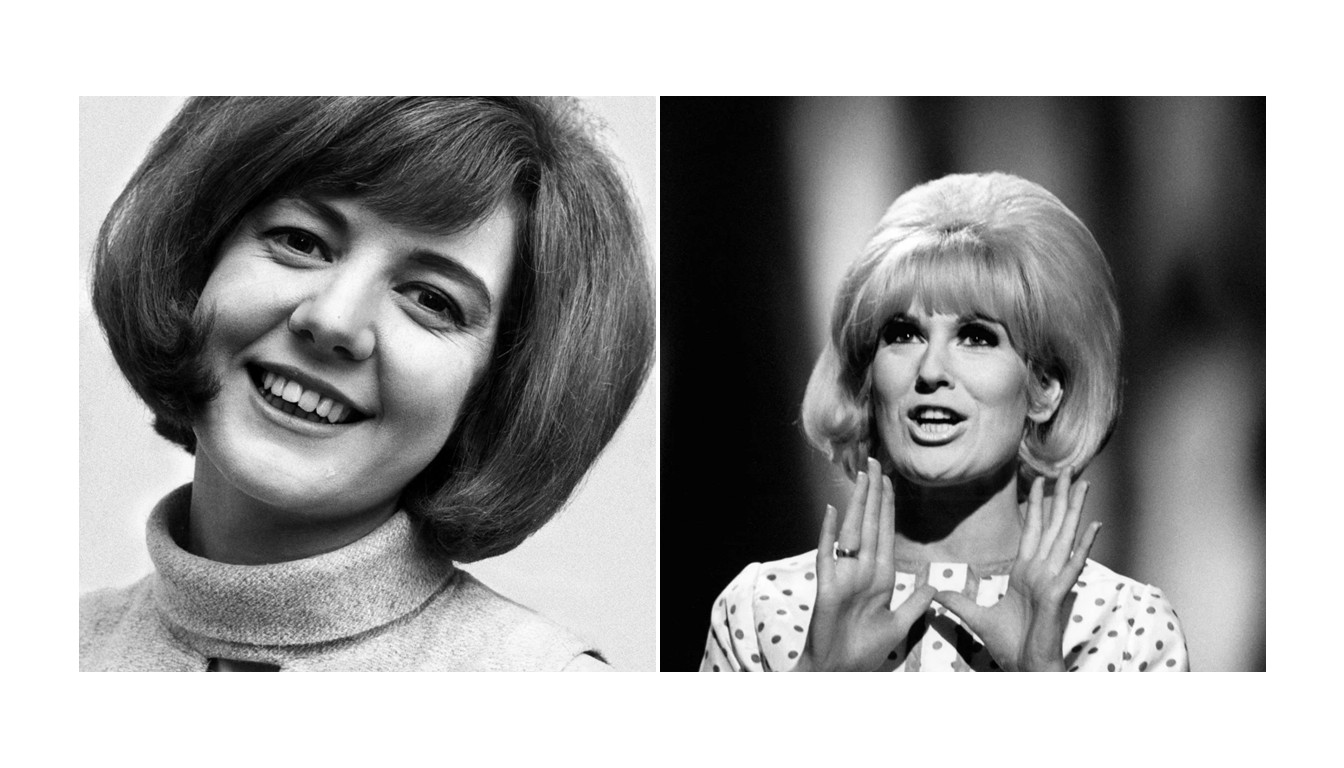
In the previous articles covering the British Invasion in 1964 we focused on male groups that had considerable success in the charts (The Beatles, The Dave Clark Five and others). We now turn our attention to the ladies and a review a number of wonderful British female singers who also had a fantastic run of songs and albums in 1964. We begin with two artists who started their solo careers late in 1963.
Dusty Springfield
While with the Springfields trio to record their 1963 album ‘Folk Songs from the Hills’ in Nashville, TN, Dusty Springfield was absorbing sounds of American music that excited her. The group arrived in New York City, and Dusty found herself one night on Broadway street next to the Brill Building: “I was standing outside the Colony Record Store on Broadway about 2 in the morning, hearing that voice, ‘I know – something – about love’ and going Wow! How do I do this? I knew it could work if I could adapt them in some way.” That was the song ‘Tell Him’ by The Exciters, written by Bert Berns and produced by Jerry Leiber and Mike Stoller. Dusty later said, “The Exciters sort of got you by the throat. Out of the blue comes blasting at you ‘I know something about love,’ and that’s it. That’s what I wanna do.”

When they later arrived in Nashville, Dusty was overtaken by another song she heard over the radio. It was the very beginning of the legendary collaboration between Dione Warwick and the songwriting duo of Burt Bacharach and Hal David. Warwick’s debut single ‘Don’t Make Me Over’ inspired the British singer who came over to Nashville to record an album of country music: “I had to sit down on the bed, fast, because I thought, Pop music’s never going to be the same again. I want to do that! And I knew I couldn’t do it in Nashville.”
The experience of visiting the United States and the songs she heard planted the seeds of a desire to start a solo career for Dusty. As The Springfields dissolved in 1963, Dusty spent the autumn of that year recording songs at Olympic Sound Studios, searching for the one that would launch her solo career.
I Only Want to Be with You
Nine songs were recorded, none of them deemed suitable for a single. Dusty was looking for an upbeat song, a danceable ditty ala ‘The Twist’ and ‘Dancing in the Street’. The music trade papers were not all kind to her following the departure from The Springfields, questioning her ability to stand on her own. In a desperate move to find her the song that will properly launch her solo career, her producer at Philips Records Johnny Franz reached out to songwriter Mike Hawker: “Look, we need something that is going to put this girl into the charts, because everybody is knocking her, everybody is saying she’ll never make it – have you got a song that’s a guaranteed hit?” Hawker, who co-wrote some of Helen Shapiro’s hits including ‘Walkin’ Back to Happiness’, had just the perfect song. He previously teamed up with Ivor Raymonde and wrote a song called ‘I Only Want to Be with You‘, which singer Frankie Vaughan passed on. He now repurposed the song and recorded a demo featuring his wife Jean Ryder singing while keeping the beat by tapping on a biscuit tin lid.

Dusty Springfield and Johhny Franz knew they had a hit the moment they listened to that demo. Raymonde brought into the studio all the members of the London Philharmonic Orchestra that he could find, and they recorded a Phil Spector-ish wall of sound production. ‘I Only Want to Be with You‘ was released in November 1963 and it climbed to #4 in the UK charts. A month later Dusty Springfield had the honor of being the second British Invasion artist after the Beatles to have a hit in the US, reaching #12 in the Billboard Hot 100 chart.
Wishin’ and Hopin’
In December 1963 Dusty Springfield saw Dionne Warwick perform at the Olympia Theater in Paris. Warwick was a fantastic interpreter of songs penned by Burt Bacharach and Hal David, and Dusty was paying attention. A month later she was in the studio recording her debut album ‘A Girl Called Dusty’, including three songs by the songwriting duo: ‘Twenty Four Hours From Tulsa’, ‘Anyone Who Had a Heart’ and ‘Wishin’ and Hopin’. In May 1964 Record Mirror gave it a glowing review: “WOW! If there’s a better all-girl album this year, it’ll have to be a sensation. Long-awaited, this set shows Dusty’s remarkable voice and technique and ability to ‘move’ a song with superb clarity. Like the wildies? Try ‘Don’t You Know’ or ‘Do Re Mi’. Care for the smooth ballads – ‘Anyone Who Had A Heart’ or ‘Colouring Book’ will do nicely. Dusty is unique, magnificent, sensational. She’s never been better. But occasionally the recording seems top-heavy on the backings. Who cares? BUY, buy, buy!”

When the album was released in April 1964, Philips Records decided to put out Wishin’ and Hopin’ as a single in the US. The song peaked at No. 6 on the Billboard Hot 100, earning a nice review from Cash Box magazine who described it as, “a tantalizing, cha cha beat-ballad affair that Dusty waxes in money-in-the-bank-for-all-concerned fashion.”
The song is a vocal challenge, moving quickly from staccato to legato, and the singer has to open out into longer notes halfway through each verse. Dusty sails through this recording, a performance that earned her the respect of its song writer. Burt Bacharach later said that her version, “Knocked me out. I believe that Dusty is not only the best pop singer in England but one of the top singers in the world. What she has is the power to command attention. Her performance of ‘Wishin’ And Hopin’’ just walks right off that record. She really takes charge.”
I Just Don’t Know What to Do with Myself
In February 1964 Dusty Springfield made a three-day PR trip to New York, where she finally got her chance to meet with Burt Bacharach. She visited his Manhattan apartment, where he played her some of his songs, an experience of which Dusty later said, “I was falling off my stool in ecstasy. I left thoroughly confused: for once I’ve got too much good material.” One of the songs Bacharach played for her was ‘I Just Don’t Know What to Do with Myself’, a great song that nevertheless remained unsuccessful up to that point. It was recorded twice in 1962 by Chuck Jackson (unreleased) and Tommy Hunt (failed to chart). The song had left Dusty in such an elated state that after a visit to Bacharach’s bathroom she left with his hairbrush instead of hers. She later said: “I fell in love with it at once (the song, not the hairbrush). It had been recorded a couple of years before and hadn’t got anywhere but that didn’t worry me.“

On her return to England dusty Springfield recorded the song at Olympic Studios. Ivor Raymonde arranged and conducted the orchestra, with session musicians Big Jim Sullivan on guitar and Bobby Graham on drums. The single was released in the UK in June 1964 and quickly climbed to #3 in the chart, only surpassed by ‘A Hard Day’s Night’ by The Beatles and ‘It’s All Over Now’ by the Rolling Stones. Following that achievement, Bacharach gave Dusty a fine compliment: “That girl listens with an arranger’s ears. She’s a fine musician and it must be a great pleasure to work with her on a recording. I only hope that her next American release will be ‘I Just Don’t Know What To Do With Myself’. I think it could be a monster hit.” But the US market missed on that opportunity, and only released the song a year later as a B-side to her then-hit ‘Some of Your Lovin’.
Cilla Black
We move to Cilla Black, who had less of a success in the US, but scored two big hits in the UK in 1964, both topping the singles chart. Black used to work in the same Liverpool venues where The Beatles, Gerry and the Pacemakers and a host of other groups honed their craft. She worked as a cloakroom attendant at Cavern Club, where she met the fab four. John Lennon later introduced her to Brian Epstein, who auditioned her with the Beatles playing as her support group. Not too many artists in the history of music can claim John, Paul, George and Ringo as support musicians on their resume. However, that audition proved to be a difficult initiation for Black, as she later recalled: “I’d chosen to do ‘Summertime’, but I hadn’t rehearsed it with the Beatles and it had just occurred to me that they would play it in the wrong key. It was too late for second thoughts. With one last wicked wink at me, John set the group off playing. The music was not in my key and any adjustments that the boys were now trying to make were too late to save me. My voice sounded awful. Destroyed—and wanting to die—I struggled on to the end.”

But Epstein did not give up on the promising young singer and after watching Black perform on stage, signed her and quickly added her to the queue of his favorite producer, one George Martin. Her first recording experience was also challenging. The Beatles gave her the song ‘Love Of The Loved’, which was part of their live set and one they played when they auditioned for George Martin in 1962. She said this about her first recording date: “I get to the studio and I’m surrounded by proper musicians. And I hated it. I just didn’t see it at all. You’ve got to remember, I’m a kid who’s buying hit records every week, so I knew what was gonna be a hit. I said to Brian, ‘This is so not a hit, Brian, why do you put me with professional musos? I’ve gotta be with a rock band, and let it sound like Paul does it with The Beatles in the Cavern.’” The song was released as her first single, a meek peak at #35. Compared to the phenomenal early successes of Epstein’s other artists at the time, this was considered a failure. But Epstein did not lose faith, and her next single proved him right.
Anyone Who Had a Heart
Dionne Warwick, Burt Bacharach and Hal David come in again as the inspiration that launched the career of a British pop star. In a single session in November 1963 Warwick recorded the songs ‘Anyone Who Had A Heart’ and ‘Walk On By’, both penned by Bacharach and David. Cilla Black remembers the moment she heard ‘Anyone Who Had A Heart’ the first time: “I used to look in Billboard magazine for anyone with a girl-sounding name in the Top 100, and I spotted Dionne Warwick, at 77 or something. And I went into NEMS and asked for this record to listen to, and I really was blown away. “

Brian Epstein was in New York on one of his business trips at the time, and upon coming back announced to the singer: “I’ve got a Number 1 hit record for you!” What might this Number 1 be, you ask? None other than ‘Anyone Who Had A Heart’. Warwick’s first major single was climbing Billboard’s Hot 100 chart, capturing the attentive manager’s ears. The song was brought in front of George Martyin, who immediately saw the potential of the song and the lush orchestration behind it: “I absolutely flipped. I thought it was marvelous.” But his first instinct was to give the song to the classy and established Welsh singer Shirley Bassey, telling Epstein, ”I very much doubt that Cilla’s ready for an emotional piece like this.” Epstein stood his ground, and a recording date was secured for Cilla Black’s second attempt at a single. Martin had a formidable task on his hands, knowing that this recording will be compared to the magnificent original, released only a couple of months earlier. He needed help, as he later recalled: “I wasn’t then known as an orchestrator, and with others around who had big reputations it would have been cheeky of me to assert myself too much. So I brought in Johnny Pearson, who did a marvelous score for the song.”

The song launched Cilla Black’s career. It climbed to No. 1 in the UK chart at the end of February 1964, leaving far behind Dionne Warwick’s original version. Pop Weekly magazine didn’t spare the exclamation marks when it wrote: “This girl has got IT! The record knocked me out! It’s a gas! It has just about everything—and Cilla, you’re heading for the top! If this isn’t a No. 1 in more than four English-speaking countries it ought to be.” And the biggest compliment came from the song’s composer Burt Bacharach: “The great thing about the British is that they’ve always ‘got’ my songs right away. They are also one of the most loyal audiences in the world. I think Cilla reflected that kind of ability. She understood the song and she had a kind of long-term stickability, which is so very hard to achieve in this business.”
You’re My World
When George Martin listened to Umberto Bindi’s performance of the song ‘Il Mio Mondo’, he immediately heard its potential. Now that Cilla Black proved her ability to sing an emotional, dramatic song with ‘Anyone Who Had A heart’, he could envision a grandiose arrangement to back her up on an English rendition of the Italian song. He asked American songwriter Carl Sigman, who later found fame with his lyrics to ‘Where Do I Begin’, the theme song for Love Story, to write an English version. Cilla Black was not sure about the song: “You’re My World was an out-and-out ballad and I’m a rock’n’roll singer at heart. I didn’t think I could do this song any justice at all. I thought, ‘Is this song me? Isn’t it more like that lady who used to sing and cry every time?’ I thought, ‘I’m turning into Vikki Carr.”

Johnny Pearson was again commissioned to write the arrangement, and in April 1964 he conducted his orchestra at Abbey Road Studios, backing Cilla Black who delivered a stellar vocal performance. Previous doubts about her ability to match the original performance of ‘Anyone Who Had A Heart’ vanished. Pop Weekly wrote in June 1964: “There are people who say that Cilla ‘pinched’ her style of singing from the American vocalist, Dionne Warwick. This she may have done on the first platter, but on You’re My World I think she has found her own way of phrasing, and one that is better suited to Cilia than to Warwick.” ‘You’re My World’ climbed to the top of the UK chart in May 1964, where it remained for four weeks. In the US the song reached #26, her highest position over the Atlantic. 1964 was indeed Cilla Black’s greatest year. After these two consecutive No. 1s, she would never return to the top of the charts.
Sources:

Leave a Reply